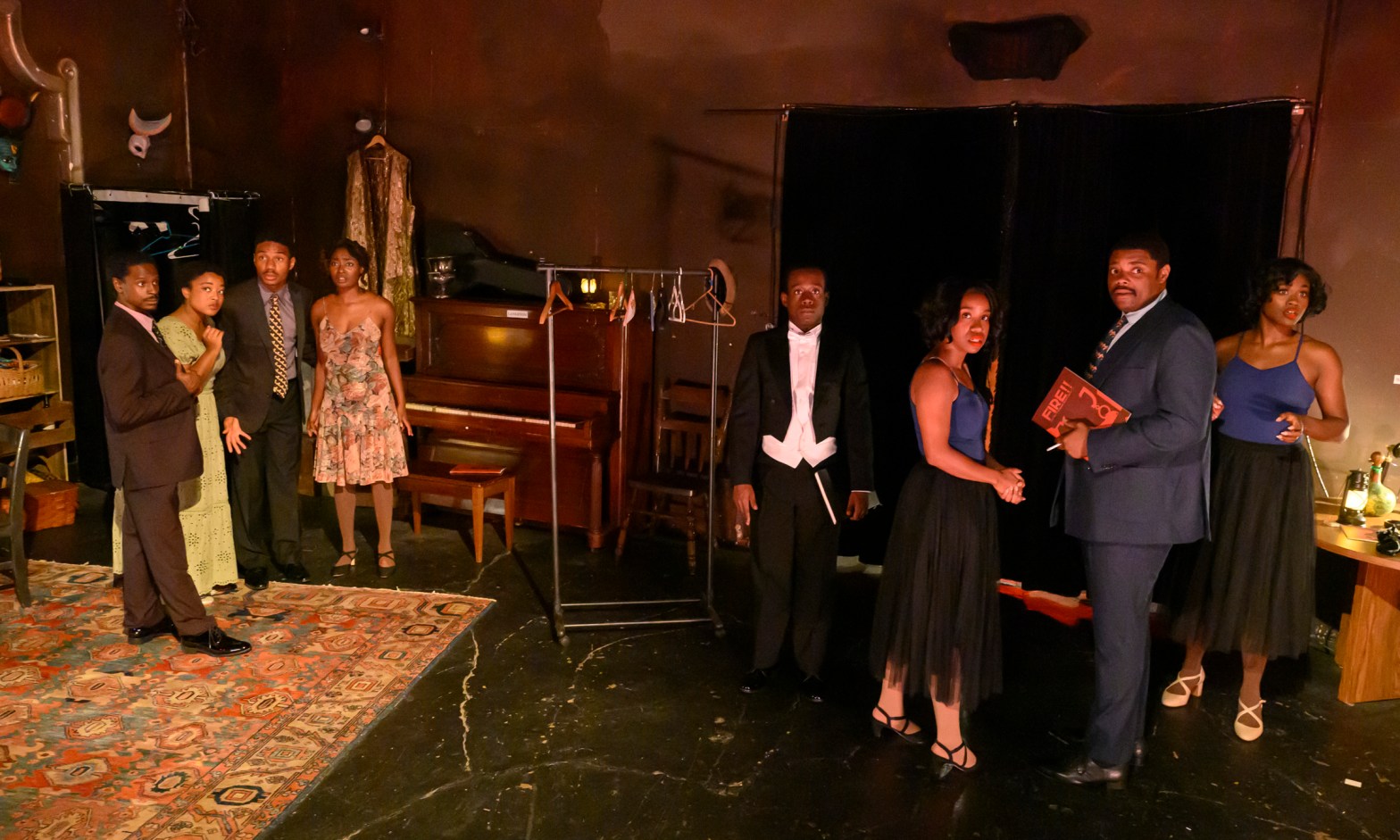
“Fire” was a journal developed in 1926 by Wallace Thurman, Langston Hughes, Zora Neale Hurston, and others to publish the works of “Younger Negro Artists” whose voices went unheard. It dared to present works dealing with homosexuality and prostitution using the more contemporary Black vernacular. It challenged an older Black generation of authors. Even the title, “Fire,” was symbolic of the burning up of older ideas. The presentation in the Quintessence production, premiering this month, was written and adapted by Marilyn Campbell-Lowe and Paul Oakley Stovall. It is a vital piece as it brings to the stage the literature of the Harlem Renaissance in New York City, of the 1920’s, during the mass migration to northern cities beginning in 1910.
The play consists of the actors presenting six of the pieces from the journal that have been adapted by Campbell-Lowe and Stovall. It starts in the large lobby of the Sedgwick Theatre when the actors come out in costume, move amongst us and welcome us. They are eleven beautiful actors who are totally captivating.
We then move to our seats and see that there are two parts of the stage- the back being the actor’s dressing room where the actors go and change costumes between the plays. Then, Wallace Thurman (Kaisheem Fowler-Bryant), the main organizer of the journal, whose story, “Cordelia the Crude,” is one of the six pieces presented, becomes the host of the evening. The action shifts back and forth between the presentations and the talk in the dressing room. And therein lay my first problem with “Fire.”
I missed most of the conversations in that dressing room because I couldn’t understand what they were saying. At the intermission, I learned that I was not alone. Everyone I talked to couldn’t make out the words spoken back there, One guy who saw I was taking some notes during the play approached me and asked if I followed the themes of the play. He told me that he was sitting in the second row and missed about 50% of the words, even when they were down stage presenting the writers’ works. And the only reason I was able to understand what was being said was because a friend who had seen a preview warned me to read the program before. She too couldn’t follow the stories because she didn’t hear most of it. I did read the superb program, and I followed the stories better.
As for the stories, they were powerfully honest and decades ahead of their times. Several deal with skin color and the fascination of darker skinned people for lighter skinned ones. Jealousy arose out of these issues.
Homosexuality and bisexuality are explored in an era where these subjects were banned or ignored. Domestic violence is the subject of “Sweat.” The only piece that I found boring was the essay, “Intelligncia,” where I felt that the actor was pontificating, talking at us instead of to us.
In the cast, there were some members who spoke clearly and projected well, while there were others, particularly Nicholas Parker, who I rarely understood. After the play, I asked some younger members of the audience if they had the same hearing issues as I- they did.
But the faces of each were so expressive that I could see and understand their fears and desires. Watching the characters move on stage was a treat as the choreography by Polanco Jones Jr. was arresting! The costumes by LeVonne Lindsay were gorgeous, and the three-piece accompanying band was excellent, though I wish there were a few more jazz numbers from that era.
This is an important play bringing to the public 100 years after the Harlem Renaissance, many great writings of the famous and not so famous. Perhaps a smaller space would have worked better. As it was a World Premier, I hope it is refined more. And I strongly recommend that you read the program with the short descriptions of each piece, to enjoy it more.
“‘Fire” by Marilyn Campbell-Lowe & Paul Oakley Stovall at Quintessence Theatre, 7137 Germantown Ave., Philadelphia, PA 19119, 215-987-4450, quintessencetheatre.org Thru November 2, 2025
 Philadelphia Theater Reviews by Frank Burd