Forever Plaid at Act II Playhouse

Though the show, “Forever Plaid” was created 35 years ago and has been performed around the world, it is a musical that I’d never seen. I only knew it was something about the “boy bands” of the 1950’s and a kind of musical review. It is so much more than that as presented at Act II Playhouse. I will go so far as to say I wouldn’t have gone to see the show had I not been reviewing it. It would have been a great loss for me.

            On February 9, 1964, a 1959 Mercury convertible was carrying four young men to a major gig to perform their songs. This all-boy band was hit by a school bus carrying Catholic school girls to the Ed Sullivan show to see another boy band- The Beatles. The four, who were hit by the bus, performed under the name, The Plaids. They were all killed. We don’t see the accident.  It is told to us by the four who have returned to this day to give us the concert they never had a chance to perform. And they do perform!!!

They recreate the classic songs of the 1950’s and early 60’s with such expertise, you would think that they were the original artists. “Three Coins in a Fountain, Moments to Remember, Heart and Soul, Catch a Falling Star, Lady of Spain. They sing the songs of their heroes, The Four Freshmen, The Hi-Los, and The Crew Cuts among others. They sing a Beatles song, there is a tribute to Perry Como, and there is a hilarious 3-minute tribute to The Ed Sullivan Show. I could go on and on. I was surprised that I remembered the lyrics of so many of the songs and was singing with them… in my head. But they are more than just any barbershop quartet.

Liam Snead, Thomas Smith, Matthew Wright-Conti and Michael Indeglio (who also directed this 90-minute masterpiece) are real people with beautiful voices. In Act II’s intimate space, we can see the joy on their faces as well as the confusion when they take a wrong step or move to the wrong spot on the stage. Stephen Casey’s choreography is both simple and beautiful. And the on-stage accompaniment by pianist Dan Matarazzo and bassist Hans Hibbard is soft and strong. We never miss a word of the songs from overly loud music.

I don’t know how Michael Indeglio managed to direct this piece and star in it. I could never act in a play that I was directing. You must have eyes in the back of your head to be performing and still watch the others on stage with you. Such a talent!

I can see why Stuart Ross’s play continues to draw large audiences. It is a timeless story of dreams that were unfulfilled in life but have a chance to happen forever. And it is done with so much joy and so many comedic touches. I am so glad to have seen it.

“Forever Plaid” by Stuart Ross at Act II Playhouse, 56 E. Butler Avenue., Ambler, PA 19002, 215-654-0200,   act2.org    Extended thru June 23, 2024

Hurricane Diane at People’s Light

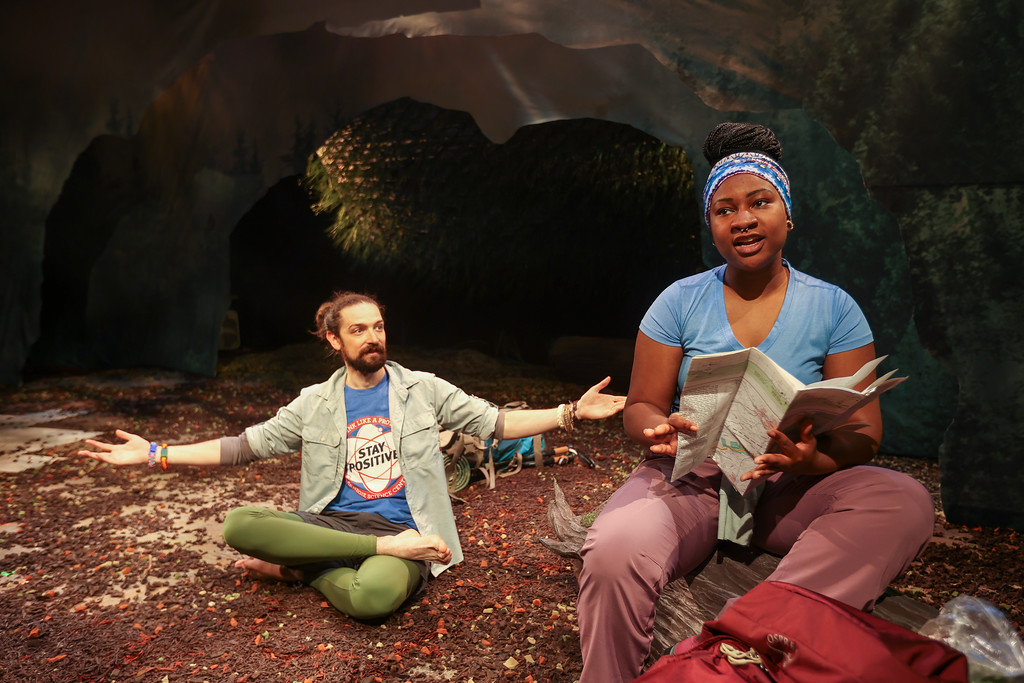
Dionysus was the Greek god of vegetation and fertility. In her Obie winning play, “Hurricane Diane,” Madeleine George has the god look down upon the modern world and, seeing it about to be destroyed by man’s poor treatment of the planet, decides to come to Earth to save it. Able to inhabit different bodies, he arrives in New Jersey as a she- Diane. And she comes as a landscaper, trying to persuade four suburban housewives who live on a cul-de-sac, to change their properties and to create a sustainable agricultural ecosystem- permaculture. It’s a strange premise to begin a story, but the play soon takes on many more dimensions, some rather interesting and some rather silly.

            The four women have their own stories. Carol (Terri Lamm) just wants her yard to look good- curb appeal. And she wants a new wrought-iron bench. Diane tries to convince her otherwise.

            Beth (Julianna Zinkel) has been struggling since her husband walked out on her a few months earlier. She can’t even bring herself to mow her lawn and it is very overgrown. That appeals to Diane. Beth is susceptible to Diane’s arguments and also, to her sexual advances. Dionysus’ powers also include pleasure.

            Renee writes for a gardening magazine and is fascinated with Diane’s ideas. Married now, she had many affairs with women before and previously identified as gay. Those sexual feelings are aroused again by Diane.

Pam (Suli Holum) is a sexy Italian woman who is hard to convince of anything until Diane turns on the charm (probably as a man, though it is not fully clear).

These four friends met regularly to talk about their lives and their families before the arrival of Diane. And in order to succeed in her mission, to save the planet, it seems to be determined that she must have all four go along with her plan.

Though the play won the best writing award for Madeleine George at the 2019 Obie Awards, I found the production at People’s Light to a rather limited look at stereotypical women that seemed more like a television show- lots of overacting. That these women needed to be convinced by a god to save the planet was presented as just silly- no need to overact. It is a comedy about serious stuff. But I didn’t find it very funny. As for the portrayal of Diane by Rami Margron, I found it shallow. Perhaps if Director Molly Rosa Houlahan explored the subtle nuances of the script more effectively, it might have worked better.

If you want to see if Diane saves the planet, you can check it out. There were even some people laughing at times, so maybe you will find it funnier than I did.

“Hurricane Diane” by Madeleine George at People’s Light, 39 Conestoga Rd., Malvern, PA 19355, 610-644-3500, peopleslight.org   Thru May 19, 2024

Torch Song at 1812 Productions

“Torch Song Trilogy” by Harvey Fierstein premiered in New York in 1982. It consisted of three shorter plays performed in three acts. It revolved around Arnold Beckoff, a Jewish drag queen and torch singer in New York City.  It was four hours long. In 2018, Fierstein revised the play, cutting it to 2:45. 1812 Productions is presenting this dramatic comedy about a man seeking love and connections in a humorous but very poignant manner.

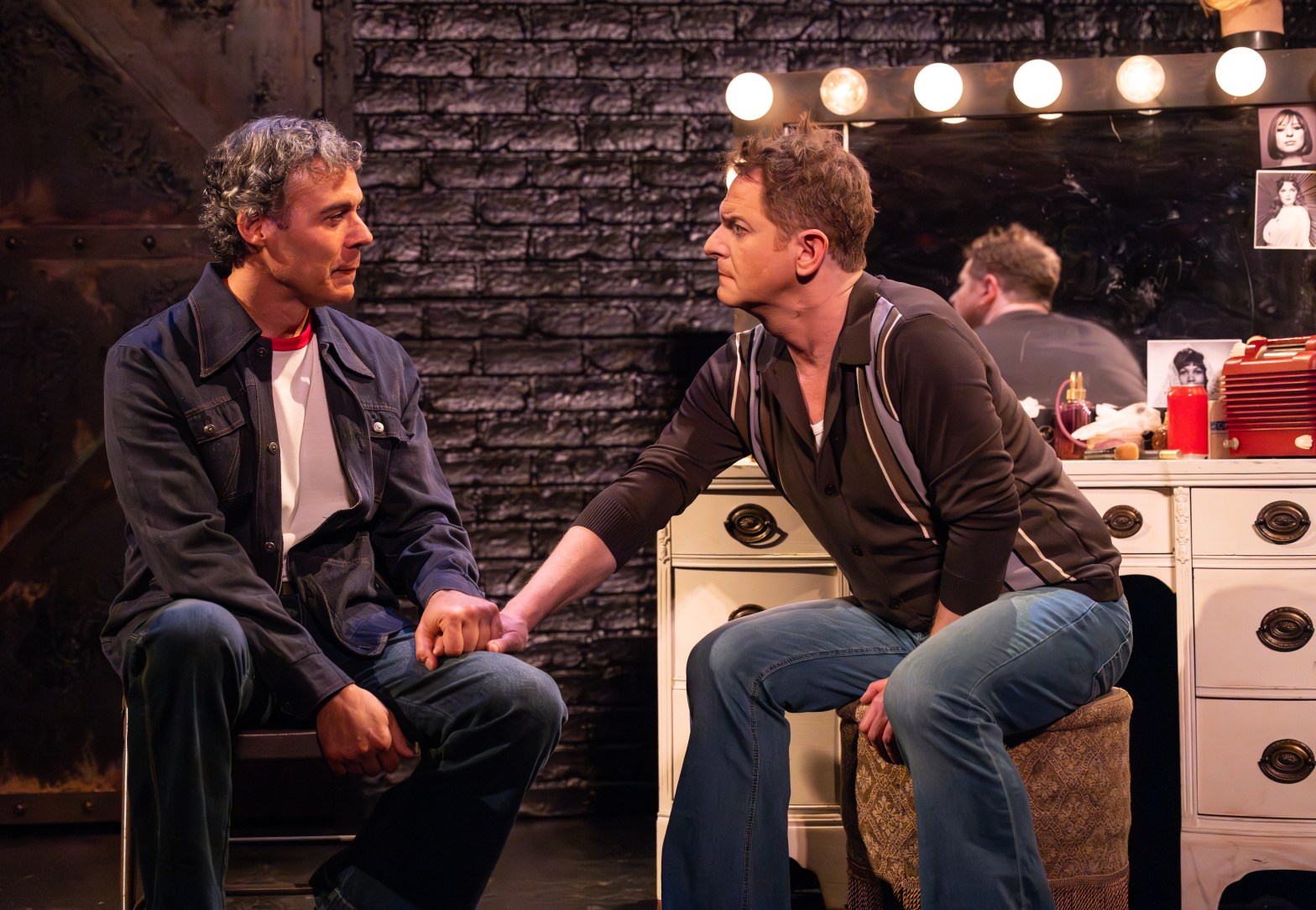
            It is the 1970’s, and Arnold Beckoff (Jamison Stern) is hoping and struggling to meet the man of his dreams. He finds anonymous sex in the back room a place called International Stud, to pass the time, until he meets Ed (Gregory Isaac). A relationship ensues, but Ed is conflicted, He is bisexual, and is hiding it from the woman in his life, whereas Arnold is not.

            Though Arnold dresses in drag to perform, he is not presented to us in a stereotypical manner, but rather as just another guy who wants to find love. It is a complex play as he is also dealing with his Jewish mother’s disapproval for not only his life style, but his entire life.

            Fierstein asks many questions that anyone in a relationship might ask- “Do I love him enough” and “What rights do you have when you love someone?” And at what point do you actually say, “I love you.”

            This play is also about friendship. What boundaries dare we cross in a friendship? Can two people who have been lovers move on and become friends?

            Then, there is the mother, Mrs. Beckoff (Grace Gonglewski). While Fierstein gives her lots of comic lines, the relationship between mother and son is complicated and effects Arnold greatly.

            And there is more. We meet Ed’s woman, Laurel (Karen Peake), who, as she learns of what is going on with her man, tries to figure out her own next move. We also meet David (Elliott Colahan) in the second act. He is a misfitting gay teenager who Arnold seeks to help. There are many complicated situations expressed with both humor and gravity. Arnold is only one of the many here who seek love.

            This profound piece of literary art, expertly directed by Bill Fennelly, is beautiful and will most definitely be around for another 40 years. Don’t wait. See it now.

“Torch Song” by Harvey Fierstein,  1812 Productions, at Players and Players Theater, 1714 Delancey, Philadelphia, PA 19103, 215-592-9560, info@1812 productions.org   Thru May 19, 2024

It’s Only a Play at Act II Playhouse

This is a copy of the review that first appeared in Broad Street Review after opening night. After the first weekend, it was sold out for the entire run.

Terence McNally was one of America’s greatest playwrights whose career spanned some six decades and who received Tony awards for “Master Class, Love, Valour, Compassion, Kiss of the Spider Woman, and Ragtime.” His work dealt with the struggles of life and the challenging connections between people. He wrote plays and musicals that continue to be performed all around the world. But “It’s Only a Play,” written in 1978 under the title “Broadway, Broadway,” starring Geraldine Page, closed in previews in Philadelphia. It would be seven more years before the comedy was rewritten with a new title, opening off-Broadway in New York with Christine Baranski. It was a huge success. Act II Playhouse has brought “It’s Only a Play” to its intimate theater in Ambler, but it’s not the 1985 show- rather it’s the result of further revisions by McNally to bring it up to date and that came to Broadway in 2014. It’s an outstanding production. And it’s very funny.

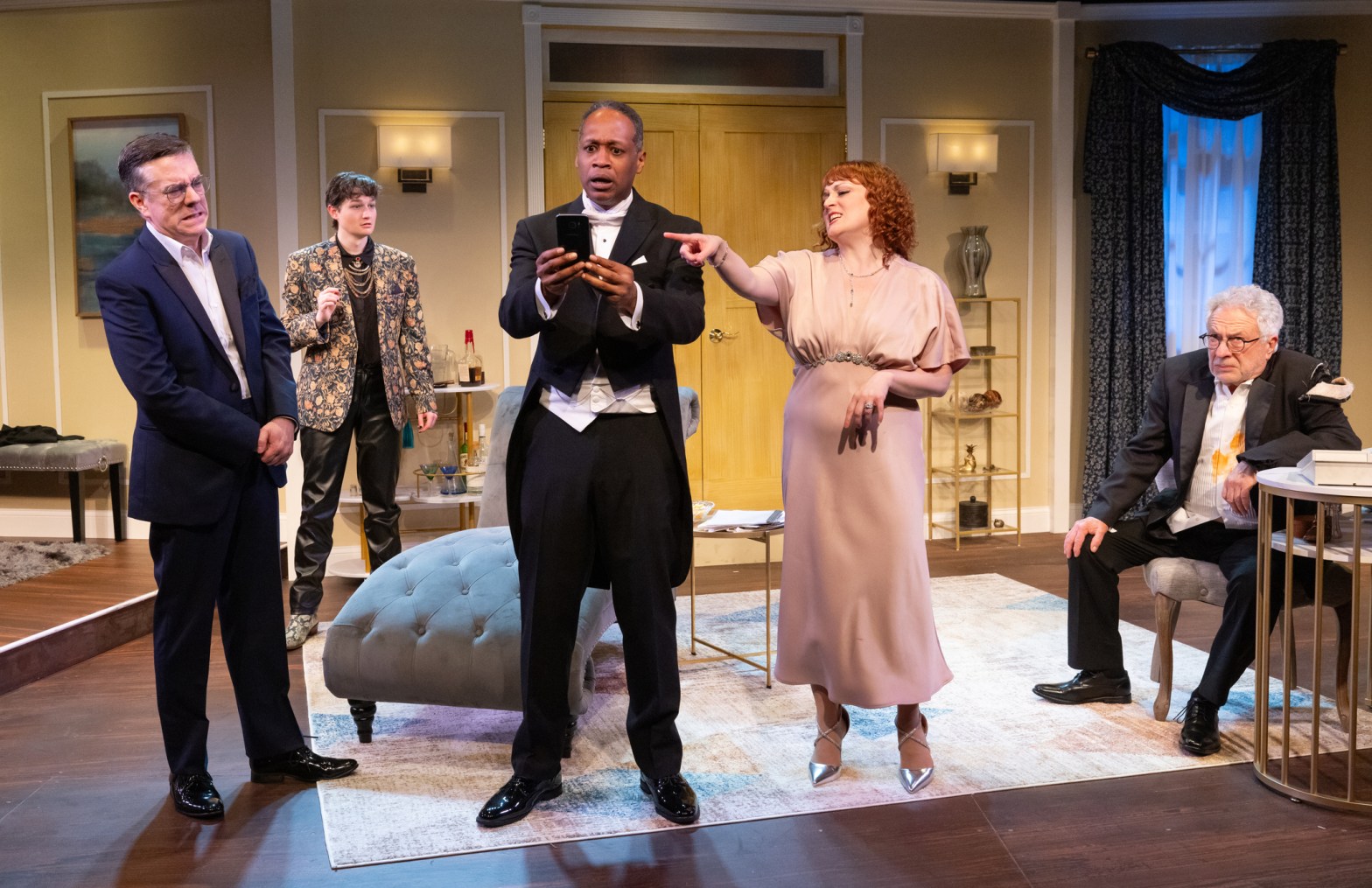
            The play begins in the hotel suite of the producer of the new play, “The Golden Egg,” by Peter Austen, which just opened that evening at the Ethel Barrymore Theater.. His old friend, James Wicker, who has flown in from California, has arrived first, and he fills us in about how bad the play, and particularly the lead actor, was. Wicker had to turn down the role which was written for him because he was locked into the tv show he had been in for nine years. In short order, he is joined by the bellhop (an aspiring actor), the producer, Julia Budder, the lead actress in the play, Virginia Noyes, the playwright, Peter Austen, the director, Frank Finder, and a theater critic, Ira Drew. If this seems like a lot, it’s not. McNally gives each a unique comedic element that keeps us engaged and laughing as they discuss the quality of the just-performed play and are reminded- it’s only a play.

            They are all together to await the early reviews of the play, hoping for success so that it may have a long run on Broadway. Budder is sweet, but somewhat of a simpleton making, malapropisms. Nevertheless, she had the money to invest in the play. Noyes is an experienced actress with lots of issues and wears an ankle monitor because of her criminal record and drug addiction. Finger is a talented young director but also a bit of a thief. And Drew is simply a mean critic who has a nasty word for everyone. Each of the characters was fun to observe.

            There are jokes about Hollywood versus New York and about tv and film versus live theater. There are jokes about the famous people that were in the audience for the show that night. There are intellectual jokes and bad jokes. Yet this isn’t a slapstick comedy. It is a smart one. We are laughing at the situations presented and about the lies they tell.

            When the first act ends, the reviews are just starting to appear. The laughter doubles in the second act. Comedy is such a personal thing and what appeals to one person may not translate into laughs for another. I wondered whether this play would appeal as much to a younger generation as it did to me and to the mostly senior audience in attendance. Still, the amazing ensemble is captivating with every word.

            Tony Braithwaite, with his acerbic dry humor, heads the cast, as he portrays the visiting friend. The critic, played by Teti, has a curmudgeon-like quality that is cruel, but crazily funny. My favorite was E. Ashley Izard, the brash, yet insecure actress, as she deals with the reviews as well as her anklet and drug issues. This is a hilarious ensemble, with different comedic styles, put together by Director Kevin Glaccum, and it couldn’t have been stronger.

“It’s Only a Play” by Terrence McNally at Act II Playhouse, 56 E. Butler Avenue., Ambler, PA 19002, 215-654-0200,   act2.org    Thru April 14, 2024

The Good Person of Setzuan at The Wilma Theater

“The Good Person of Setzuan” is a drama written by German playwright Bertolt Brecht about a poor but kind prostitute in China in the 1940’s. Brecht was living in exile in the U.S. at the time, having fled from Nazi Germany, when he completed the play. It was first presented on the stage in Switzerland in 1943 and published ten years later. By then, Brecht had been interrogated by HUAC as a Communist and left the U.S. the day after. Among his other notable works were “The Threepenny Opera, Mother Courage, and The Caucasian Chalk Circle.” The production on the Wilma stage is from Tony Kuchner’s adaptation in 1997.

            Three men arrive in Setzuan, China and seek shelter for the night. They encounter the water seller, Wang (Jungwoong Kim) for recommendations. He tries many places but is turned away until he talks to, Shen Te (Bi Jean Ngo), a young prostitute, struggling financially, who agrees to take them in. We soon discover that these men, dressed as if they are going for a vacation in Miami Beach, are actually gods who have been searching for a good human being. They reward Shen Te’s generosity with enough money to leave her profession and open a tobacco shop- her dream.  

            She is good towards all, and soon turns her store into a refuge for poor homeless people. Everyone uses her and takes advantage of her kindness until, unable to manage anymore, she creates and disguises herself as her own cousin, her male alter ego. It is a fascinating story. Unfortunately, I did not enjoy the loud, absurdist Wilma production, though I did love the set by Steven Dufala.

            To begin the show, we meet the water carrier, a kind of narrator. He speaks in Chinese and is translated simultaneously on speakers.  I couldn’t understand more than half of what he was saying. On top of that, he is accompanied by drums and chimes and bells throughout, making it even more difficult. The loud musical accompaniment continues throughout the long play. It is three hours and forty-five minutes with only one intermission. It is exhausting, working so hard to understand what is happening.

            And although Bi Jean Ngo did a fine job portraying Shen Te and her male cousin (and was perfectly comprehensible when the sound effects were dimmed), the rest of the cast was creating a rather over-the-top ridiculous narration of the story, which I did not fully understand until I got home and read the play. “The Good Person of Setzuan” is a profound piece that deals with the issues of greed and morality. Brecht is also challenging capitalism by suggesting it leads to corruption. I didn’t get this from the production on the Wilma stage. There, I only saw a silly and tiresome presentation by an overacting ensemble. The substance and stories are buried under Director Justin Jain’s heavy-handed direction …. Read it instead.

            “The Good Person of Setzuan” by Bertolt Brecht, translated by Wendy Arons, adapted by Tony Kushner at Wilma Theater, 265 S. Broad St., Philadelphia, PA 19107, 215-546-7824  wilmatheater.org    Thru April 21, 2024

The Last Yiddish Speaker at InterAct Theatre Company

An old, Yiddish speaking woman, lands on the steps of the home of Mary and Paul in upstate New York. It is 2027, and they have fled from New York City in the wake of a successful January 6th rebellion that has brought a white supremacist regime into power. They are Jewish, passing as Christians in this small town. Interact Theatre is presenting the world premiere of “The Last Yiddish Speaker,” by Deborah Zoe Laufer at the Drake. It is engaging, suspenseful, and powerful as we watch a father and his 17-year-old daughter try to figure out how to reply, not just to the woman, but to the events around them.

            The play begins in the home where Paul (Dan Hodge) and Mary (Katlyn Zion) live. Hung on the walls are crucifixes and a portrait of jesus. But we soon learn that they are trying to blend into a society that doesn’t know their true identities. Mary’s real name is Sarah.

            The third major player before the woman arrives is John (Gabriel Elmore), a good-looking young man who is in Mary’s senior class in high school. They have serious crushes on each another, and he is to be taking her to the senior prom. But not only does he not know of Mary’s real identity, he is also part of the youth group that seeks to root out all those who oppose the regime. They are seeking “to take the country back” from the Jews, the gays, the non-whites, and even the women, who are prohibited from attending college. When the old woman, Chava (Stephanie Satie) arrives, they cannot let John know about her and they hide her in the basement. Paul doesn’t even want to keep her there, lest their true backgrounds be revealed.

            So who is this old woman? She says she is Mary’s great aunt. She says she’s been married over a dozen times. She says she lived 1000 years ago. The only things we can be reasonably sure about is that she is Jewish and speaks Yiddish. And that is a threat to Paul- revelation of hiding a Jew can lead to serious consequences and his only goal is to protect his daughter. Her mother, his wife, disappeared mysteriously a few years earlier.

            Chava awakens in Mary a sense of what is means to be a Jew, and it threatens the precarious situation in which it challenges Paul’s attempt to let them “blend in” to their new life. She makes Mary laugh. She gives her a sense of history.

            We are riveted for every moment of this 95-minute drama, but also the effective comedic touches that Laufer has given us, like the results from the downloading of the Yiddish app on Mary’s phone to understand what Chava is saying, before we realize it won’t be needed. And what will happen to many of the professions usually dominated by Jews if they are eliminated? But what struck me so powerfully were the brief descriptions of Jewish identity based upon the centuries of repression.

            The ensemble is terrific- so honest, so real, so conflicted. From the challenging daughter to the protective father, from the questioning young suitor to the mysterious yet sweet old woman, they all create memorable characters. Director Seth Rozin does a superb job bringing this dystopian future play to life. I loved every minute!

“The Last Yiddish Speaker” by Deborah Zoe Laufer at InterAct Theatre Company at The Drake, 302 S. Hicks St., Philadelphia, PA 19102, 215-568-8079  interacttheatre.org  Thru April 21, 2024

MacBeth at Quintessence Theatre

When I first read William Shakespeare’s “MacBeth” in high school, I was terrified. I had trouble understanding the English language of the times.  But I got through it with the aid of Cliff’s Notes. Had I seen the play instead of reading it, I might have understood it better. Now, the play, Shakespeare’s shortest tragedy, is on the Quintessence stage. Sadly, I hadn’t prepared myself by reviewing the tale which I hadn’t seen in over 40 years, and I found myself lost in the language once again.

             Three witches visit Scottish General MacBeth and his friend Banquo and tell them that MacBeth will become King of Scotland. He is excited and so is his wife. He decides to expedite his ascent to the throne and murders Duncan, the current king. But the witches also tell them that Banquo’s heir will be a future king. That becomes a problem for MacBeth.

            The plot gets more and more complicated as various allegiances and several ruthless murders take place. Knives and swords are in constant use, and the fighting scenes are well choreographed. So too are the scenes with the three witches, costumed in black with spooky masks. And in keeping with the productions of plays during Shakespeare’s times, all the roles were played by men- the witches as well as Lady MacBeth.

 I did not care for Scott Parkinson’s portrayal of the very complex queen, wife of MacBeth. It was rather flat… two dimensional.  It didn’t come alive on the stage. Actually, that was a problem I had with almost all the characters, including MacBeth himself. They simply and boldly recited their lines, but I didn’t get the feelings I usually get in such a powerful, emotional play.

When I don’t care for a production, I often ask the person I came with whether he or she liked it. This time, it was my friend who was a professor of literature at Temple and Manor Colleges for over 40 years and often taught “MacBeth.” It didn’t work for her either.

            When I read the director’s notes after the play, I saw that director Alex Burns’ goal was “to move away from method acting and realism, and to focus on heightened language…” I felt as though I was in a reading of the play, not a performance. It didn’t feel like the bard’s shortest tragedy. I wonder what Shakespeare, an actor as well as a playwright, would have thought of it.

            If you go, be sure to read a summary of the play in order to better understand what is going on on the stage, as you will miss some of the information recited in Shakespearean tongue. You won’t get it in the acting.

“MacBeth” by William Shakespeare at Quintessence Theatre, 7137 Germantown Ave., Philadelphia, PA 19119, 215-987-4450, quintessencetheatre.org   Thru April 21, 2024

The Lehman Trilogy at Arden Theatre Company

From 1844 to 1850, three brothers emigrated from Bavaria to the U.S., settling in Montgomery, Alabama. From a dry goods store to one of the largest investment companies in the world, these brothers created an enterprise that invested in businesses throughout the U.S. and the world. “The Lehman Trilogy” traces the evolution of the company for a century and a half through the family and its descendants that took those risks. Three actors portray the Lehmans, their kids and grandkids, and even their wives, who didn’t even change their costume (a vested suit)- they simply talked to each other and to us, the audience as we came to understand the history and evolution of a business that was the personification of an American dream of immigrants. Three hours and three acts with two intermissions, yet it was mesmerizing as I sat there, not wanting to miss a word of their stories.

            It begins with the collapse of the company in the financial crisis of 2007-2008, but that is only a very small part of the story. There hadn’t been any Lehmans running it for decades, and this is the story of the people and their responses to the events of the times. The Civil War, devastating fires, and the Crash of the Market in 1929 had major effects on the direction of the company. These are the stories of a family that responded to those events.

            There are lots of details about how the Lehmans wound up in the cotton trade, about how they moved their base after the Civil War to New York, and about how they wound up financing other products- first coffee and railways, then oil, cinema and even television were things they invested in. Eventually, the most lucrative product invested in was money itself. In each case, a younger generation of Lehmans had to convince their parents to adapt to the changing times. There is much story to digest. And we do.

            This Philadelphia premier, staged by Arden Theatre Company, features Scott Greer, Charlie DelMarcelle, and Akeem Davis. The Lehmans were Jewish. None of these actors are Jewish. Davis is African-American. Director Terry Nolen is not Jewish. It doesn’t make a difference. They understand theater. They know how to create. They told stories so believable without overplaying their characters. They are great! The press release says that they played over 50 characters… And it all worked! It all worked!! Each character they portrayed moved the company forward as we observed the evolution of a branch of American capitalism.

We knew many of the events that are described in the play, but we didn’t know the players. Playwright Stefano Massini gives us that story that was hours longer before Ben Power adapted it down to a perfect three hours. 150 years in three hours is pretty good as it takes us forward in time. At the end of the play, I spoke to two people who had seen the play on Broadway. Both said that this production was better. I’m not surprised. It is a tour de force!

“The Lehman Trilogy” by Stefano Massini, adapted by Ben Power at Arden Theatre Company, 40 N. 2nd Street, Philadelphia, PA 19106. 215-922-11222   ardentheatre.org   extended thru April 14, 2024

the ripple, the wave that carried me home at People’s Light

            The play begins with Janice Collen, alone on stage, telling us that she hates water. She understands that it is necessary for life, that the body is made up of 60% water… but she still hates it. Janice, an African-American woman, grew up in landlocked Beacon, Kansas in the 1960’s and 70’s. She escaped the state and her family to move to Ohio where she had her own family. But now, she is being pestered to return to her birthplace to speak at an event to honor her father.  This memoir-style play, “the ripple, the wave that carried me home,” is the story of Janice’s relationship with her parents, who were major activists in trying to overturn the racism of the day that manifested itself in the segregated swimming pools, and her relationship with water.

            From the time she was a child, Janice acted in her parent’s interests and became a spokesperson against racism. She also became an active swimmer. There were three “public” pools in Beacon but only one was open to Blacks. When there was a protest at one of the White pools and Blacks entered the water, they shut it down for days after for “sanitation.”

            Four boys, who were friends and wanted to swim together (two Black and two White), but couldn’t do so at a pool, went to a local lake where three of them drowned because of the unsafe conditions. It led to a more active pursuit of integrated swimming pools, largely and sadly, to no avail.

            Janice herself was an avid swimmer, taught by her mother. They used to go at sunrise to the White pool where a friendly manager let them in long before it opened on Saturday mornings, for Janice to swim. Returning from the pool one time, they were pulled over by a patrol car who told the mother to get out of her car. It was a scary and scarring moment for Janice to watch what happened.

            But this is much more than the story of racism. It is a tale of being the daughter of an activist whose life is so much about fighting injusticee than caring for his daughter. She moves away after college, hoping to never return… until after her father has died. This the same year that the Rodney King incident and trial is going one. She is asked to return home for a ceremony honoring her father at a pool naming event. Besides having mixed feelings about returning, she is bothered by the fact that they are not also honoring her mother, who worked just as hard to fight the segregation of the day.

In spite of all the interesting information that I got from the play, my only objection was that often, it did not feel like a play, but rather a little like a lecture at times. I wanted more theater. Show me, don’t tell me. The cast of four was superb when they enacted the scenes. Janice (Patrese D. McClain) was an excellent narrator, but I have to work harder as an audience member in order to follow the narrative. And one hour and fifty minutes without an intermission, was quite challenging for me.

Nevertheless, I found the play most powerful and moving. I just wished that there was an act break to give me a chance to digest it all.

“the ripple, the wave that carried me home” by Christina Anderson at People’s Light, 39 Conestoga Rd., Malvern, PA 19355, 610-644-3500, peopleslight.org   Thru March 24, 2024

Faith Healer at Lantern Theater Company

A man, Francis Hardy, the faith healer, comes out onto a nearly empty stage and talks to us. He does not preach. He does not try to convince us of his healing powers. He does the very opposite- he reveals all the phoniness of the profession, the acting, the bogus shamans. This is the first of four monologues that comprise the play “Faith Healer,” written by Brian Friel in 1979 and brought to the stage by Lantern Theater Company.

            We listen as Hardy explains the profession and his attraction to it. But it is also about the man himself- his childhood, his relationship with his partner Grace, and with his manager, Teddy. There are descriptions of his travels from Ireland to Wales and Scotland and the people he tried to “cure.” He is not sure of his own “power” and he tells us that he fails nine out of ten times. There is so much information in this first scene, even though it is interesting, that it is a bit overwhelming to stay focused and absorb it all.

            Things start to become clearer in the second scene when Grace replaces him on stage. We learn from her that she is in Frank’s (Francis’) wife and not just his partner. She tells us of her troubled family and of her attraction to her husband. And unlike Frank, who says she is infertile and unable to bear children, we learn of the miscarriages and still born child. We quicky realize that we are listening to two different interpretations of the same events, including the preaching he’s done over the years. At the intermission between scenes 2 and 3, I could hear many in the lobby talking with each other, trying to clarify what happened and what was true.

After the intermission, we meet Teddy. He provides an outside look at the relationship between Frank and Grace. We see what he has done to push the struggling career of his client. Things become clearer…or do they? Is his interpretation of life’s events, punctuated with more humor, any more accurate?

Then, there is one last scene. Frank returns with more information, to gives us his interpretation one more time, with a few additions and changes.

Ian Merrill Peakes (Frank), Genevieve Perrier (Grace), and Anthony Lawton (Teddy) do a superb job in relating their interpretations of the events with just enough lilt of the Irish accent without overplaying it and making it harder to understand. And Peter DeLaurier has established the perfect pace for this unusual piece. But the play is telling us what happened, not showing us, so it asks a lot of the audience to listen without seeing what has occurred. And I know that if Friel presented this play to a potential producer today, he would be asked to reduce it from 2½ hours to 90 minutes- this to a world-famous playwright who has won all kinds or awards and his been called “the Irish Chekhov.”

While I enjoyed the development of a most interesting story by three fine actors, let me warn you- be prepared to be confused.

“Faith Healer” by Brian Friel at Lantern Theater Company at St. Stephen’s Theater, 923 Ludlow St., Philadelphia, PA 19107. 215-829-0395   lanterntheater.org    thru March 3, 2024.