Minor Character at the Wilma Theater

            Aging, anxiety, envy, love, failure, beauty, suffering- the subject of dramas by the great playwrights from Sophocles and Shakespeare to Ibsen and Chekhov. Powerful characters created memorable moments that seem as real and contemporary as if written yesterday, despite being centuries old. The Wilma Theater, in its first return to live audiences, has chosen to take “Uncle Vanya,” one of Chekhov’s classics, and present it in a new form, a  21st century form created by New Saloon, with the twists of comedy and confusion. I am sad to report that the confusion was so off putting that I couldn’t figure out what was happening on stage most of the time, and anyone not familiar with the original play, will find “Minor Character” especially hard to understand.

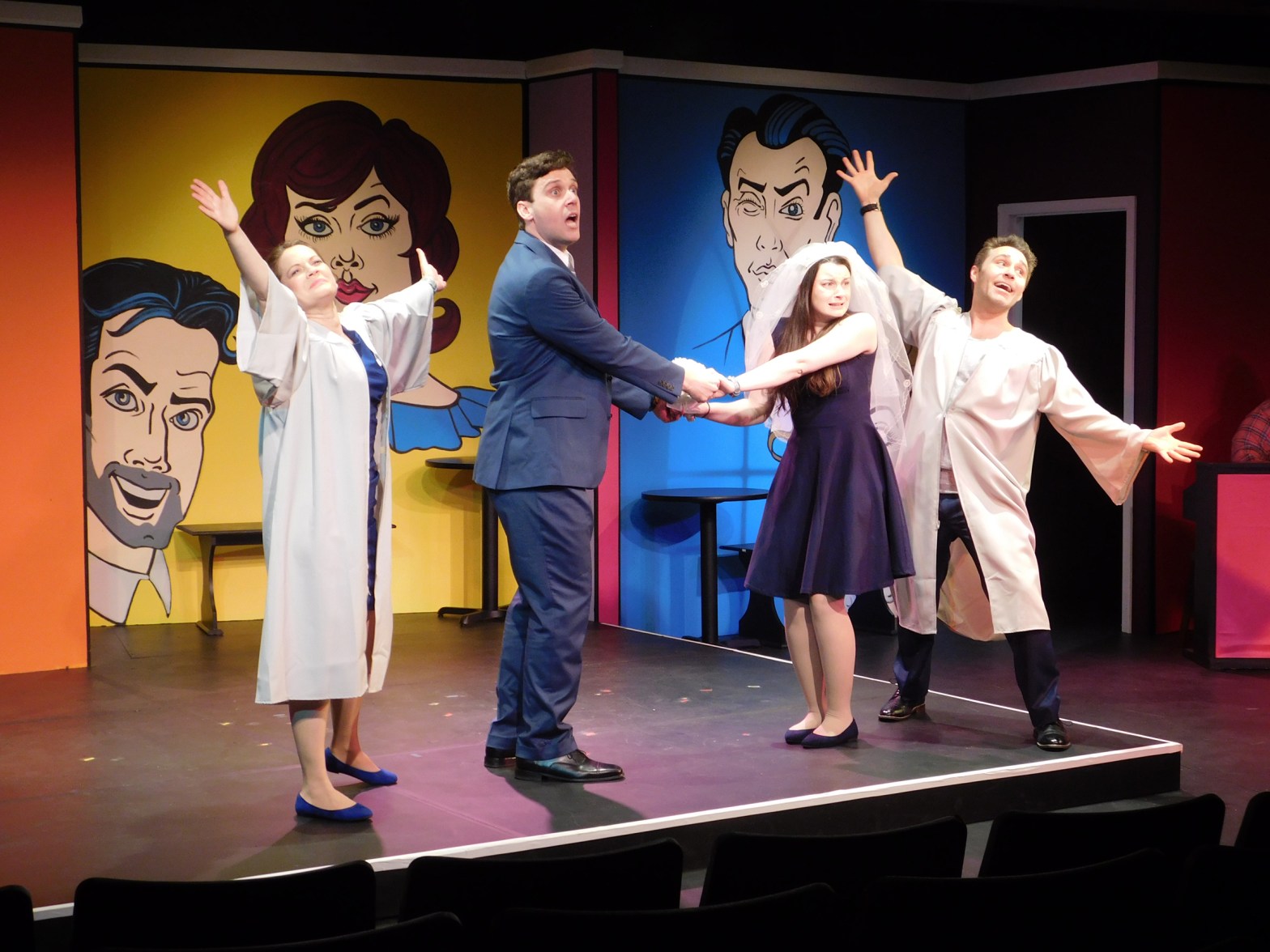
            Seven actors playing multiple parts including lots of moments where they were on stage at the same time, spitting out lines based on six different Chekhov translations- at the same time. Innovative? Yes. Comprehensible- rarely.

            The actors shout the words, but ignore the depth of emotions that made the original “Uncle Vanya” and other Chekhov plays so powerful. I felt like I was listening to brief essays on life, but I never felt connected to either a drama or the comedy that the cast and director Yury Urnov were trying to achieve.

            As the actors shifted roles, it would take me a moment to understand which character was speaking. And when three actors spoke different interpretations at the same time, I was completely lost.

            I knew that the main characters the Chekhov play- Vanya and his niece,  the doctor, the professor, and the new wife. But the actors kept switching roles and there was no attempt to reveal the inner character of any. You are spending most of the time simply trying to follow the plot that is simple in the original play, but quite convoluted in this adaptation.

            The play is almost two hours in length, without an intermission. It is tedious to sit through such a production, but I suppose the comment by the dramaturg in the digital program indicates that she had the problem with the original. She wrote “I have a confession to make. I have historically struggled to connect with Chekhov’s plays.” Perhaps “Minor Character” is meant for a younger, hipper crowd who don’t get the complexity of Chekhov.

            At the conclusion, I had to rush to the men’s room. While there, another man entered and I asked him what he thought of the play. “We were lucky,” he said. We were 15 minutes late. There was an accident on the expressway. We must have missed the good part.” He didn’t.

            I don’t like writing such a negative piece about a theater whose work and productions I both respect and enjoy. “Minor Character”   is a clever idea, but just doesn’t work for me.  As this is the first play I’ve seen live since the beginning of the pandemic, I look forward to other Wilma plays this season.

            If you can’t go but still want to check it out for yourself, Wilma will be streaming the play after the stage production closes.

On Stage thru Oct. 24, 2021

Streaming from Oct. 25- Nov. 7, 2021

Everything is Wonderful by Chelsea Marcantel at Philadelphia Theatre Company

           A young man, driving in Amish country, crashes into a buggy and kills two young brothers. Acquitted by the court, he is so grief-stricken, he goes to the home of the victims’ family to try to both apologize and come to grips with what he has done. Everything is far from wonderful.

            Chelsea Marcantel’s play, which premiered three years ago, is far more than what begins as a painful, but simple story. It is layered with the complex levels that are a part of every family and society in general.

           While we learn that the Amish are forgiving people- that they will turn the other cheek- they also have rules, strict rules. They have procedures to any who seek to enter their world. And there are mixed feelings by those whom the brothers left behind-  their friend, their two sisters, and their parents.

            Philadelphia Theatre Company’s production is being directed by Noah Himmelstein, who directed it last year at Everyman Theatre in Baltimore. I can’t imagine that production  being more powerful than the show he’s put on PTC’s stage. It is full of nuance, it is wrought with tension, and it has a remarkable cast, each character with his or her own story.

            We are initially drawn to the mourning parents whose who approach grief differently. But the sisters are also trying to cope with the loss. And one, Miri (Katie Kleiger), is particularly distraught. She has been ostracized from the family and is bothered when they take in Eric (J. Hernandez), the driver of the vehicle that killed her brothers.

            There are many realistic confrontations that challenge both their religion and their sense of who they are. “Trust in God,” is the mantra, but God has taken two of their own. What does it mean? And another question- What are the words that are used to say “I’m sorry.”

            Abram (Lucky Gretzinger), the friend, has sinned. He has violated a tenet of the church. Is it enough to simply confess to the congregation to be absolved? Is he free to go on as if nothing has happened? And what if a confession has the potential to worsen a situation for another?

            It is clear that some cope better with tragedy while others’ pain is more all-consuming. Marcantel’s two and a half hour feels both longer and shorter than the actual running time. It is longer because of the pain we feel for each character. It is shorter because she has created many brief scenes that move rapidly along, as more and more is revealed.

           Eric tries to figure out what he wants from this family and Amish life in general. The younger daughter, Ruth (Stephanie Hodge) , manages to cope with her brother’s death, with a light-hearted approach which provides an almost comic relief for her and for us. Abram is steadfast in the rigid beliefs of the church but he breaks the rules on a regular basis. The question of what will lead to forgiveness is repeatedly asked.

           Himmelstein has brought together these six actors in Marcantel’s powerful play to create the finest ensemble performance that I’ve seen this theater season.

“Everything is Wonderful.” Philadelphia Theatre Company at the Suzanne Roberts Theatre, 480 S. Broad St., Phila, PA 19146, 215-985-0420. philadelphiatheatrecompany.org   Thru March 8, 2020.

My General Tubman by Lorene Cary at Arden Theatre

            Writer, teacher, activist, organizer—the amazing Lorene Cary has now written a play about another amazing woman, Harriet Tubman. Taking place in two eras, the mid 19th century and today, Tubman is both real and imaginary as she fights to free slaves in her own time, and appears to four men within the walls of a Philadelphia prison today. But  it’s not simply a story about Harriet Tubman. It’s entitled “My General Tubman” because it  is about how a young man, Nelson Davis, sees this remarkable woman.

            Who is this Nelson Davis? He is a guy who has just been thrown into jail for trying to protect his sister. It is also the name of the young man (22 years younger than Tubman) who married Harriet after the Civil War. In both cases, it is his Tubman.

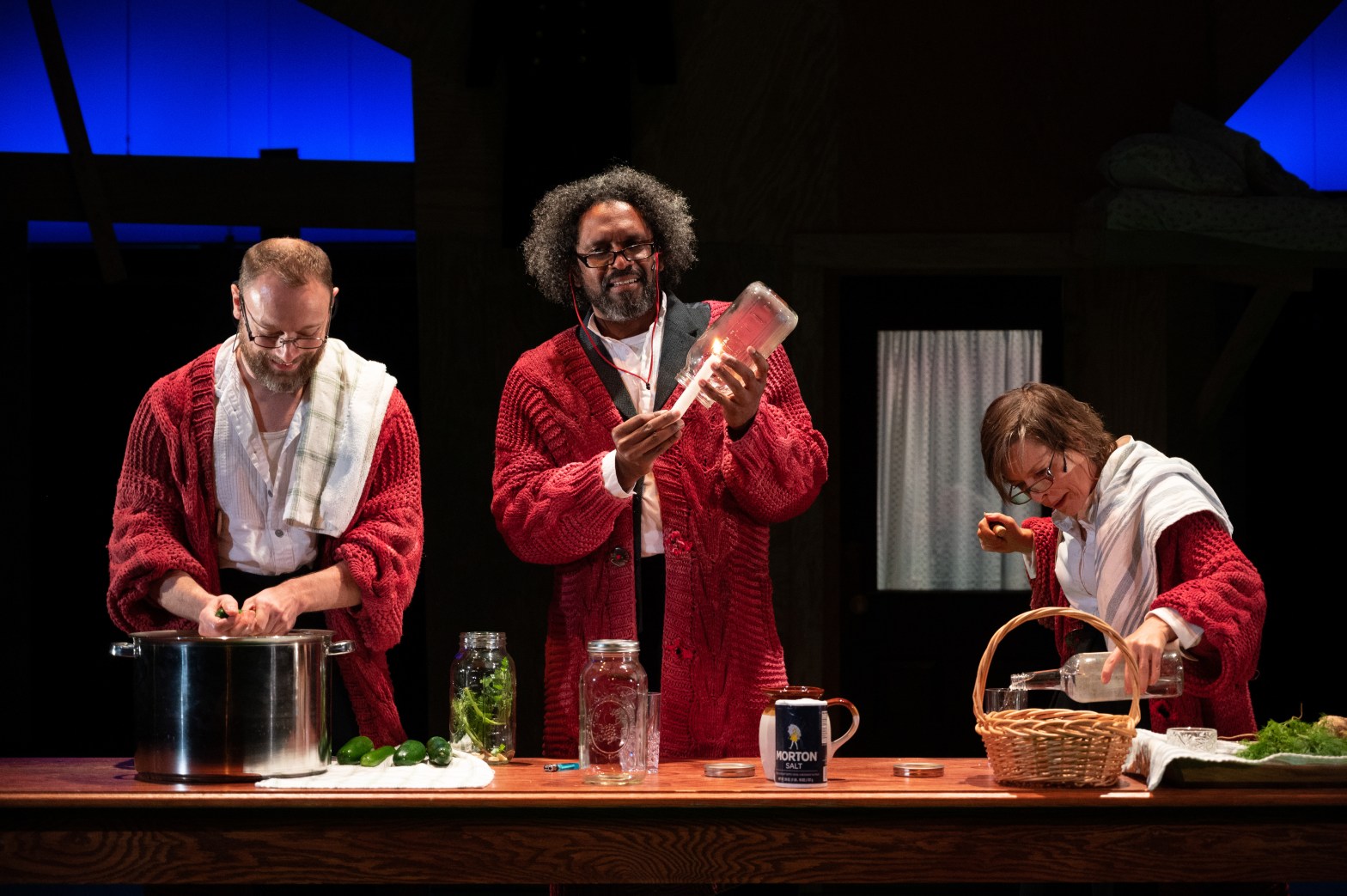
            Cary takes liberties with what may or may not have happened in a meeting that Tubman (Danielle Lenee) had with John Brown (Peter DeLaurier) before his infamous raid at Harper’s Ferry. But Tubman’s commitment to rescuing slaves from Maryland (from where she had escaped), is her central goal. We see her as she lectures to the rich at socialites to raise more money for her cause. We watch as she tries to enlist Black soldiers into the Union army. Ironically, though her presence is central to the story, it is the other four men whose tales are just as important. Two prisoners, a chaplain, a jailer- they each find in Tubman a spirit that gives them the strength they need to liberate themselves. Brandon Pierce, Damien J. Wallace, Dax Richardson, and Bowman Wright give the four characters meaningful texture.

            Tubman, whose youngest brother was name Moses, was dubbed Moses herself, as she brought slaves out of bondage. What I loved about the Arden production was they presented a Harriet who was real. They didn’t try to create a mystic, figure. She had work to do and she did it. Even when she appears to the men in jail, when she becomes an inspiration for them, it is not in some larger-than-life gimmicky way.

            It’s performed on an open stage with a painted floor that resembles a map, which can easily represent the lands and the waterways the runaway slaves had to traverse.

            The play succeeds on many levels, but not all. To bridge the scenes and provide more information, Cary uses a one-man chorus. But it is not well defined and sometimes even silly. She will need to do some more editing of that role to give the play more depth.

            The other problem I had with the production was in the presentation on the Arden stage. It was done in the three-quarter round. If you go to the play, get a ticket in the middle section, or you will miss much of the story when the actors give you their backs for many scenes. At the break, I asked others in the audience to get clarity on what happened, and they too, missed the lines.

            All in all, Director James Ijames has pieced together an interesting and unique portrait of Tubman and her followers. Though it can use some more refinement, it is  educational, fanciful, and entertaining.

“My General Tubman” by Lorene Cary, Thru March 8, 2020.  Arden Theatre, 40 N. 2nd Street, Philadelphia, PA 19106, 215-922-1122.

The Vertical Hour by David Hare at Lantern Theater

           “The Vertical Hour” is a play by the renowned playwright, David Hare, written in 2006, that begins in the office of Yale Professor Nadia Blye. She is confronting a student regarding what she thinks is his naïve view of the political process. The final scene is of Blye with a different student, who also provides a challenge to her intellect. But the core of this story is about Blye, her fiancé Philip, and Philip’s father Oliver.

            Philip has brought Nadia home to Britain to meet his father, from whom he has been somewhat estranged. His parents had had an open marriage for a while, but it got out of hand and they separated. We learn of the intricacies of that marriage as well as the complications of the relationship between Nadia and Philip. Underneath the discussions of a country’s commitment to support and even intervene in another country’s affairs (the Iraq War) are the issues of what attracts people in a relationship.  

            The play poses a myriad of questions that each character is trying to come to grips with. But a main issue is what creates an attraction between any two people. What strengths do we need in a partner to make a relationship work, whether it be between a man and a woman or a father and a son? Is what we think we are attracted to what we really want? And how much can we change, to adjust how we think and what we feel? These themes exist both on the personal level and on the larger political arena.

            They talk about materialism, they talk about Sarajevo, they talk about Iraq. But what will they do? They note that it is often easier to do nothing. And in this play, each character seems to be running. But is it toward something or away from it?

            Genevieve Perrier is outstanding as the idealistic young professor, sincere, yet convincing in an elegantly understated portrayal of Nadia. Joe Guzman’s Oliver is more pompous and harder to take. But we watch as each tries to win over the other, as Philip (Marc LeVasseur) seems to disappear into the backdrop of the lives of his girlfriend and his father.

            Unfortunately, though it is a fascinating intellectual exercise at times, the play often slips into long, talky, boring arguments and discussions which take place while the three sit or stand or just walk about the stage. Often, the dialogue is predictable and dull. Perhaps more dynamic interaction by director Kathryn MacMillan, might have enlivened the script, but I’m not sure. It’s not Hare’s best play.

“The Vertical Hour” at Lantern Theater Co., St. Stephen’s Theater, 10th & Ludlow Streets, Phila., PA 19107, 215-829-0395, www.lanterntheater.org Thru February 16, 2020.

Together Again For the First Time by Tony Braithwaite and Jennifer Childs at Act II Playhouse

            Tonight I sat laughing for seventy-five minutes as I watched Tony Braithwaite and Jennifer Childs perform a series of sketches and songs on the intimate stage at Act II Playhouse. These two actors have collected some old comic routines from the classic tv variety shows and added their own hilarious nonsense to the most enjoyable night I’ve had in the theater in a long time.

            While they pay homage to The Ed Sullivan Show (23 seasons on the air) and the Carol Burnett Show (11 seasons),- to Bob Newhart, Joan Rivers, and Jackie Mason- they borrow and adapt some of the best routines- it will leave you wondering what happened to tv comedy in the new millennium.

            I cannot begin to separate what is vintage and what is invented and reinvented by this creative duo. It doesn’t make a difference. One minute, they are singing a song “Why the Wrong People Travel When the Right People Stay back Home,” the next minute they have Abe Lincoln’s agent on the phone, giving the President advice on his Gettysburg Address, telling him how to dress,  and warning him that it would hurt his image to shave his beard.

            Braithwaite creates Rodney Dangerfield. Childs portrays Phyllis Diller. Things you have forgotten about television on the Johnny Carson show, songs that you saw performed by Sonny and Cher- it’s a rapid fire barrage of comedy.

            Owen Robbins provides the musical on-stage accompaniment to the many songs. He also gives us little bits of tv history in the very brief interludes. Braithwaite also provides some background to the evening’s merriment to add more to our experience.

            I can go on and on about the different bits, but this is a show where you need to just sit back and let them entertain you with their amazing talent. Braithwaite and Childs are the king and queen of Philadelphia comedy, and “Together Again for the First Time” reminds us why!

“Together Again for the First Time” at Act II Playhouse, 56 E. Butler Ave., Ambler, PA 19002, 215-654-0200, www.act2.org. Thru Feb. 2, 2020. 

The Wizard of Oz by L. Frank Baum at Quintessence Theatre

            In 1900, L. Frank Baum published “The Wonderful Wizard of Oz.” Two years later he worked with others to create a musical version for the stage. After opening in Chicago, it played for two years on Broadway, then toured the country. But it is the 1939 MGM version of the musical that we know today. Dormant for seventeen years, it began is classic status when it was released for television in 1956 and is now one of the most seen films in movie history.

            It is hard for anyone to picture anyone else but Judy Garland as Dorothy Gale along with her cohorts, Ray Bolger, Jack Haley, and Bert Lahr. The current “Wizard,” however, is based on the adaptation made for the Royal Shakespeare Company in 1987.

            If you begin to compare the Quintessence Theatre’s production to the Hollywood version, you will come away disappointed. But if you want to see a beautiful story on the intimate small stage, with some fine actors, you will walk away humming the famous songs of Harold Arlen and Yip Harburg., who created the music for the film. You will also love Leigha Kato as Dorothy.

            The story revolves around the 11-year-old Dorothy’s dreamy voyage to the Land of Oz. The studio couldn’t get the appropriately aged Shirley Temple and had to “settle” for the older, heavier, Judy Garland. The rest is movie history. Leigha Kato brings that innocent youth of a preteen to the stage. She has a beautiful voice. She is also an outstanding actor. In fact, she came east from California to go to University of the Arts ten years ago and has since performed widely in Philadelphia and New York. Yes, she is not 11, but you’d never know it.

            The trio of The Scarecrow (Andrew Betz), Tin Man (Doug Hara), and Cowardly Lion (Jered McLenigan) is a strong one. The costumes by Kelly Myers were, for the most part, excellent, though I would have liked a mane for the lion and something for the girl who played the dog Toto. I was not enamored by the witches (the good witch Glenda and the Wicked Witch of the West) or the Wizard himself, but I confess to being unable to view it without visualizing Margaret Hamilton and Frank Morgan from the film.

            There was another musical number, cut from the film, “Jitterbug,” meant to lighten up the ominous story. And I learned that neither the Wicked Witch’s broomstick nor Dorothy’s  ruby red slippers were part of the original story.

            It’s a joy to see “The Wizard of Oz” on stage, and though the budget prevents the mounting of extraordinary sets, Brian Sidney Bembridge has devised a series of scenes to put you right there in the cyclone, on the road to Oz, and in Oz itself. Kids will love it.

“The Wizard of Oz” at Quintessence Theatre, 7137 Germantown Ave., Phila, PA 19119, 215-987-4450. Quintessencetheatre.org Thru Jan. 3, 2020.

Natural Shocks by Lauren Gunderson at Simpatico Theatre

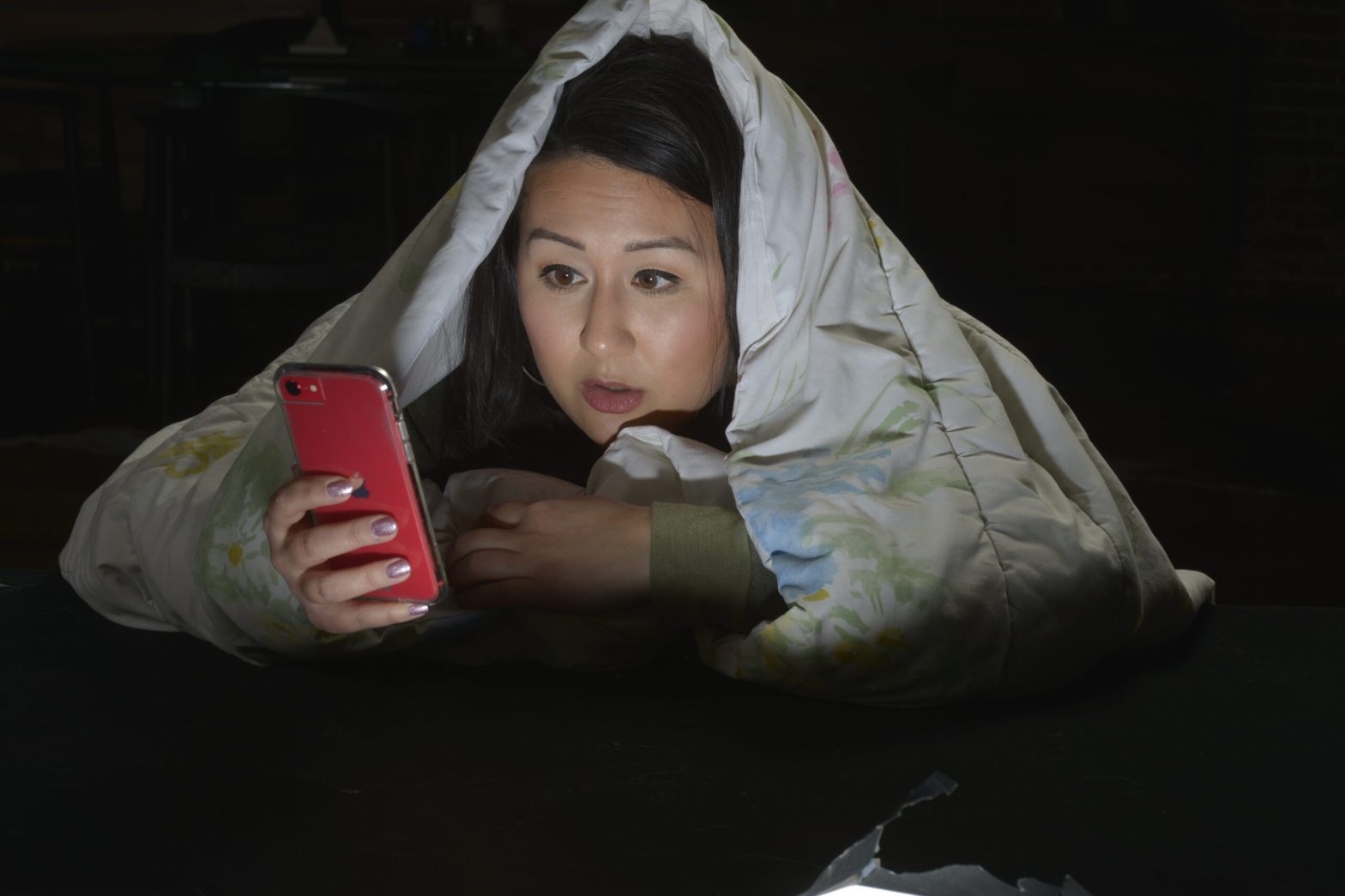
           Angela is taking refuge in her basement in anticipation of a great storm about to hit, a tornado of potentially unmeasurable destruction. She is scared. She is alone. And she begins to talk, to herself and to us, the audience. In this hour long theater piece, we will learn of this 40 something woman’s entire life- her family, her work, her fascination with numbers, her loves, and her fears in a non-linear, stream-of-conscious, rapid-fire self-expose.

            I recently learned that Laura Gunderson, who wrote “Natural Shocks,” is currently America’s most produced living playwright.  And this play had special meaning for her. When she was in high school, the shooting at Columbine High School affected her profoundly. While writing “Natural Shocks” years later, the Parkland shooting took place. She decided to turn her work into a statement of anti-guns and anti-violence, to unite the theater community against such horrific acts, acts that can occur on the spur of a moment, like a tornado.

            Throughout the piece, Angela, a numbers geek, is constantly figuring out the odds of everything, including the chances of surviving the storm. She tells us that she is a professional worrier, and this helps to sooth her. In a similar fashion, she tries to predict the probability of her future life. And life is something that is one of her worries. The title, “Natural Shocks” are words in “Hamlet’s” famous “To be or not to be” soliloquy. She is questioning existence as did Hamlet. Do we believe Hamlet? Should we believe Angela?

            We care about her. We learn about the difficult times she had with her mother. We sympathize with the troubles she’s had with her husband. We want her to find a way out. But amidst all the joking (it’s a bit of standup at times), she also tells us that some of what she told us earlier was not true.

            Each story is punctuated with numbers, separating statistics (percentages about the past) from probability (percentages about the future).  It’s all quite amusing, but it feels like an essay for three-quarters of the play. It gets tedious, and we wonder where it is going. There is no real conflict.

            In the final quarter, we start to better understand her struggle as she reveals more. But while many of Gunderson’s words clearly should have had an emotional impact they didn’t. They didn’t for two reasons.

            Laura is played by the talented, award winning actor, Amanda Schoonover. We learn that Laura has been married for over two decades. But for some reason, Schoonover  portrays Laura, not as a complicated woman, but like an eighteen-year old. She works the comic lines, but gives little attention to the depth of her dilemma, of her feelings. She zips through the those lines as if she is trying to finish it in the advertised 65 minutes. Rather than take us to the violence that underlies the play, the rhythm that she and Director Elise D’Avella develop distracts from the substance of Gundrson’s words. What Laura is talking about IS important. The way manner in which she rambled, made it less so.

            It is never a joy to give any sort of negative review. My friend, who saw it with me, didn’t find the pacing as troublesome as I did. Simpatico Theatre has a policy of paying what you decide after the play. I’m sure there were a variety of different payments.

“Natural Shocks.” Simpatico Theatre at The Louis Bluver Theatre at the Drake, 302 S. Hicks St., Phila., PA, https://ci.ovationtix.com/35118/production/1016957 for reservations, simpaticotheatre.org, 267-437-7529, Thru Dec. 22, 2019.

Home by David Storey at The Drama Group

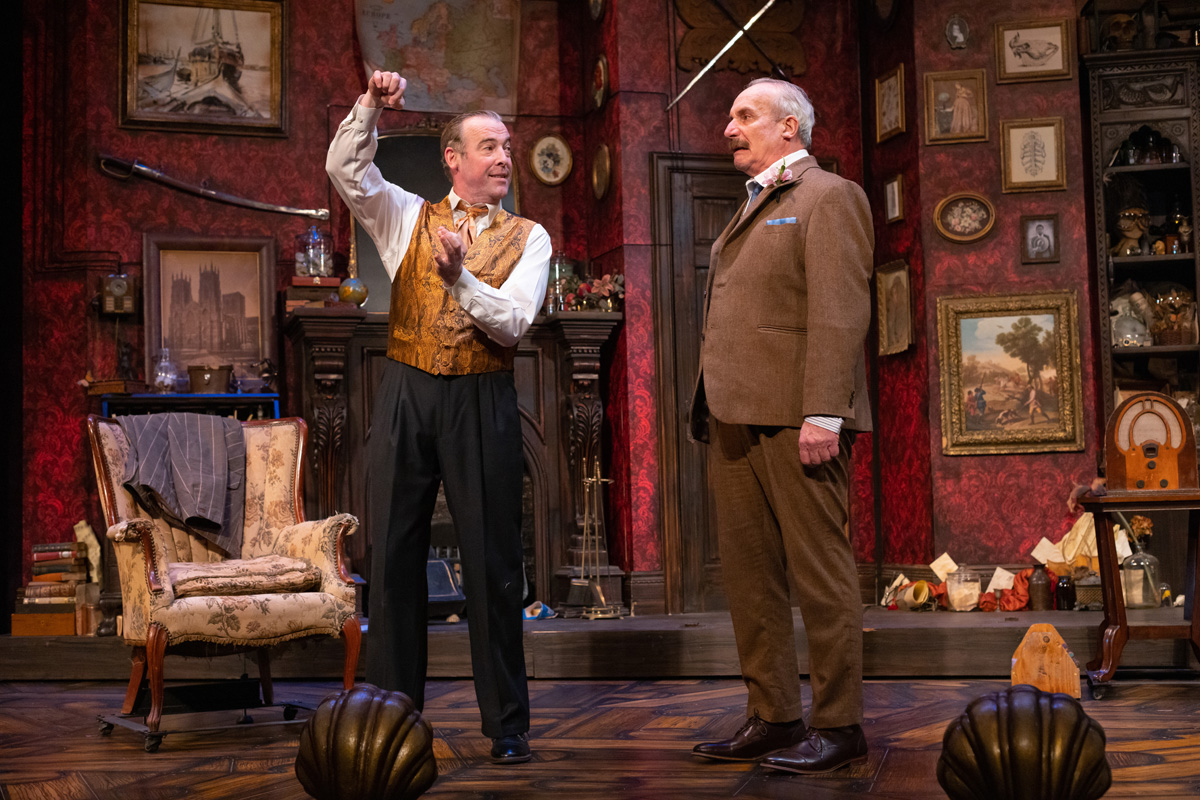
            Two finely dressed, elderly English gentleman sit in a garden, recalling their lives. They talk about their childhood, about roles in the military, about their marriages. Jack, the more talkative and opinionated one, rambles on and on while Harry responds with brief responses-  “really, ah yes, my word, indeed.”

            After about twenty minutes, the men walk off and the chairs are occupied by two  women, Kathleen and Marjorie. While they are sharing stories, we realize we are not in the backyard of someone’s estate, but in a home for the mentally challenged, what they used to call an asylum. We listen to the caustic Marjorie’s negative assault on everyone and everything, and we watch as Kathleen reveals her flirtatious, even possibly promiscuous side. We are not sure if what we are hearing are facts or delusions because none of the four characters displays any obvious signs of a failing memory or dementia itself.

            “Home,” by David Storey, which opened in London before it came to New York almost 50 years ago, presents these four seemingly normal people. But are they? One women bickers about everything and appears ready to pick a fight with anyone who disagrees with her. The second seems to be hoping to have just one more romance, one more liaison with a man. One of the men is struggling with where life has taken him, about the separation from his wife, clearly not of his own choice. And the other hides his personal distress by going on and on about the most trivial of topics.

            These are four real people behaving as people do, talking and talking and talking. They are as interesting and as boring as anyone else. They each have their little demons that haunt their inner thoughts. And they are all at this institution which provides a home for thousands, for different purposes. There’s almost a touch of the Theater of the Absurd, though the tragic and comic are kept tightly under wraps.

            Storey deliberately chooses not to tell us why they are there. Did they check in on their own? Were they committed by a friend or by a court? Are they a threat to others or to themselves?

            It is not a grand story on the scope of the classic film “Rashomon,” which tells a single story from the perspective of many characters. “Home,” on the other hand, is a series of small stories, just as everyone has many small stories. Is what they are saying true? They believe it. They believe it as much as they each have their own opinion of whether or not it will rain. They believe it in the same way they believe the varied stories they’ve created about the other residents of the home that they see in the distance.

            There is a fifth character, Alfred, in whose first entrance, we see wrestling with one of the iron chairs. He is the only one who is clearly mentally challenged. They say he was a wrestler who suffered a head injury and had a piece of his brain removed. But who knows if that is true? Who knows if anything said in that garden is true?

            The original cast included Sir John Gielgud and Ralph Richardson, two of Britain’s greatest stage actors. Director Robert Bauer has cast Frederick Andersen and Russ Walsh. Though this is not a “professional” show with equity actors, I cannot imagine any Philadelphia actor doing a finer job. Along with Susan Giddings and Carole Mancini, the production is seductively powerful. Bauer has put his actors in this awkward and confusing netherworld with grace and skill. It’s a must see, particularly for the over 55 crowd, who have experienced similar stories with parents and even with friends.

“Home” at The Drama Group performed at the First United Methodist Church of Germantown, 6001 Germantown Ave., Phila., PA 19144       http://www.thedramagroup.org/contact.shtml Thru Nov. 30, 2019