Birthday Candles at People’s Light

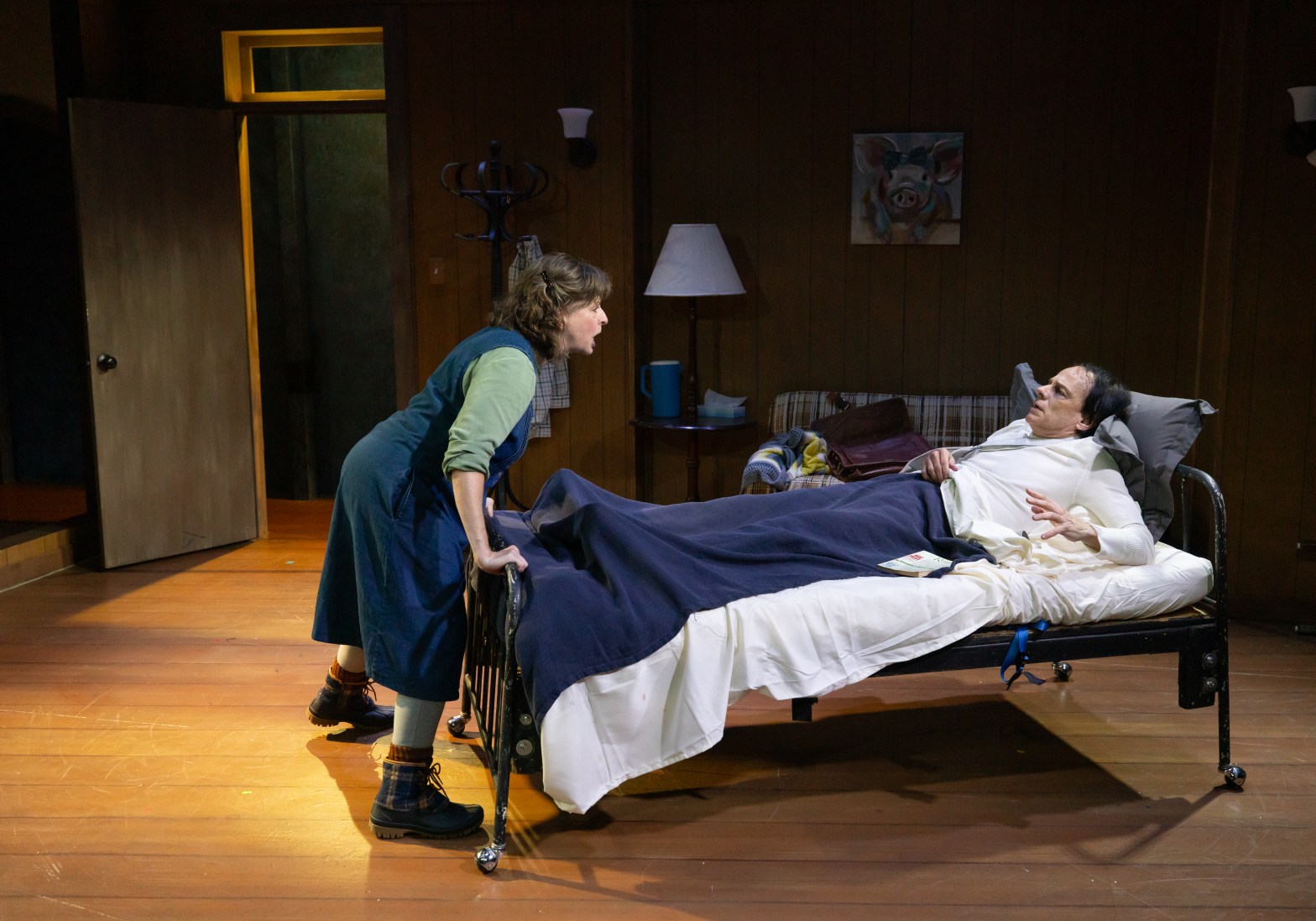
            Ernestine Ashworth celebrates her birthday with a birthday cake every year, from the time she was 17 until the age of 101, though the actress never physically ages. In 90 minutes on stage in her kitchen, we see her life in about two dozen brief scenes as she interacts with her mother, her husband, children and grandchildren in one of the most powerful, yet subtle explorations of a woman’s life. People’s Light is presenting this extraordinary journey by playwright Noah Haidle.

            It begins with 17-year-old Ernestine (Teri Lamm) arguing with her mother about how she doesn’t want to be typical- she wants much more out of life. She wants to find a special place in the universe for herself.

            We watch her deal with adolescence, with a spouse, with kids, and with life and death. They are the problems we all face, and they change as we change. Will she or the other characters in this smart play ever fulfill their hopes and dreams?

            What appears to be a comedy as kids deal with parents and vice versa, we soon realize that the comedy of life is also the tragedy of it. What or whom can we count on? Perhaps life is nothing more than the goldfish, with a 3-second memory that was a gift to Ernestine and which she replaces regularly throughout the play.

            Another thing that strangely binds some of the women as they deal with the stress of relationships is nail polish. But the big uniter is the birthday cake which Ernestine prepares every year as her growing and aging family comes to celebrate with her.

            The younger generation criticizes the older generation until they became the elders and get criticized by their kids. Mental illness, divorce, finding careers, and death are always problems that confront Ernestine. Has she fulfilled her destiny and realized her hopes and dreams? Have any of us?

Some scenes are 6 or 7 minutes- others are less than a minute. But time continues to pass, and relationships change as new children are born, age, and become part of the fabric of this family’s tale.

            In addition to her family over the years, there is also Kenneth, Ernestine’s awkward neighbor who has a crush on her.  Many of the actors who play these roles effectively double and triple as their descendants without a significant change of costume! It is a remarkable piece of theater to see so much life compressed into an hour and a half.

            Director Abigail Adams has done an extraordinary job in bringing what can be most complicated and confusing stories to the audience in such an effective and interesting way with this wonderful ensemble. I would be remiss if I didn’t mention each one- Claire Inie-Richards, Kevin Bergen, Ian Merrill Peakes, Jacob Orr, Juliana Zinkel, and of course, Teri Lamm.  They were all great! It’s a unique piece of theater, and I loved it.

Birthday Candles” by Noah Haidle at People’s Light, 39 Conestoga Rd., Malvern, PA 19355, 610-644-3500, peopleslight.org   Thru May 4, 2025

Dial M for Murder at Act II Playhouse

Though “Dial M for Murder” was written as a stage play in Britain in 1952, most people know it from the 1954 film directed by Alfred Hitchcock with Grace Kelly and Ray Milland. It is a most powerful crime thriller dealing with blackmail, infidelity, and a murder plan. With a new twist by Jeffrey Hatcher to Frederick Knott’s original play, it has experienced a revival in the past few years, and Act II Playhouse has brought it to its stage this Spring. What a scary and exciting adventure it is with their five extraordinary actors!

Tony Wendice suspects his wife, Margot (Anna Marie Sell) has been cheating on him and develops a plot to have her killed and inherit her fortune (which is why he married her in the first place). Her former lover has recently arrived from America, and Tony wonders if Margot still loves the woman (In the original, it was a man but that is insignificant- it’s about cheating, not gender). He had previously discovered in his wife’s bag, a serious love letter from the ex-lover, Maxine Hadley (Jessica Delacanton). It was stolen and Margot got a letter demanding a large ransom for the return of the letter.

In a seeming side story, Tony (Jamison Foreman) has called a man in order to buy an auto. When he arrives at Tony’s home, we soon see that Tony knows a lot about the man, Lesgate (Mark Swift), and tries to force him to murder Margot.  

It is an involved plot that depends upon the relationships but also about the keys to the home, the telephone, fingerprints, lying, and alibis. And it is not merely talking about these things- we are mesmerized as we watch the movements of Tony as he devises the plot and its aftermath.

We study the faces of all as we try to figure out what they are thinking and what will happen next. There are so many twists and turns in the one room where it all takes place. Needless to say, things go wrong.

 I enjoyed every moment of the story- every twist. In the second act, we meet Inspector Hubbard (Paul L. Nolan), who tries to unravel the growing mystery. Even if you are not a devotee of this genre, you will be entranced. That’s because of the fine direction of Kate Brennan and her extraordinary cast that kept it so real! They didn’t try to play it in an over-the-top fashion like many theaters do today.

There is so much more to the story, but I dare not reveal more lest I be a spoiler. See it for yourself and watch this classic story, made famous by the Alfred Hitchcock film, come to life at Act II Playhouse.

“Dial M for Murder” adapted by Jeffrey Hatcher from the original by Frederick Knott at Act II Playhouse, 56 E. Butler Avenue., Ambler, PA 19002, 215-654-0200,   act2.org   thru April 27, 2025

Antony & Cleopatra at Quintessence Theatre

William Shakespeare had written 38 plays when he died at the age of 52 in 1616. My first exposure to him was when we read “Julius Caesar in my 9th grade class. It was a challenge to read as it was written in Early Modern English, also known as Elizabethan English, which lasted until the mid-18th century. When I go to see a play by a French or Russian playwright, I see a translated version. But alas, when I go to see one by The Bard of

Avon, I must do the translating in my head as I watch the performance.

            Of the many plays by Shakespeare, I was most familiar with Hamlet, MacBeth, and Julius Caesar. Growing up in Queens, New York, I often went to free performances of Shakespeare in Central Park. I even took a course in Shakespeare in college. (I got a B). But alas, that was a very long time ago. The only thing I knew about Antony and Cleopatra is what I got when I saw the film with Elizabeth Taylor and Richard Burton in the early 1960’s. As a result, I was most curious to see the production of “Antony & Cleopatra.”

            This play is being performed in repertory with “A Midsummer Night’s Dream” at Quintessence Theatre. But while I was entranced by “Midsummer,” I found “Antony & Cleopatra,” performed by the same twelve actors, unsatisfying for many reasons.

            Shakespeare’s play is about the political maneuverings of the triumvirate running the Roman empire after the death of Julius Caesar. His great nephew Octavius Caesar, Lepidus, and Mark Antony share power. There are alliances, wars, and outright murders. And then there is the love affair between Antony and Cleopatra, which greatly effects those alliances. The stories are there- the deliveries are not.

            All the information we get about what is going on comes by way of lengthy monologues or dialogues that are challenging to follow. Talk, talk, talk without much action in the first hour and a half act. And with the challenging Elizabethan English, I found that when I missed a few lines in a row, I drifted away from the play until something happened- unfortunately not often enough. The problem was less about the words then about the way the actors spit them out. I saw a few people sleeping in the audience.

            There was little nuance. Actors just ranted on and on. I didn’t feel the chemistry between Antony and Cleopatra, essential to the play. I was most disappointed. Were they really in love? Was she a seductress? You’ll never know from this production. Director Alex Burns, who so effectively directed “Midsummer,” let the actors drone on and on. And ironically, Lee Thomas Coropassi, who was so great in “Midsummer” as Puck, was anunconvincing Octavius. I also found it difficult to follow the changing characters playing several roles, as they did not create separate personae for those characters.

            William Shakespeare has explored so many powerful and meaningful themes in his many plays. But a really good production of those the plays requires much more than actors just spouting them out as if they were holy. It is an effort to watch it for three hours.

“Antony & Cleopatra” by William Shakespeare at Quintessence Theatre, 7137 Germantown Ave., Philadelphia, PA 19119, 215-987-4450, quintessencetheatre.org   in repertory with “A Midsummer Night’s Dream” Thru April 27, 2025

A Midsummer Night’s Dream at Quintessence Theatre

            Quintessence Theatre is bringing two Shakespeare plays with the same cast to run in tandem for March and April.  “Antony and Cleopatra” will open this Saturday, a week after “A Midsummer Night’s Dream,” one of the bard’s most popular. “Midsummer” is a comedy set in Athens with several intertwined stories about love. But there is also magic and confusion that envelopes the characters as a magic potion effects the lovers’ choices.

            Duke Theseus is going to marry Queen Hippolyta in a few days. At the same time, one of his noblemen, Egeus, has come to the duke to complain that his daughter, Hermia, is resisting her father’s demands to marry Demetrius because she is in love with Lysander. The rules of the day are that she must adhere to her father’s choice or be put to death.

            Then there is Helena, Hermia’s best friend, who is in love with Demetrius and planned to marry him before he left her for Hermia. These tales make up the main story of “Midsummer.” But there are two other stories that are happening at the same time.

The second story brings us to a forest of fairies who have their own problems and secretly engage with the young lovers. King Oberon and Queen Titania are at odds with each other while they observe what is going on in Athens with Hermia, Helena, Lysander, and Demetrius. The king employs his sprite, Puck, to find a potion to put in the eyes of the lovers that will change their desires. He also decides to put it in the eyes of his queen. Unfortunately, the knavish Puck makes mistakes and chaos ensues.

There is also the preparation for the wedding, for which Peter Quince has gathered “The Mechanicals” to perform the play, “Pyramus and Thisbe” on the wedding day. That play is about young lovers and family feuds and mistakes that lead to deaths. At the rehearsals, Quince must deal with the over-inflated ego of Nick Bottom, who wants to play many roles.

It is a joy to watch so many fine actors enact the stories so realistically. Under the fine direction of Alex Burns, each one powerfully reveals his or her emotions with a look or a movement that tells us a story. My favorite was Puck (Lee Thomas Cortopassi), who when not creating mischief, watches the events unfold, and we watch him as much as we watch the scene itself. But the truth is, I’d have to name each member of the cast for the quality that he/she brings to the many characters.

Twelve actors portray the twenty roles with beautiful costumes which they must change rapidly as the play moves back and forth among the alternating scenes. It is a visual treat- so much so that it alone takes us into the play. But it is also challenging. Having reviewed a Shakespeare play last month at Lantern Theatre, I am reminded how difficult it is for the modern audience to “translate” Shakespearian English into today’s English. Once again, I advise anyone going to see a Shakespeare play to read a summary beforehand.

My main criticism is not with the production but with the program, which was a program for both this play and for “Antony & Cleopatra.” It was all about “Antony & Cleopatra.”I wanted more, including the names of the actors playing multi-roles with their pictures beside it as opposed to on the first page. And though I know that in Shakespearian England, that all the roles were played by men, I was confused by the choice to portray some women as men but not all. And I wish I’d realized earlier in the play that Oberon, the king, was the woman, and Titania, his queen was portrayed by a man.

But the bottom line for this production of “A Midsummer Night’s Dream” is that it was funny, it was clever, it was visually stimulating, and it was mostly accessible. And we are reminded by one immortal line of Puck- “What fools these mortals be.” How many plays of today will still be meaningful in 400 years?

“A Midsummer Night’s Dream” by William Shakespeare at Quintessence Theatre, 7137 Germantown Ave., Philadelphia, PA 19119, 215-987-4450, quintessencetheatre.org   in repertory with “Antony & Cleopatra” ”Thru April 27, 2025

**** Quintessence has since expanded its original program with four pages about “A Midsummer Night’s Dream.” I saw this when I attended “Antony & Cleopatra.”

KOAL at theatre exile

“Philly GRIT” is a series of what they call “unfiltered performances by Philadelphia based artists.” Theatre exile began the series last year and this Spring, they are presenting   two plays.  I saw the 70-minute play, “KOAL.” It was a theater experience like none  I’ve had  in years.

            On the stage at the start of the play is a rather abstract, tent-like structure, made of brown paper and fabric supported by two ladders. A woman emerges from it, and we are not sure who or what she is. In short order, she dons a ranger’s cap and becomes another character in this quirky play. In time, actress Jacinta Yolland will also portray a coal miner and a Koala. We also see the structure on stage which will come represent a eucalyptus tree, the inside of the coal mine, and a boulder… And then we see smoke.

            In 2019, wildfires raged across large portions of Australia. That is where “KOAL” takes place. How will the people and the animals stay safe? The ranger vows to protect the animals, including his favorite, the koala, who is scampering about, afraid. Everyone is afraid. One is an indigenous young woman who doesn’t know where to go either. As for the coal miner, he is trapped inside a mine that is collapsing.

            It is December, summer in the southern hemisphere, and it is a hot summer. When fires do break out, they spread rapidly because the leaves and bark of eucalyptus trees are extremely flammable- these trees, poisonous to people, are the basic food of the koala.

            All this is presented by the amazing actor, Jacinta Yelland. She is mesmerizing as we watch her trapped in the cave and scooting around as koala. I was disappointed when the stage went dark, because I couldn’t see her when she was moving about. And I also couldn’t see the revealing looks on her most expressive face. On top of all that is happening, she still brings the comic moments to the stage as she interacts with the audience. We even get a brief talk about the development of the earth’s surface, which may now be destroyed by the lack of climate control.

            It was a bit challenging to follow the different threads of the story and I wish the indigenous girls’ story was more accessible. Nevertheless, I understood her terror.

This one-woman show was written by Yelland, who was born in Australia and came to the United States and Philadelphia to study theater. Here, she met Trey Lyford, with whom she further developed the play and who directed it. What a talented pair! I have friends who would love this show and others that wouldn’t. But that is theater. I really enjoyed seeing it with my son for a younger perspective.

Note: This show is alternating with another play and is only there for a week and a half. There are three more performances of “KOAL.” Check their website for the dates.

“KOAL” by Jacinta Yelland at Theatre Exile, 1340 S. 13th St., Philadelphia, PA 19147, 215-218-4022,  boxoffice@theatreexile.org   Thru March 8, 2025

A Raisin in the Sun at People’s Light

The play, “A Raisin in the Sun,” got its title from a line in a short Langston Hughes 1951 poem. It begins “What happens to a dream deferred? Does it dry up like a raisin in the sun?” Six years later, at the age of 27, Lorraine Hansberry wrote the now classic play. It opened on Broadway two years later. It has opened again with a very strong cast in a People’s Light’s production. Incredibly sensitive and powerful, it takes place in the 2-bedroom apartment of a Black family in their South Side Chicago apartment in the 1950’s.

            In this space live the grandmother Lena, Waiter (her son), Ruth (Walter’s wife), Travis (her 10-year-old grandson), and Beneatha (her grown daughter). They eke out a living with the low-paying jobs they can get, each with a dream, but little hope of fulfilling that dream. They don’t have the money to get out of where they are until… until now. Lena’s husband has recently died and there is a ten-thousand-dollar life insurance check that will soon arrive.

            Walter would like money to open a liquor store. Benethea plans to go to medical school which she hopes Lena will pay for. And Lena herself would like to buy a home of their own that will have more space and three bedrooms. They have dreams which money CAN buy.

            And then there are other issues like Walter’s drinking. There is Ruth, trying to balance the struggles of everyone’s needs while worrying about finances. There is Lena’s devout religious belief and her daughter Beneatha’s dismissal of religion. She is being courted by George, a man who has money and has assimilated into white society, who she finds shallow and indicates to her family that she has no use for him. The other man, who has recently entered her life, is Joseph, a student from Nigeria, who reminds her of her African heritage. What is a Black person in mid-century America?

There is so much more to the stories that evolve, but they are just a part of the play. What I enjoyed the most was the force behind each character that Hansberry has created, and that Director Steve H. Broadnax III has brought to the stage. We don’t want to miss a word in the rapid movement of the story. We don’t want to miss an expression on these faces. Can any of them come close to getting what they desire? How much will they sell themselves to achieve their goals in the face of the flagrant racism of the day?

            My only problem with the production was the set. Instead of a small, crowded apartment, the stage at People’s Light was large and bright and uncluttered. But that was minor.

            Five years after the play got to Bradway, the first by a Black woman, the theater world lost its brilliant playwright, Lorraine Hansberry to pancreatic cancer. But her work lives on in this modern classic. People’s Light does her honor with this outstanding production.

“A Raisin in the Sun” by Lorraine Hansberry at People’s Light, 39 Conestoga Rd., Malvern, PA 19355, 610-644-3500, peopleslight.org   Thru March 30, 2025

Much Ado About Nothing at Lantern Theater Company

William Shakespeare wrote the romantic comedy, “Much Ado About Nothing” over 400 years ago. Since then, it has played around the world and in the 20th century alone, has won numerous awards with some of the most famous actors portraying the roles. Originally written in five short acts, contemporary theaters have been presenting it in two longer acts. And let me say from the start, it’s not about nothing- it’s much ado about relationships and connections, about deception and truth.

            The essence of the story is the love or lack of love between Claudio (Trevor William Fayle) and Hero (Cheyenne Parks) and between Beatrice (Karen Peakes) and Benedick (J Hernandez). An insurrection by Don John, the half-brother, of the prince, has just been squashed and there is joy in the land as one of the returning heroes, Claudio, seeks to court and marry the daughter of Governor Leonato. He is encouraged by Leonato and while Claudio is shy, the prince, Don Pedro, will secretly propose for him at a masked ball.

Don Pedro also vows that his friend Benedick, will be the next target for setting up a marriage- Benedick is determined never to marry. Leonato’s niece, Beatrice, also doesn’t seek a marriage and is always verbally sparring with Benedick. With the help of others, Don Pedro fabricates stories while Beatrice and Benedick are within earshot and believe them. It’s most entertaining for us.

While many overhear the staged scenes meant to encourage marriage, the angry bastard brother, Don John (Jered McLenigan who also plays Don Pedro) has heard of the impending marriage and tries to foil it by staging an infidelity scene around Hero. Some believe what they saw while others do not,

Will Hero survive the false accusation? Will Beatrice and Benedick succumb to the trickery and get together? The themes are timeless, though there are a few caricatures, it is, after all, a comedy. However, Director Charles McMahon could do with a little more nuance. The other suggestion I have for him is to slow down the very fast-talking conversations that are hard to absorb and challenging to understand at times.

            The most difficult part of the play for me was the language I was often struggling to understand some of what was going on on the stage as I was translating Shakespearian English to modern English in my head. When I read his plays in high school and college, I always bought an edition that had side-by-side old and modern versions. I highly recommend reading a summary of the play beforehand, both to get the meaning and to recognize some of the characters since there is double casting.  With such a large cast, it requires double casting  to  make it affordable to  mount such a production.. Hernandez and Peakes were outstanding as Benedick and Beatrice. In fact, the entire ensemble was great.

There is one more facet to the play- that is the comic relief provided by Tony Lawton as Dogberry. Some of it was written by Shakespeare but the Bard of Avon encouraged productions to allow the actor portraying Dogberry to improvise. Lawton is great!

It’s a good production, but remember, if you don’t know the story, read a summary of it first before seeing it.

“Much Ado About Nothing” by William Shakespeare at Lantern Theater Company at St. Stephen’s Theater, 923 Ludlow St., Philadelphia, PA 19107. 215-829-0399   lanterntheater.org   thru March 16, 2025

Quixotic Professor Qiu at InterAct Theatre Company

            Before going to a play, we all do a little research to see if it deals with subjects and themes that we like. After all, a theater ticket is expensive. I am privileged to review plays, so I don’t usually know what to expect. In the case of InterAct Theatre, I am always excited to see what they are presenting, often a world or area premier.  Artistic Director Seth Rozin has selected and put on the stage so many brilliant works. With their current show, “Quixotic Professor Qiu,” I did read their press release and looked forward to seeing this unusual play on stage. Though it got off to a promising beginning, with an interesting theme, the play didn’t deliver., not because of the acting but because of the weak, talkie script that is rather confusing and without enough substance.

            Apparently Chinese-American scientists were being targeted for espionage and that inspired playwright Damon Chua to create a story of a math professor who is being scrutinized by the FBI and by his own colleagues because he is Chinese.

            Professor Qiu (Justin Jain) is an intelligent math professor and researcher in the United States. Though born in China, he has been in America since he was a child. His only connection to China is his childhood friend, Anna Zeng (Bi Jean Ngo). But he did get a grant that financed about 10% of his research from a Chinese company.  Fascinated by numbers, Qiu developed an obsession as he explored different patterns based on the seemingly infinite quantity of prime numbers.

He is soon referred to as the quixotic professor, a term I had to look up even though I knew of the tales of Don Quixote. It can mean easily sidetracked or unpredictable. It can mean crazy or foolish. Qiu is none of these. He’s just consumed by his fascination with prime numbers…. But he was born in China, even though he is thoroughly American. As a result of receiving money from the Chinese company, he is being investigated by the FBI for non-disclosure of his research which he insists is already in the public domain. It seems that one of his heroes wound up in prison for some sort of economic espionage. The FBI agent is relentless, though rather stereotypical.

            What has the potential for making the story interesting are the two women in his life. One is Valeria (Madeleine Garcia), a fellow professor who flirts with him at the beginning. The other is Anna, the childhood friend whom he visits when he returns to China every summer before he goes to college. Children of parents who weren’t allowed to have more than one child according to the Chinese government, they are like brother and sister. This gets misinterpreted by the FBI and by Valeria. There is so much story potential, but playwright Chua doesn’t create the depth of his female characters. He doesn’t tell us why Anna rejects him. As for his fellow professor, Valeria, she’s turned into a rather shallow person. The press release states that Professor Qiu is forced to choose between his birth identity and his adopted land. I didn’t get that from the play. It’s an old theme- the persecution of an individual because of his or her ethnicity, color, religion, or gender. It needs more than the same old cliches.

            I never thought I’d write a review requesting that a play be longer. As is, it is an hour and forty-five minutes with an intermission. But Chua needs to develop these characters and to give more depth to his quixotic professor as well as making it more accessible in order to create a powerful presentation of an important story.

“Quixotic Professor Qiu”” by Damoon Chua at InterAct Theatre Company at The Drake, 302 S. Hicks St., Philadelphia, PA 19102, 215-568-8079 interacttheatre.org  Thru February 23, 2025

Grace & Glorie at Act II Playhouse

            “Grace and Glorie” is a play by Tom Ziegler that debuted in 1991. It is about a 90-year-old woman, with cancer who has checked herself out of the hospital and has gone home to die alone in her cottage in the Blue Ridge Mountains. Soon, Gloria, a volunteer hospice worker, with her own issues, arrives from New York. This is their story. When it played off-Broadway, it featured Estelle Parsons and Lucy Arnaz. Now, it is playing at Act II Playhouse in Ambler, featuring the multi-talented Penelope Reed as Grace. I can’t imagine anyone better in this poignant and powerful story, laced with humor throughout.

            How does one create a comedy about dying of cancer? How does one make surviving the deaths of a woman’s five children over a lifetime, bearable? How can a New Yorker with a graduate degree appeal to an old woman in the hills of Virginia who can’t even read? Ziegler has done it all, and Director Patricia G. Sabato has masterfully put it together for us all to enjoy.

            It is 1990,.and Grace Stiles (Penelope Reed) is in bed in the cottage, down from the main house. Her family once owned all those hundreds of acres with apple orchards and chickens and crops, but she had been pressured to sell. She cannot fathom that hospice worker, Gloria Whitmore (Genevieve Perrier), volunteers to help people die. She doesn’t want any help, and she makes that clear- repeatedly. Although she hasn’t been in a church for decades, she still believes in God, something that Glorie (that’s what Grace calls her) has let go of. In time, we learn of Glorie’s story and why she and her husband moved to Virginia, a sad tale.

Grace hasn’t been out of bed since she got home, and she desperately needs to pee. Glorie insists she use the soup tureen, a piece left by Grace’s mother-in-law, who she hated. While she gives in then, she won’t give in by taking morphine to ease her pain. And so begins their days together as the women get to know each other and their limits. From squawking chickens to rats, to the foods they eat,, to the noisy bull dozers outside that are clearing the land, Grace is constantly in Glorie’s face.

What is the best way to die? We even wonder at one point if Glorie also wants to die. Perrier as Gloire,is outstanding in portraying the foil for the outrageous Grace. And I learned that after stage managing for 28 years (13 at Act II), this is Sabato’s directorial debut. What an outstanding job she and the others have done in putting together this classic!

“Grace & Glorie”  by Tom Zeigler” at Act II Playhouse, 56 E. Butler Avenue., Ambler, PA 19002, 215-654-0200,   act2.org   thru March 2, 2025

The Drag at Ego Po Theater

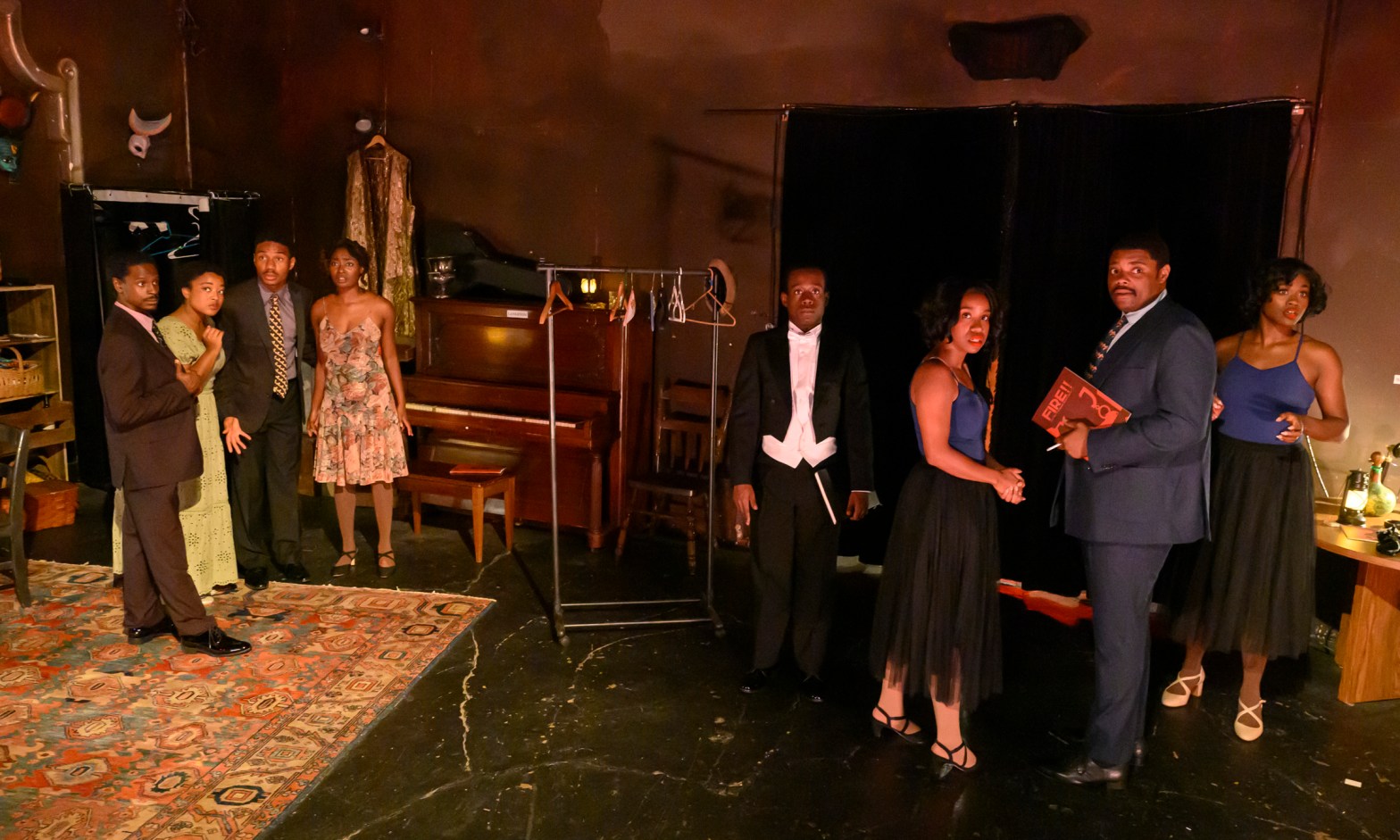
            Mae West, a singer, actress, comedian, and writer, was known more to the public as a sex symbol and free thinker for most of the first half of the 20th century, though she lived until 1980 and continued to write. In 1926, she wrote, produced, directed, and starred in the play, “Sex.” Though it was a box office success, the theater was raided, and she was arrested for corrupting the morals of youth. Her next play, “The Drag,” previewed outside New York but never opened in the city because it was about homosexuality and cross-dressing. She had developed it with her many gay friends as she tried to express the struggles and anxiety felt by a homosexual in America in the 1920’s. Ego Po has brought the play to the Philadelphia stage 98 years later. It is the core of West’s play surrounded by contemporary talk by the actors portraying the roles. West encouraged additions and ad   -libbimg in her play. Ego Po’s production has been reworked by Thomas Choinacky and A Z Espinoza.

            Twelve actors make up this incredibly talented cast. There are men playing women and women playing men. They are of different races. They are gay and/or cross dressers. It doesn’t make a difference what they are- they are human beings who have the same issues as everyone, but those issues are compounded by their “differences” according to the mainstream. In fact, this season, Ego Po Theater, after dedicating seasons to Crossing Oceans and the Harlem Renaissance, has named its 2024-25 season, “Queer Revolutions.”

            There are tons of jokes that the characters crack about themselves and about each other, but there is also a doctor who believes that homosexuality can be “cured” with conversion therapy. There are men, married to women who are both unhappy because these men want to be with men. They struggle to be who they are, though they must hide it to avoid the rampant discrimination that existed. As one says, “I have done nothing wrong.” The term pansy is thrown about- but then we are reminded that besides it being a derogatory reference to gay folks, it is also one of the most resilient flowers.

            The costumes by Ilycia Boatwright-Buffaloe are worth the price of admission alone. They are so creative whether it be a simple mustache or smoke from a cigarette to exotic, flamboyant outfits. The range of masculinity and femininity is broad and real. The twelve performers play over twenty roles effectively. While some were stronger than other, it doesn’’t undermine the spirit of what is happening on stage.

            West’s original play comprised of three short acts. My main beef with this production was that it consisted of an hour and forty-five minutes without an act break. I needed a break, both to absorb what I saw and to talk with my friend who accompanied me about the story. I needed some clarification about who wanted what and who wanted whom. Also, at times, the clever humor disintegrates into silly jokes. Nevertheless, Ego Po has given us a unique look at an important play by a most iconic figure.

“The Drag” by Mae West with additions by Thomas Choinacky and A Z Espinoza at Ego Po Theater, being performed at Christ Church Neighborhood House, 20 N. American House, Philadelphia, PA 19106, 267-273-1414, www.egopo.org   Thru February 9, 2025