Walden at InterAct Theatre

“Walden” is a book by Henry David Thoreau, published in 1854. It’s about Thoreau’s reflecting on the simple living he enjoyed for two years while he lived in a little cabin beside Walden Pond in Massachusetts. In it, he examines the things about the society in which he lived, including individualism and nature, with self-reliance also in the forefront of his mind. It has become a symbol for retreat and reflection.

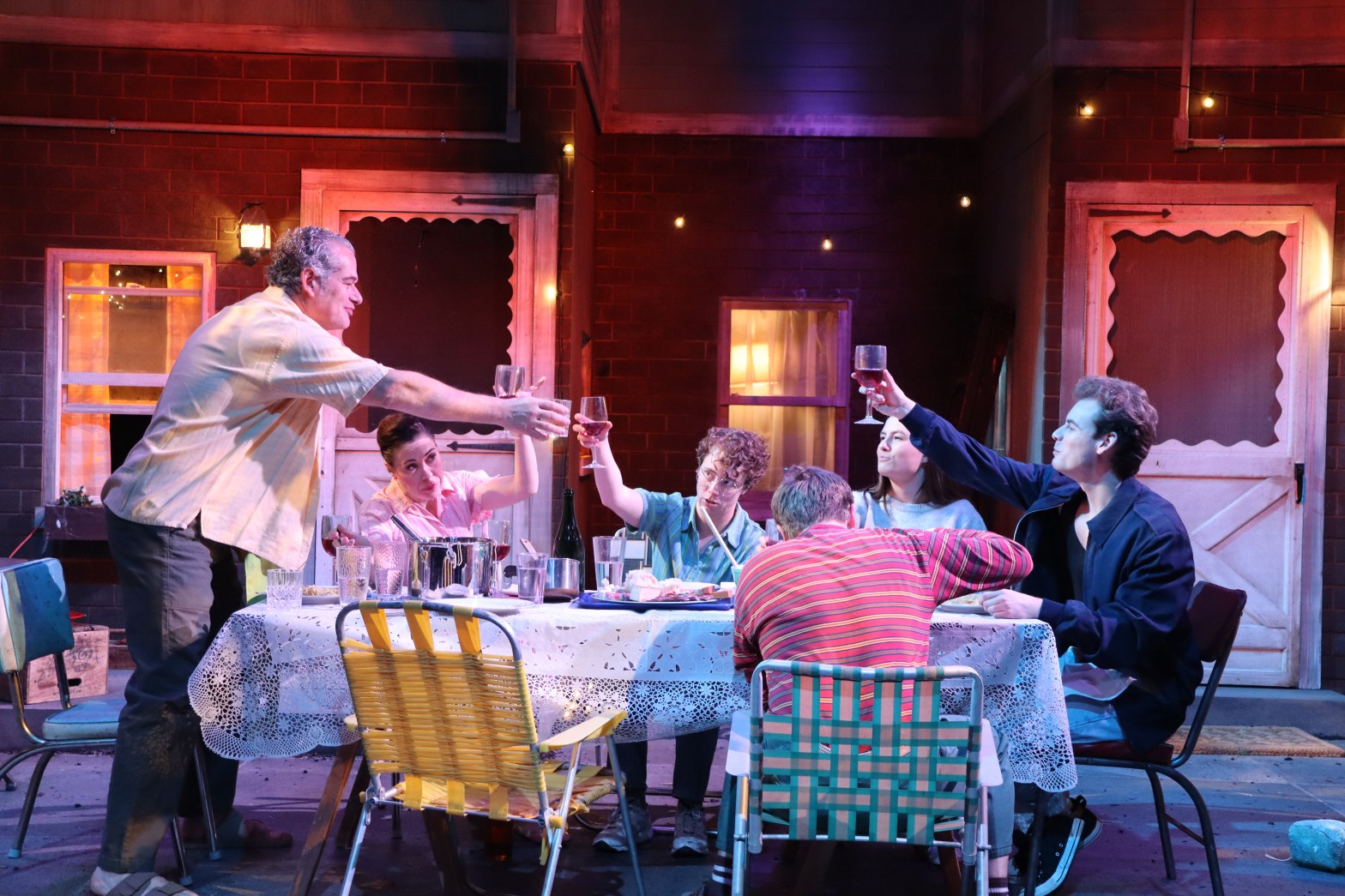
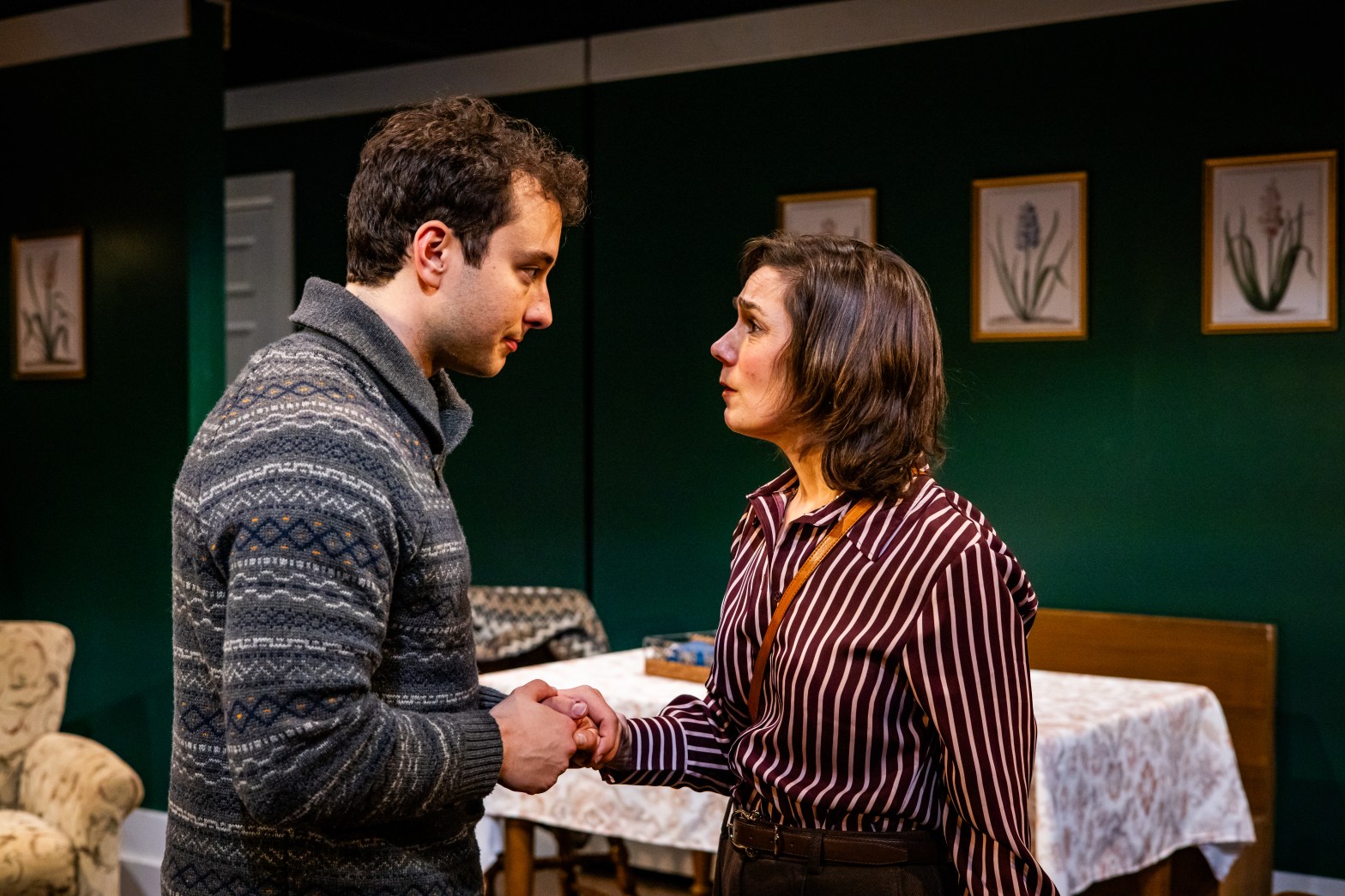
            This “Walden,” by Amy Berryman, making its Philadelphia premiere at InterAct Theatre, also takes place at a remote cabin in the woods, It is a few years in the future and the very planet Earth is in danger. A tsunami has just killed a million people while hot climates and pollution are threatening lives everywhere- except in places like this cabin in the woods and in other remote places where the air is still good. That’s where Stella (Alice Yorke) has been living with her lover, Bryan (Newton Buchanan) for the past year, living a most natural life.

Stella had worked for NASA along with her twin sister, Cassie (Campbell O’Hare), a botanist, for eight years, both hoping to follow in their astronaut father’s footsteps and become astronauts themselves. She was even in a relationship with one of her NASA coworkers until she was told that she would not be selected to go into space and left the program while her sister was selected to go to the moon for a year to find if she could grow food there. After not communicating for a year, Stella has invited her sister to their cabin.

            There are two things that follow which create the core of Amy Berryman’s play. The obvious one is the future of the world. Should exploring places like the moon and the planet Mars be a priority for government spending or should the money be used to improve life on Earth as Bryan believes? Cassie is scheduled to begin training for her flight to Mars with 20 others (on the previous journey to the planet, all the astronauts perished) to create a world there for people to eventually migrate to before the Earth disintegrates. Stella, on the other hand, is committed to life with her partner Brian, who she met in a group therapy.  He is an Earth Advocate (EA) who seeks to live without the benefits of modern technology including electricity and modern plumbing. They are in love. And though the sisters love each other, they are constantly bickering.

            This finely crafted play about the Earth is so much more as it delves into the lives of the twins. How will the sisters reconcile? Will Stella succumb to Cassie’s urging that she leave Brian and return to the space program? Will Cassie try to control Stella’s decisions? But most of all, is either sister truly happy or have they just succumbed to the idea that they have some destiny that must be fulfilled? What is destiny anyway? So much struggle within the souls of each.

            All three actors were so passionately real in presenting this profound drama. And Director Seth Rozin has done a superb job in bringing this unusual play to the InterAct stage.

As for why the play is called Walden, we learn that it was their father’s favorite book. And when Stella was working at NASA as an architect, she named the resettlement plan she had devised for the colonization of other planets, Walden.

            While on the surface, the play deals with the decision to create a place in space to flee to, there is so much sub story, filled with ambivalence, questions, and family relationships in this powerful play.

“Walden”” by Amy Berryman at InterAct Theatre Company at The Drake, 302 S. Hicks St., Philadelphia, PA 19102, 215-568-8079 interacttheatre.org  Thru November 23, 2025

Macbeth at Lantern Theater

“Double, double toil and trouble. Fire burn, and cauldron bubble.” That’s what I remember from when I read William Shakespeare’s “Macbeth” when I was in college a million years ago. It was a prophecy by the three witches while they stirred a potion that was brewing in a cauldron. They had previously prophesied that Macbeth would replace Duncan as the King of Scotland. I got a refresher of the play last year when Quintessence did a production of “Macbeth.”

            Macbeth learns from the king that he has just become the new Thane (duke) of Cawdor- one of the prophesies-and tells Lady Macbeth, his wife of the other prophecy, that he will become king of Scotland. She immediately tells him that he must kill those who are in his way, to ascend being king. How ambitious is he? Would Macbeth have acted without his wife’s prodding? Would Adam have eaten the apple without Eve’s offering it to him? Who is he really? He murders King Duncan (offstage) and Lady Macbeth is thrilled.

During the first half of the play, there is only talk of the political situation and of the many intrigues until the final scene when Macbeth kills his friend, Banquo, on stage. For me, it was too long to sit and listen to words, even profound ones, with no action. Even the three witches were not dynamic and their costumes not interesting. (The men in the play did wear handsome kilts). On top of that, nine actors portrayed some 30 different roles, and I was often confused which character they were playing, particularly when they were playing the children of the nobles.

             The second half of the play was a bit easier to follow, though I still got lost in some of the longer monologues. And I always perked up when I heard some of the classic lines- “Fair is foul and foul is fair, Out damned spot!, Tomorrow, and tomorrow, and tomorrow,”

            The original play consisted of 5 acts and usually ran over four hours. Lantern’s production of two hours and ten-minutes felt as long. William Shakespeare is considered the best playwright in the English language. I don’t know if he included stage directions for the director. I needed more feeling, more nuance, and as I said before, more action. They could have staged a more interesting movement of the forest (Macbeth felt safe since there was no way the forest was going to move and thereby undermine his position as king.) I don’t think director Charles McMahon got enough from his actors to engage the audience as much as possible. And his cast was first rate, with the likes of Anthony Lawton, Karen Peakes, J Hernandez, and Frank X.  It’s a great play, but this production was lacking.

“Macbeth” by William Shakespeare at Lantern Theater Company at St. Stephen’s Theater, 923 Ludlow St., Philadelphia, PA 19107. 215-829-0399   lanterntheater.org   thru December 7, 2025.

Fire at Quintessence Theatre

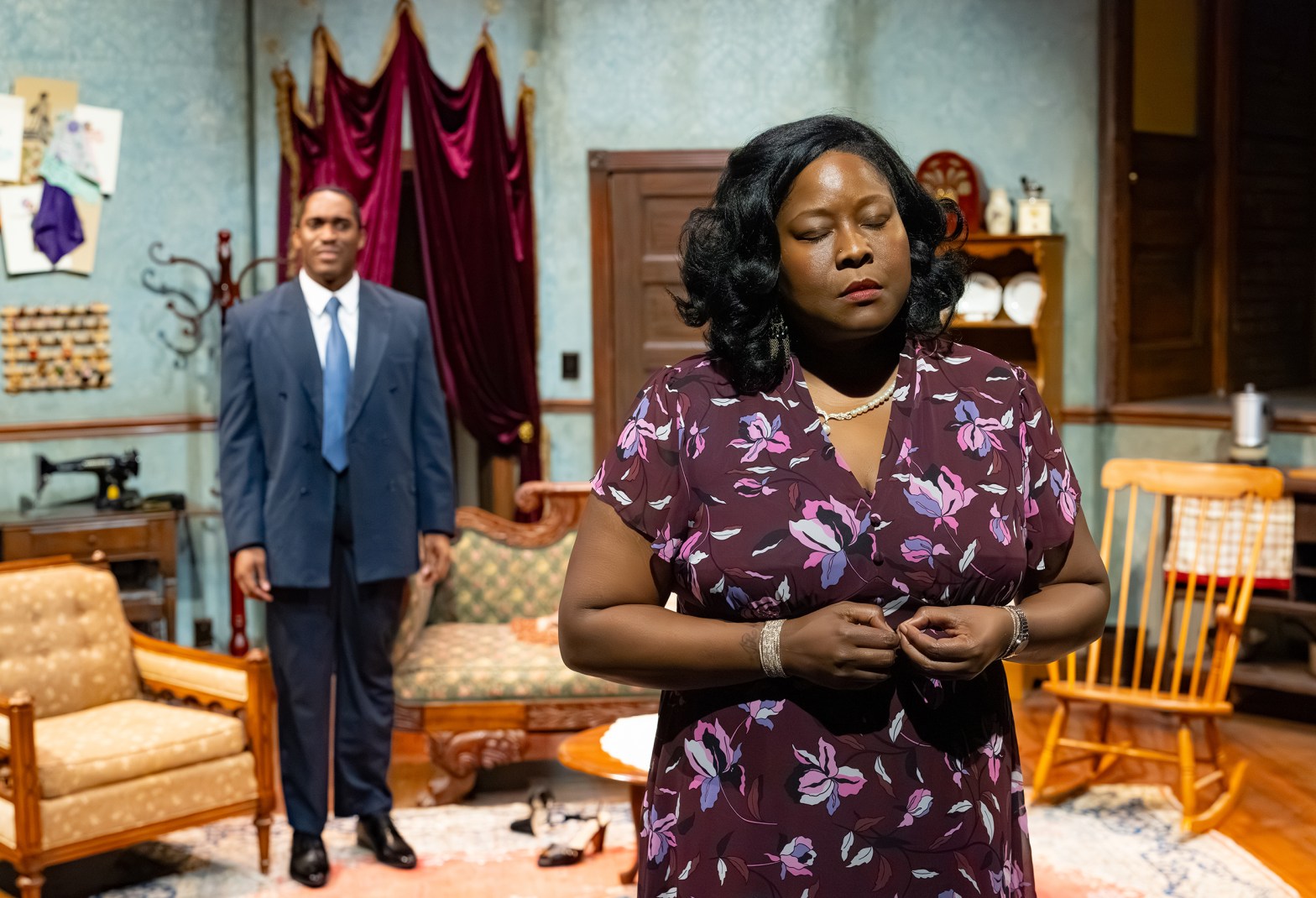
“Fire” was a journal developed in 1926 by Wallace Thurman, Langston Hughes, Zora Neale Hurston, and others to publish the works of “Younger Negro Artists” whose voices went unheard. It dared to present works dealing with homosexuality and prostitution using the more contemporary Black vernacular. It challenged an older Black generation of authors. Even the title, “Fire,” was symbolic of the burning up of older ideas. The presentation in the Quintessence production, premiering this month, was written and adapted by Marilyn Campbell-Lowe and Paul Oakley Stovall. It is a vital piece as it brings to the stage the literature of the Harlem Renaissance in New York City, of the 1920’s, during the mass migration to northern cities beginning in 1910.

            The play consists of the actors presenting six of the pieces from the journal that have been adapted by Campbell-Lowe and Stovall. It starts in the large lobby of the Sedgwick Theatre when the actors come out in costume, move amongst us and welcome us. They are eleven beautiful actors who are totally captivating.

            We then move to our seats and see that there are two parts of the stage- the back being the actor’s dressing room where the actors go and change costumes between the plays. Then, Wallace Thurman (Kaisheem Fowler-Bryant), the main organizer of the journal, whose story, “Cordelia the Crude,” is one of the six pieces presented, becomes the host of the evening.  The action shifts back and forth between the presentations and the talk in the dressing room. And therein lay my first problem with “Fire.”

            I missed most of the conversations in that dressing room because I couldn’t understand what they were saying. At the intermission, I learned that I was not alone. Everyone I talked to couldn’t make out the words spoken back there, One guy who saw I was taking some notes during the play approached me and asked if I followed the themes of the play. He told me that he was sitting in the second row and missed about 50% of the words, even when they were down stage presenting the writers’ works. And the only reason I was able to understand what was being said was because a friend who had seen a preview warned me to read the program before. She too couldn’t follow the stories because she didn’t hear most of it. I did read the superb program, and I followed the stories better.

            As for the stories, they were powerfully honest and decades ahead of their times. Several deal with skin color and the fascination of darker skinned people for lighter skinned ones.  Jealousy arose out of these issues.

            Homosexuality and bisexuality are explored in an era where these subjects were banned or ignored. Domestic violence is the subject of “Sweat.” The only piece that I found boring was the essay, “Intelligncia,” where I felt that the actor was pontificating, talking at us instead of to us.

            In the cast, there were some members who spoke clearly and projected well, while there were others, particularly Nicholas Parker, who I rarely understood. After the play, I asked some younger members of the audience if they had the same hearing issues as I- they did.

            But the faces of each were so expressive that I could see and understand their fears and desires. Watching the characters move on stage was a treat as the choreography by Polanco Jones Jr. was arresting! The costumes by LeVonne Lindsay were gorgeous, and the three-piece accompanying band was excellent, though I wish there were a few more jazz numbers from that era.

            This is an important play bringing to the public 100 years after the Harlem Renaissance, many great writings of the famous and not so famous. Perhaps a smaller space would have worked better. As it was a World Premier, I hope it is refined more. And I strongly recommend that you read the program with the short descriptions of each piece, to enjoy it more.

“‘Fire” by Marilyn Campbell-Lowe & Paul Oakley Stovall at Quintessence Theatre, 7137 Germantown Ave., Philadelphia, PA 19119, 215-987-4450, quintessencetheatre.org   Thru November 2, 2025

Misery at Act II Playhouse

            “Misery” is a 1987 novel by Stephen King that three years later made it to the silver screen starring Kathy Bates and James Caan, with the screenplay written by William Goldman. A few years later, Goldman and Simon Moore, separately adapted it many times for the stage for productions around the world. Act II is presenting the Goldman version of the play this October.

            I don’t usually choose to attend thrillers or horror stuff. It’s not a genre that I prefer.  But Act II’s outstanding productions of “Gaslight” and “Dial M for Murder” in recent years, made it a no brainer. I wasn’t disappointed as Director Mary Martello gave us two very real people, even if one of them did become scary as the play progressed.

            It begins in the living room of the Colorado cabin of Annie Wilkes (Sabrina Profitt) where we find successful romance novelist Paul Sheldon (Christopher Patrick Mullen) in a hospital type bed, bandaged and with braces. He has just crashed on the snowy roads outside the town and Annie has rescued him. Annie was a nurse and has everything the victim needs. and brought him to her cabin. The road to the hospital was snow-covered, but fortunately, Annie has the tools and the medicines to care from him.

            We quickly learn that she is a major fan of Paul Sheldon- to the point of worshipping him- and has read all of his eight “Misery” novels, loving the heroine, Misery Chastain. But in short order, the story takes a hard turn as she learns that he has done something in his newest book with the character, Misery, that she doesn’t like. She also doesn’t like the memoir he has been working on and tries to control his writing by withholding his meds or even hurting him. She is not just his Number 1 fan as she calls herself, she is obsessed with him and his writing to the point of a borderline personality disorder- she has extreme emotional reactions. It is not a horror story but a scary one because she is so real!

            Meanwhile, Sheldon tries to deal with her from his bed and wheelchair, compromising his principles and fearful of what she might do, yet is grateful to her for saving his life.

            I never saw the movie for which Kathy Bates won an Oscar, but I can’t imagine anyone better in the role than the multi-talented Sabrina Profitt. Christopher Patrick Mullen is also compelling in an understated way as a victim trying to just survive. And I would be remiss if I didn’t congratulate director Mary Martello for putting together this powerful piece of theater that was a 310-page novel, edited down by Goldman to an 1:47 film, and further edited to a 90-minute piece with just three actors.

            Act II’s productions often sell out so I recommend getting tickets now to this extraordinary play, superbly performed on its Ambler stage.

“Misery” by Stephen King adapted for the stage by William Goldman at Act II Playhouse, 56 E. Butler Avenue., Ambler, PA 19002, 215-654-0200,   act2.org   thru November 9,, 2025

The Unexpected 3rd at People’s Light

What can we expect if we live to the age of 78? As we reflect upon our lives as a parent, a spouse, and a friend, what lies ahead? How do we deal with or merely accept our past? In “The Unexpected 3rd,” Kathryn Grody explores this and so much more in a sincere, yet funny look at her life in this one-woman play that she wrote and is making its world premiere at People’s Light. It is not merely a good play beautifully performed- it is the best one-person show I’ve seen in years!

            Kathryn complains about so many things in her life, but she is not whining. She is speaking to us, to me, about the things that have gone wrong and right. I identified with every one of her struggles, from doing everything to stay young, to chronicling her aging. There are papers all over the stage from previous attempts of writing her memoir and more pages appear throughout her the play as she examines her past and tries to figure out what is next. She asks, “Why can’t we embrace this aging process” and then quotes Philip Roth- “Aging isn’t a war, it’s a massacre.” On the painted backdrop is a Dali-like representation of the dripping clock while she reminds us that the biggest obstacle is time.

            What can she do to be remembered in a positive way by her family and by the world in general?  Is there something she can still do to avoid feeling obsolete, invisible? How can she deal with her sons who are so critical? After all, she was the same arrogant way toward her parents when she was younger. How to connect better with her grandchildren?  How does she stop talking all the time? How does she manage in the digital world?  How will she handle the covid crisis where she is losing one of the things she loves most, touching and hugging?

            Will she ever stop trying to figure out her life? She tells us she has thought about and written this piece over 50 times. She thinks she finds solutions along her life’s journey but then questions those solutions.

So many questions. So much anxiety. So much fear. Yet this is not a sad story. It is very funny as she searches for the things that will lead to happiness and just staying alive. I want to be her friend- to listen and talk with her about all the issues we face.

I enjoyed every moment as I listened to and watched Grody. She is my age. She deals with all the problems I have been facing and with all my own questions about life. When the show ended, I asked a few younger members in the audience if they enjoyed the show. Each told me that they loved it. The friend I went with wants me to try to get a copy of the script so she can relive this finely written piece and so she can recall many of the smart but simple words again and again. The run is being extended because so many people want to see this unusual, thought-provoking piece of theater that is sure to travel to cities around the country. It is not to be missed.

“The Unexpected 3rd”” by Kathryn Grody at People’s Light, 39 Conestoga Rd., Malvern, PA 19355, 610-644-3500, peopleslight.org   Extended thru October 26, 2025

Primary Trust at Philadelphia Theatre Company

When I heard there was a play called “Primary Trust,” I figured it was about some sort of financial arrangements that have to do with a will or estate. As I know little about that stuff, I googled it and discovered that the play I was going to see by that name won the Pulitzer Prize for Drama in 2024. I stropped reading lest I learn too much about the play. I would soon find out if it was about banking or trusting someone. While the bank plays an important role in Kenneth’s life, I learned upon seeing it, how complex trust is in this finely crafted play by Eboni Booth.

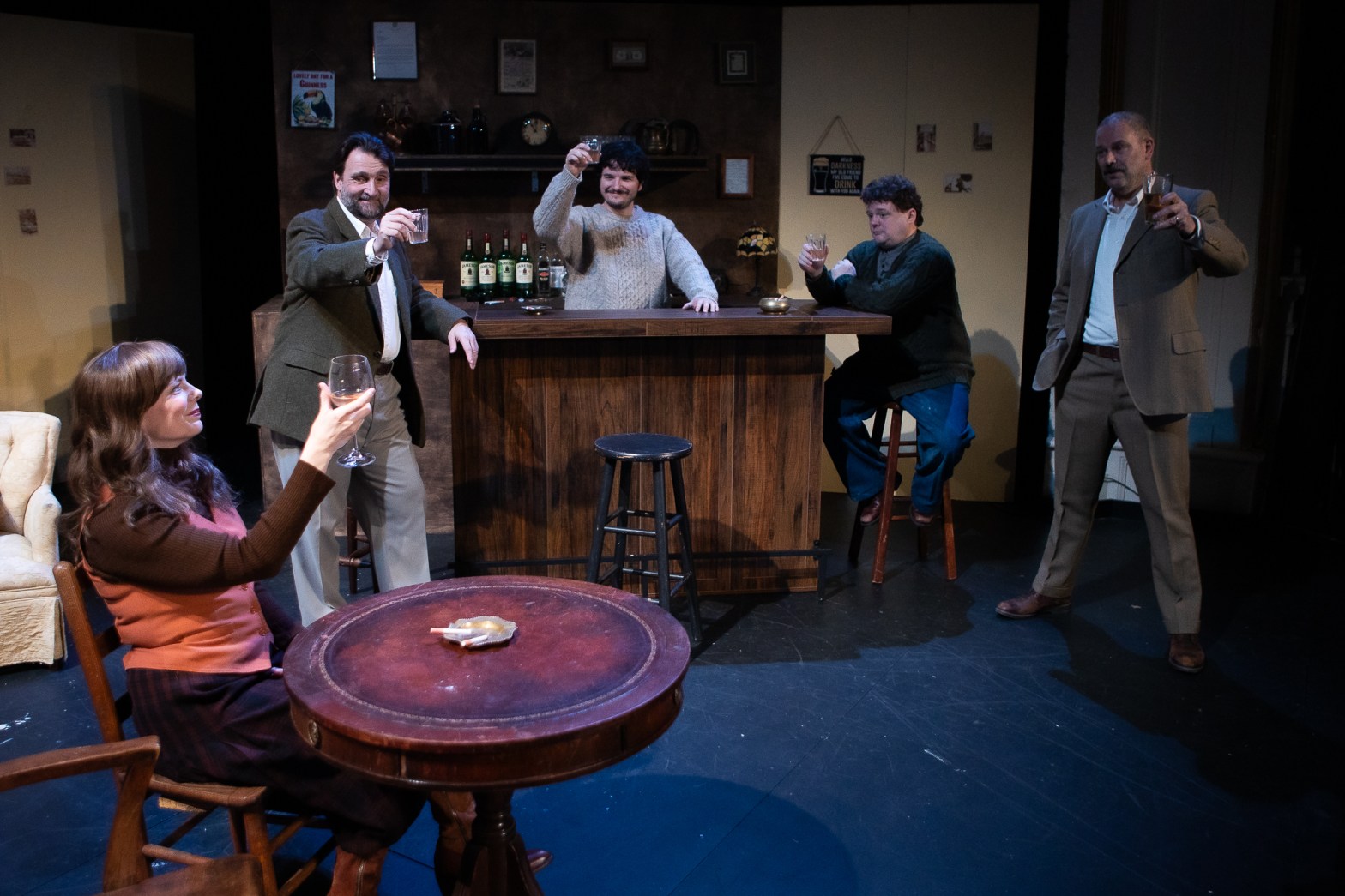
            It begins on an empty stage with the protagonist, Kenneth (Newton Buchanan), alone on stage, breaking the fourth wall and telling the audience “This is what happened.” Then, the curtain goes up and we find him with his best and only friend, Bert, at Wally’s in the upstate town of Cranberry, New York. They are ordering and drinking Mai Tais at the happy hour when it is two drinks for the price of one. No one else sees Bert (Akeem Davis) because he exists only in Kenneth’s mind.

            Kenneth loses his job when Sam tells him that he is shutting down the bookstore where Kenneth has worked for 20 years, since he was 18. Kenneth is distraught not knowing where to to turn, having lost his mother to cancer when he was 10 years old. One of the servers, Corrina, at Wally’s, suggests he apply for a job at Primary Trust Bank. Though unqualified for the job, he impresses the bank manager, Clay, and gets hired.

            Though there is much story to Booth’s play, it is more about the internal struggles that Kenneth is dealing with, from the trauma of his mother’s death to his being shuffled off to an orphanage at such a young age. He resists the friendships of Corrina and Clay, preferring only his imaginary friend, Bert. Can he trust anyone who is real? Can we trust him? Can he trust himself?

In front of a beautifully painted representation of an intersection in the town of Cranberry by scenic designer David P. Gordon, there are scenes of the restaurant, the bank, and the bookstore that are created by simply rolling on a bar, a bookshelf, or a teller’s window. It is exquisite in its simplicity. And the four actors perfectly create a very real story. The ensemble was A+.

Buchanan’s Kenneth was filled with so many confused emotions in such a real sense, that we cannot help but feel for him and his anxieties. David Ingram and Taysha Marie Canales each portray several characters so beautifully and effectively that I didn’t even realize that the two actors were playing multiple roles until well into the play. And I can’t imagine anyone better bringing this simple but powerful play to the stage than Director Amina Robinson. She is sooooo good. I will go anywhere to see a play she has directed.

There is much more that gets revealed, through Kenneth’s direct talk with the audience and his private talks with Bert. It’s easy to see why this play was awarded the Pulitzer Prize. It is a powerful, yet unique story magnificently told. What a great start of the season for The Philadelphia Theatre Company.

“Primary Trust” by Eboni Booth at Philadelphia Co. at Suzanne Roberts Theatre, 480 S. Broad St., Philadelphia, PA 19146, 215-985-0429   boxoffice@philatheatreco.org   thru October 5, 2025

Vanya and Sonia and Masha and Spike at Bristol Riverside Theatre

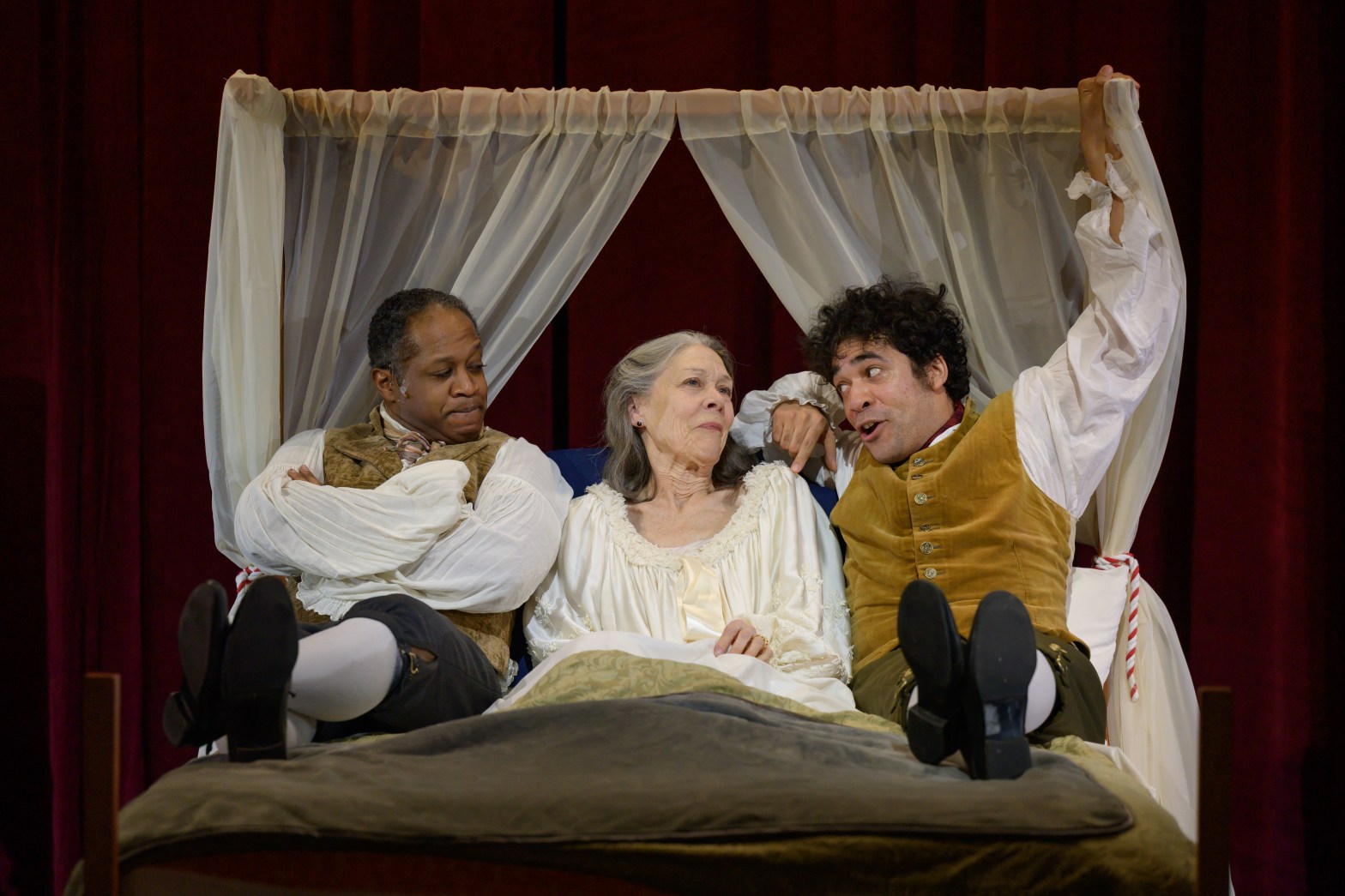
            Vanya & Sonia & Masha & Spike by Christopher Durang is a smart comedy that won many awards including the Tony Award for best play in 2013. It revolves around middle-aged single siblings living in the Bucks County country house where they took care of their parents before they died.

            Vanya, 57, is gay. Sonia, 52, was adopted by their college teacher parents when she was 8. The parents loved the playwright, Anton Chekhov, thus their names. They were characters in his play, “Uncle Vanya. Their sister, Masha, is also named for a character in a Chekhov play, “The Sea Gull.”. She is coming for a visit.

            It begins with siblings Vanya (Alan Safier) and Sonia (Amanda Schoonover) living a quiet life in the country. They are bemoaning their lost lives. But it anything but quiet inside their heads. Neither has had a significant relationship and neither has worked for many years. Their sister has paid all the bills, first in supporting the parents, then continuing to pay for her siblings in the house. She has been reasonably successful with her acting career, though she mourns the loss of her five husbands who all left her. She is not an easy person.

            We watch these unhappy siblings as they mourn their own issues and even go after each other at times. Sonia is constantly putting herself down. Vanya is sad and painfully lonely when he thinks about what could have been as compared with the way his life turned out. And Masha (Angela Pierce), despite all her bravado, is just as just as insecure… as an actress and as a woman. She is competitive with everyone, particularly her sister.

Another major character is Cassandra (Megan McDermott), the house cleaner, who is also a fortune teller with some psychic powers. She often predicts foreboding events to come.

Masha arrives with her young boyfriend, Spike, (Dante Gianetta), a hulk of a young man 30 years her junior. He is constantly showing off his muscular body but is not very bright.  They are going to a costume party, she as Snow White, and she wants her siblings to go as her dwarves. She informs Vanya and Sonia that she plans to sell the house and leave them destitute. Still, there is much humor under their painful stories.

Though there are many references to Chekhov, you need not be familiar with the famous Russian playwright to enjoy Durang’s play. The issues are universal, from the dysfunctional family and self-doubt to jealousy and control. The second act gets more serious and there is less humor, as each of the siblings struggles to escape their woeful destiny.

The story is powerful. The costumes by Linda B. Stockton are beautiful. The actors were superb. It is a wonderful tribute to Durang who lived in Bucks County and passed away last year. Under the skillful direction of Ken Kaiser, we watch these real people in this black comedy evolve, and we are listening intently and laughing at the same time.

“Vanya and Sonia and Masha and Spike” by Christopher Durang at Bristol Riverside Theatre, 120 Radcliffe St., Bristol, PA 19007, 215-785-0100, brstage.org,  thru October 5,, 2025

Be Here Now at Montgomery Theater

            The night before its opening, I received an invitation to go to Souderton, PA to see a play by Deborah Zoe Laufer, “Be Here Now,” at Montgomery Theater. Normally, I wouldn’t respond to such a last-minute invite that is at a theater where I don’t usually review their plays. But I had seen another Laufer play at InterAct Theatre last year and loved it, so I said yes. I was so glad I did.

            It is about Bari (Eleni Delopulos), a woman who is constantly down. She teaches at a college and is trying to work on her dissertation about nihilism. But she has writer’s block, taken time off from teaching, and is working beside two friends in a store that sells Tibetan spiritual statues that are made in China. It is fraud. And she feels like her whole life has been a fraud.  One of the two women suggests she date her handsome cousin, Mike, to forget her woes. But Bari is determined to remain depressed… until she has a seizure and collapses.

When she comes to, she is a different person. She wants to meet Mike. She wants sex. She wants to write. But then, she passes out again and the others want to take her to the hospital. She refuses to go. It is not out of her negative nature but from her newfound optimism that she fears she will lose.

Meanwhile, Mike (Benjamin Bauman) has his own set of issues and survives by building small houses out of garbage. It is his art, that derived from a sad set of circumstances earlier in his own life when he had to live in his first garbage house. He has no phone, no internet or computer, and hasn’t driven a car in years. He gets around on a bike.

The question for each is “how to move on.” What changes dare a person make to find happiness and does happiness even exist? If Bari gets the operation to prevent her seizures, will it take away the joy she feels after each one? Does Mike dare to change the hermetic life he is living?

Delopulos and Bauman are great in conveying their angst- it is so powerfully honest. It is fascinating to see these two characters on different journeys through life who have little in common and wonder if they can ever get together on any level.

Laufer’s play is a unique look at what it means to try to live in the moment while it questions the standard remedies to attain happiness. Director Kristin Heckler has done an outstanding job in presenting this simple yet complex story about two troubled people. In this brilliant 90-minute play.

“Be Here Now” by Deborah Zoe Laufer at Montgomery Theater, 124 Main Street, Souderton, PA 18964. 215-723-9984   montgomerytheater.org   thru October 5, 2025

The Real Thing at Lantern Theater Company

Tom Stoppard’s first full length play, “A Walk on Water,” was staged in 1964. Two years later, he gained worldwide fame with his play, “Rosencrantz and Guildenstern are Dead,” about two minor characters in Shakespeare’s “Hamlet.”  Besides the two dozen plus plays he’s written, Stoppard’s adapted lots of plays and books for film and television

            “The Real Thing” came to the stage in 1982 in London before a revised edition played on Broadway two years later with Jeremy Irons and Glenn Close, directed by Mike Nichols. It is that version that Lantern Theater has put on its stage. Directed by the multi-talented Peter DeLaurier, it is an extraordinary look at relationships and love through the eyes of his four main characters in England in the early 1980’s.

            It begins with Max (Adam Howard) confronting his wife Charlotte (Brett Ashley Robinson) saying that her supposed trip to Switzerland was a coverup for a clandestine affair that she was having. But in the second scene, we are momentarily confused as the two are in a room with Henry (J Fernandez) and Annie (Cambell O’Hare) and we are not sure who is partnered with whom. Henry is a playwright, and the others are stage actors.

            It gets more complicated as we see that love exists outside these marriages and we watch the four trying to cope with the desires and ideals of the others. “Is jealousy warranted” and “Is fidelity needed,” the characters ask. We watch them bicker and we watch them love, but we wonder if each is telling the truth.

            And then there is the absent character of Brodie who is incarcerated for burning a memorial wreath during a protest. They support his goals, but Henry wonders if his wife has fallen in love with Brodie, or for that matter with Billy (Trevor William Fayle), with whom she is in a play in Scotland.

            Though it is a bit confusing at first, we feel for each character as they try to find their way to happiness which one character equates with equilibrium.  Stoppard’s words are powerful and profound as they not only analyze sex, but the very verb, “know,” which in biblical times meant to have sexual intercourse. Henry ridicules writers- particularly Brodie who has written a piece- who can’t write because they don’t know how to use words effectively.

            The cast was superb with special kudos going to J Fernandez for handling the range of emotions in a very real sense. My only issue with the production was the manner in which the actors spit out their lines so fast that I missed some important information that would have made it less challenging for me. And though I never imagined I would say this-  I wish that the two-and-a-half-hour production were longer so that it would give more bite to this extraordinary play… and I wouldn’t miss a line. As Harry says, “words deserve respect.”

We are constantly asking ourselves what the real thing is- about love, commitment, AND sex. It was a great season opener for Lantern Theater.

“The Real Thing” by Tom Stoppard at Lantern Theater Company at St. Stephen’s Theater, 923 Ludlow St., Philadelphia, PA 19107. 215-829-0399   lanterntheater.org   extended thru October 5, 2025

Theatre People at Act II Playhouse

With the summer upon us, I hadn’t seen a play in six weeks as many theaters took a hiatus. So, I was glad that Act II Playhouse’s first play of the 2025-26 season had a show on its intimate stage in Ambler in August. “Theatre People” is a play by Paul Slade Smith, author of “The Outsider,” a political farce that ran successfully last season at Act II. This too is billed as a farce. In fact, much of the first act was an absurd, silly comedy and it felt like so many of the tv comedies that I don’t watch. I am so glad I am a reviewer and don’t leave at the act break because the second act was superb!

            It revolves around husband-and-wife playwrights who are meeting with a young novelist Oliver (Carl Nathaniel Smith), to show them the play they created from his novel. But they can’t proceed until he signs a contract with the publisher and the book is produced. They discover that he has not signed it because he is waiting to show it to Margot, after which the romantic story was based. He had met her 18 months earlier and has fantasized about her ever since.

            Margot (Renee McFillin) is coming to this mansion in Newport, Rhode Island, where they each have a room. She has gotten there a day early and is in the adjoining room (set up by the writers, Charlotte (Morgan Everitt) and Arthur (Joe Mallon) Sanders to spur on the romance between Oliver and Margot on which the novel and play were based). But when the Sanders and Oliver arrive, they hear Margot through the door, making love with the dim-witted Victor Pratt (Kevin Toniazzo-Naughton), the man she is to sing with the next night on stage. Oliver is distraught. He wants to tear up the novel.

            The story is actually pretty good, but the over-the-top slapstick is too much and becomes tedious. It’s not necessary to turn every third line into a laugh line with some ridiculous behavior. Arthur’s fast blabbering and Oliver’s overly childish behavior acting like a six-year-old having a tantrum, become annoying. You would never believe that he can write a good novel. Charlotte provides a measure of sanity to hold the story together. I enjoyed her performance the most.

            Why, I ask myself, are they playing it so broadly? Director Tony Braithwaite has been for years, my favorite comedic actor and director. But I think he went too far with this opening act. On the other hand, Braithwaite captures the comedy, the cleverness,and  the nuance of Smith’s writing as the story becomes more intriguing after the intermission. It is fascinating how they connive to fix things. I won’t reveal that here.

            There is one more character I enjoyed. Throughout the play, Olga, the housemaid observes the goings on of these theatre people and offers her funny, and often strange interpretations of what she sees. Sabrina Profitt masters this role she almost seems born to play.

            Maybe you will enjoy and laugh through the whole play as many in the audience did. You will definitely do that in the second act.

“Theatre People” by Paul Slade Smith” at Act II Playhouse, 56 E. Butler Avenue., Ambler, PA 19002, 215-654-0200,   act2.org   thru Sept. 7,, 2025