She Gets Around at 1812 Productions

Jennifer Childs is at it again. This time, she is cleaning out her closet. In a solo comedy, she shares with us her thoughts that are triggered by the many outfits she sees.  But it is far more than memories. In 90 minutes, while changing clothes about two dozen times, she gives us a brief, yet powerful story of the women in comedy who inspired her. She also gives us an intimate look at her life and her feelings that we can all relate to in her play, “She Gets Around,” which she wrote and stars in.

            Childs takes us through her school days as she relates what was going on at the time. Wearing first, her girl scout uniform, she reminds of the Watergate scandal, where the President of the United States lied to the people and was forced to resign. And then, a moment later, she confesses that her idol was Doris Day, the “perfect woman.” Then again, there was Vivian Leigh, who she also loved as Scarlett O’Hara in “Gone with the Wind.” It made her want to be a bad girl.  But my telling you about it doesn’t come close to hearing Childs explain it.

She learned much about life from the Good Housekeeping magazine. She learned about sex at a very early age from her mother, but in a most clinical way. It is so exciting to travel with her as she tries different clothes on and different approaches to life until she realizes that she wanted to be a funny girl.

But on the way there, she toyed with writing poetry and with singing hip hop while she supported herself by working as a waitress and bartender. So much story so brilliantly told. And she keeps us laughing along the way.

At one point, she shows eight outfits that represent some of her favorite comedians- Gracie Allen, Totie Fields, Sophie Tucker, Joan Rivers, and Mae West among them. They were all bawdy and brave! She then fires off a joke from each of them. Her favorite though was Phyllis Diller, who taught her the most!

She actually met Diller who suggested she partner with Childs’ friend, another woman, to form a female comic duo. There were only pairs of men or of a man and a woman doing standup comedy.

She spends some time during the performance talking about the harassment of women in all walks of life. It is poignant and it is real.

I can go on and on but nothing I would say would come close to the incredible presentation that Jennifer Childs has written and is performing at 1812 Productions, where she is the Producing Artistic Director.  We feel her strength and we understand her vulnerability. We are very lucky to have such an extraordinary woman here in Philadelphia.

The only criticism I have about the show was that it ended after an hour and a half. I wanted more.

“She Gets Around” by Jennifer Childs at 1812 Productions, at Players and Players Theater, 1714 Delancey St., Philadelphia, PA 19103, 215-592-9560, info@1812 productions.org   Thru May 17, 2026
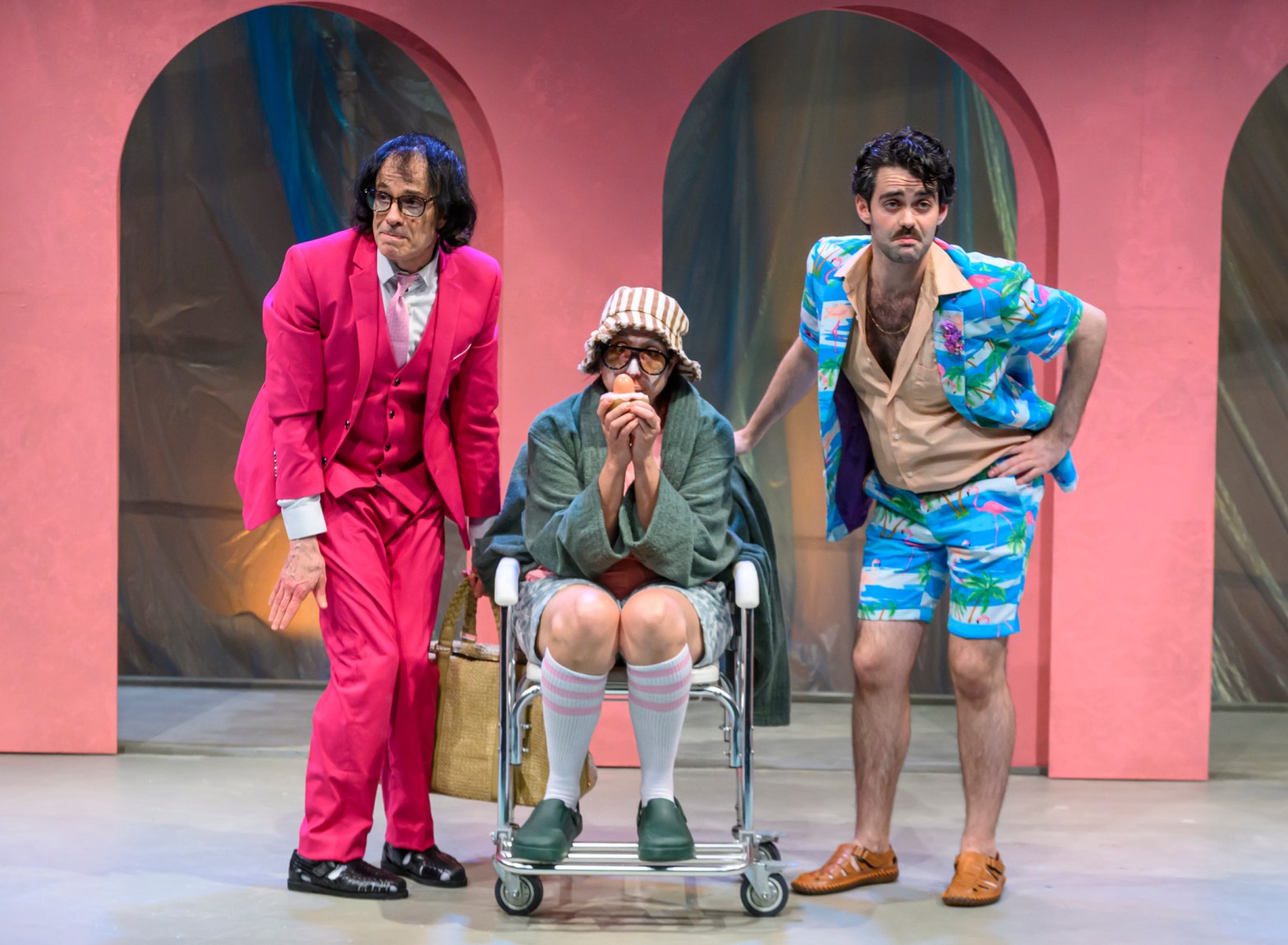
The Hypochondriac at Quintessence Theatre

Moliere was a famous French playwright of the 17th century who wrote about 30 plays during his 14 years in Paris. They dealt with the hypocrisy of the society he inhabited and were full of smart dialogue and as well as slapstick jokes. Most famous among those plays were “Tartuffe, The Miser, The Misanthrope, The Bourgeois Gentleman, and The Imaginary Invalid.” When I heard that Quintessence was doing a play by Moliere called “The Hypochondriac,” I discovered that it was a modern translation of “The Imaginary Invalid.” And this production is the world premier of still a new translation by Sir Ranjit Bolt.

            Argan is a man who is convinced that he is sickly and seeks treatment from anyone and everyone, including medical quacks and charlatans giving him bad information. He even seeks to marry his daughter, Angelique, to a young physician who is the son of a physician, in the hope of getting daily medical care. But Angelique is in love with another man, Cleante.  

Then there is Argan’s maid, Toinette, who recognizes the absurdity of her employer’s maladies, but tries to humor him, even though he is constantly calling her vulgar names. She also tries to convince Argan that the doctor’s son is not a good match for Angelique. Toinette recognizes the selfish motives of Argan’s wife Beline, Angelique’s stepmother, in her greedy attempts to obtain all the money she can from him. Beline seeks to convince Argan to send his daughter to a convent to remove her from the scene, a threat that he makes to his daughter repeatedly, if she will not marry the man of his choice. When Argan’s brother Beralde arrives, Toinette and Angelique enlist him to convince Argan to let his daughter marry the man she chooses.

Amidst all the chaos, there are the “medical” issues facing Argan. I put it in quotes because few believe he is ill. Beralde thinks his brother is the healthiest man alive. But Argan has doctors and an apothecary constantly supporting the false facts that he is sick to their own advantage. They have him taking all sorts of drugs and receiving enemas almost every day. And he is constantly farting in people’s faces. Beline, clearly a trophy wife who is constantly pushing her breasts in her husband’s face, acts as though she supports him, but is only there for the inheritance she hopes to receive.

Moliere hated doctors! He thought them to be little more than scammers who knew nothing about health, and he ridicules the medical profession, arguing that the only thing they did know was the Latin words for things. Actually, Moliere portrayed Argan in a few opening performances before he collapsed on stage and died soon after. I now understand a shift in the roles that occurred in this new version which will leave you baffled if you don’t read the director’s notes in the program.

Last week, I criticized the casting of a woman playing Don Quixote in a production of “Man Of La Mancha,” for not portraying the qualities of the man. Ironically, a woman (Eleni Delopoulos), portrayed Argan in this show. She was more effective in the role than Jered McLenigan, who played Argan in the second act with an accent that was often hard to understand.

Ranjit Bolt, a playwright himself, has translated dozens of plays into English. He also admits that he paraphrases often to make them more contemporary and funnier. But then, any translation is subject to the choice of words of the translator. I think Bolt took some serious liberties in translating Moliere’s play.

 In “The Hypochondriac,” Director Trey Lyford has added the character of King Louis, who sits on a throne in the audience, interrupting the action at times. The setting is beside the pool of a tropical resort-like locale today. The interludes, an essential part of Moliere plays, are colorful song and dance numbers that Lyford has recreated.

I read Moliere plays when I was in college and thoroughly enjoyed them. I’m not certain as to why I didn’t enjoy this production as much. I’m not sure if it was the translation or the director’s choices, but I didn’t find that Moliere’s play captured my attention as I remember it  I think it was the way they let go of the underlying meaning of the issues that seemed to become secondary to the broad comedic sketches. The acting quality of this ensemble was mixed. Rather than point out those actors who I didn’t care for, let me say that I especially liked Hannah Gaffney as the conniving wife, Tanara Colem as the maid, and Christopher Patrick Mullen in two roles. It’s one of those plays where I suggest that theater goers check it out with others who may have seen it, since there were many in the audience who WERE laughing.

“‘The Hypochondriac” by Moliere and translated by Sir Ranjit Bolt at Quintessence Theatre, 7137 Germantown Ave., Philadelphia, PA 19119, 215-987-4450, quintessencetheatre.org   Thru May 19, 2026

Seng’s Hair Salon at InterAct Theatre

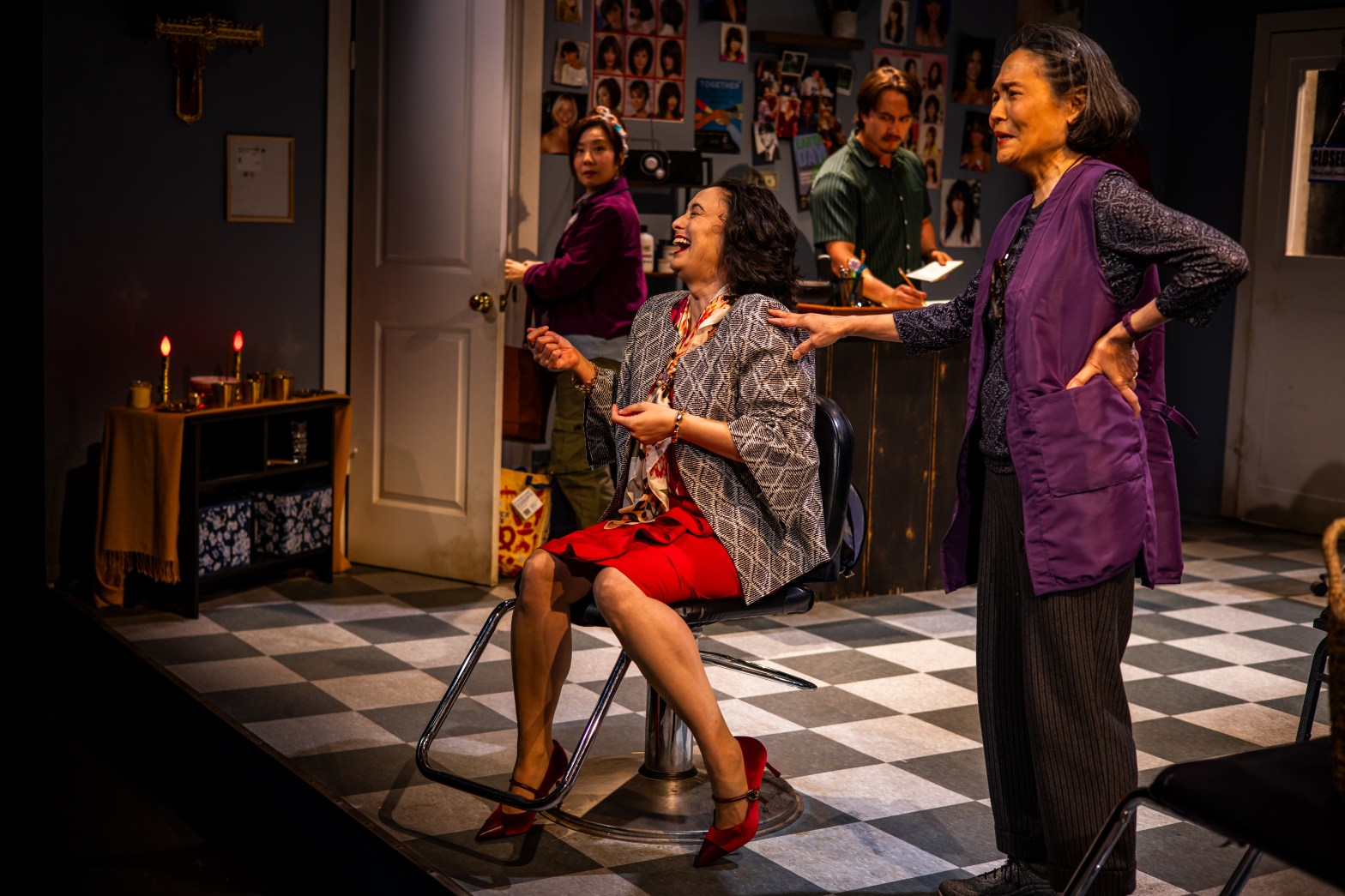
I am always fascinated by the remarkably wide range of plays discovered by Artistic Director Seth Rozin for the InterAct stage. This time, it is one of three plays in “The Philly Cycle” that Rozin commissioned with Philadelphia themes. Written by Saymoukda Duangphouxay Vongsay, a Lao American poet, essayist, and playwright, it takes place inside a South Philadelphia hair salon and features Lao, Vietnamese, and Cambodian characters. It is about a changing neighborhood that is gentrifying and trying to push out Seng, who has operated her hair salon there for almost 40 years.

            Seng (Lydia Gaston) fled her native Laos and came to America with her husband after the war in Vietnam and the Communist takeover in that part of the world. They raised their little girl, Vimala (Bi Jean Ngo), then bought a building where the salon was on the first floor. Eventually, her daughter, then her grandson, Prince (Daniel Ubin Burgess), worked at the salon. She also has a best friend, Anh (Joanna Leo). They are so close, they call each other sister. And both lost their husbands to Sudden Uneplained Nocturnal Death Syndrome (SUNDS) that killed southeastern Asian men suddenly in their sleep in the early 1980’s. Seng has a little altar where she talks to her dead husband and often asks for his advice.

            “Seng’s Hair Salon” is about a small corner of life as seen through these southeast Asians who have lived in the U.S. for decades. Prince is a business major who sees the practicality of everything, including the possible sale of the building to the would-be developers. Vimala regrets her decision of not going to art school when she was young and had a child. She also has a very best friend that weighs in regarding their building and the neighborhood.  Anh is having a house built in Vietnam and hopes to return to her native land. She also hopes Seng will sell the salon and join her. At first, I was confused because everyone uses familial names- sister, cousin, aunt, and father- when talking about or talking to each other, but it is just a custom of this close-knit group. We love their banter, especially that of Anh, which is full of comedic talk about her dress, her fragrances, and most anything.

            The very salon has been a sort of community center where people of the neighborhood talk while being groomed. Seng doesn’t want to let go of the life she created with her husband in Philadelphia despite the pressure she is faced with. I don’t want to give anything away, but I loved watching the progression in the second act as things try to get resolved. The story and the dreams of each character emerge in this finely crafted play by Vongsay. She gives us insight into people in our community that we know little about. And Director Chongren Fan has put it together so seamlessly that we feel as though we are there with them.

“Seng’s Hair Salon” by Saymoukda Duangphouxay Vongsay at InterAct Theatre Company at The Drake, 302 S. Hicks St., Philadelphia, PA 19102, 215-568-8079 interacttheatre.org  Thru May 10, 2026

Man of La Mancha at Montgomery Theater

“Man of La Mancha” opened on Broadway in 1965 and besides four revivals there, it has played at theaters around the world in Europe, Asia, Africa, and South America. This musical, with the story written by Dale Wasserman, the music by Mitch Lee, and the lyrics by Joe Darion, which is NOT a faithful rendering of the book, “Don Quixote” or of Cervantes’ life, IS one of the most beautiful works of musical theater in the 20th century! It is now on the stage at Montgomery Theater.

            Let me begin by saying that though I never saw “Man of La Mancha” on stage, I did know most of the songs. The beautiful melodies and powerful lyrics is reason enough to see this production.

            It takes place in Spain during The Inquisition and Miguel de Cervantes, an actor, a playwright, and a tax collector is in a holding place of a prison for foreclosing on a monastery. The other prisoners set up a mock trial, and, in his defense, Cervantes puts on a little fake beard to becomes the character Alonso, an old man who is a bit mad. The others in the holding cell agree to this defense and willingly take on the characters of the manuscript (which he has with him) of Cervantes’ play,

            I was a bit confused for a moment until my friend who accompanied me, whispered to me that it was important to suspend my disbelief, as the critic, philosopher poet Samuel Taylor Coleridge espoused in the early 19th century. Once I did, I was immersed in the passionate story of that man of La Mancha and all the other characters’ stories.

            Alonzo is a dreamer. He sees things that aren’t there, like the windmill, which he thinks is the enemy and the inn, which he sees as a castle. He renames himself Don Quixote de La Mancha. He even believes the innkeeper is a Lord and insists that he bestow knighthood upon him. But the most powerful story is that of the peasant girl, Aldonza, who is a serving maid at the bar and a part-time prostitute. He calls her Dulcinea, which symbolizes beauty and virtue. She argues with him, but he sees only good in her.

And with him is his trusty squire, Sancho Panza, who supports his knight and doesn’t try to change him.

            The supporting actors were all superb, especially Drew Jacobson, Dominic Santos, and Owen Corey who played multiple roles. But it was Emily Rooney’s portrayal of Aldonza that really blew me away. Her acting, her voice, her mere presence on stage was an A plus.

            The three-piece band at the back of the stage performed softly and sweetly so you could hear ever word of Wasserman’s script and Darion’s lyrics. And what lyrics they are! Though the story is that of a fantasy of a crazed man, there is so much to listen to. Some of my favorites were “It’s All the Same, Dulcinea, I’m Only Thinking of Him, I Really Like Him, Little Bird, Knight of the Woeful Countenance” – wait, I am naming almost all the great songs! But I would be remiss if I didn’t mention “The Impossible Dream.”

            Sadly, the one aspect of the play that I found weak was in the portrayal of Don Quixote. I told my friend at the intermission that the guy playing that part just didn’t convince me that he was delusional or that he loved Aldonza. He stood out being rather flat amongst the talented cast. And then my friend told me that the guy playing Don Quixote was a woman! Yikes!! Could a woman play the part? V. Sterling has played other male roles. I just didn’t feel that Stephen Casey, who directed and choreographed so well, succeeded in creating the complex character of Don Quixote with her. And the portrayal of Sancho Panza (Jordan Hunter Fidalgo), also played by a woman, would have worked better if she weren’t so much bigger than Don Quixote. I don’t doubt that a woman can portray a man. It just didn’t work in with this production.

            Here is a 1000-page novel that deals with idealism and fantasy that was altered and reduced to 2 hours on a bare stage in a musical that will continue to play for a long time. It’s such a great piece of musical theater! And Montgomery Theater has mounted a solid production.

“Man of La Mancha” by Lindsay Joelle, music by Mitch Leigh, lyrics by Joe Darrion at Montgomery Theater, 124 Main Street, Souderton, PA 18964. 215-723-9984   montgomerytheater.org   thru May 3, 2026

The Contrast at Philadelphia Artists’ Collective

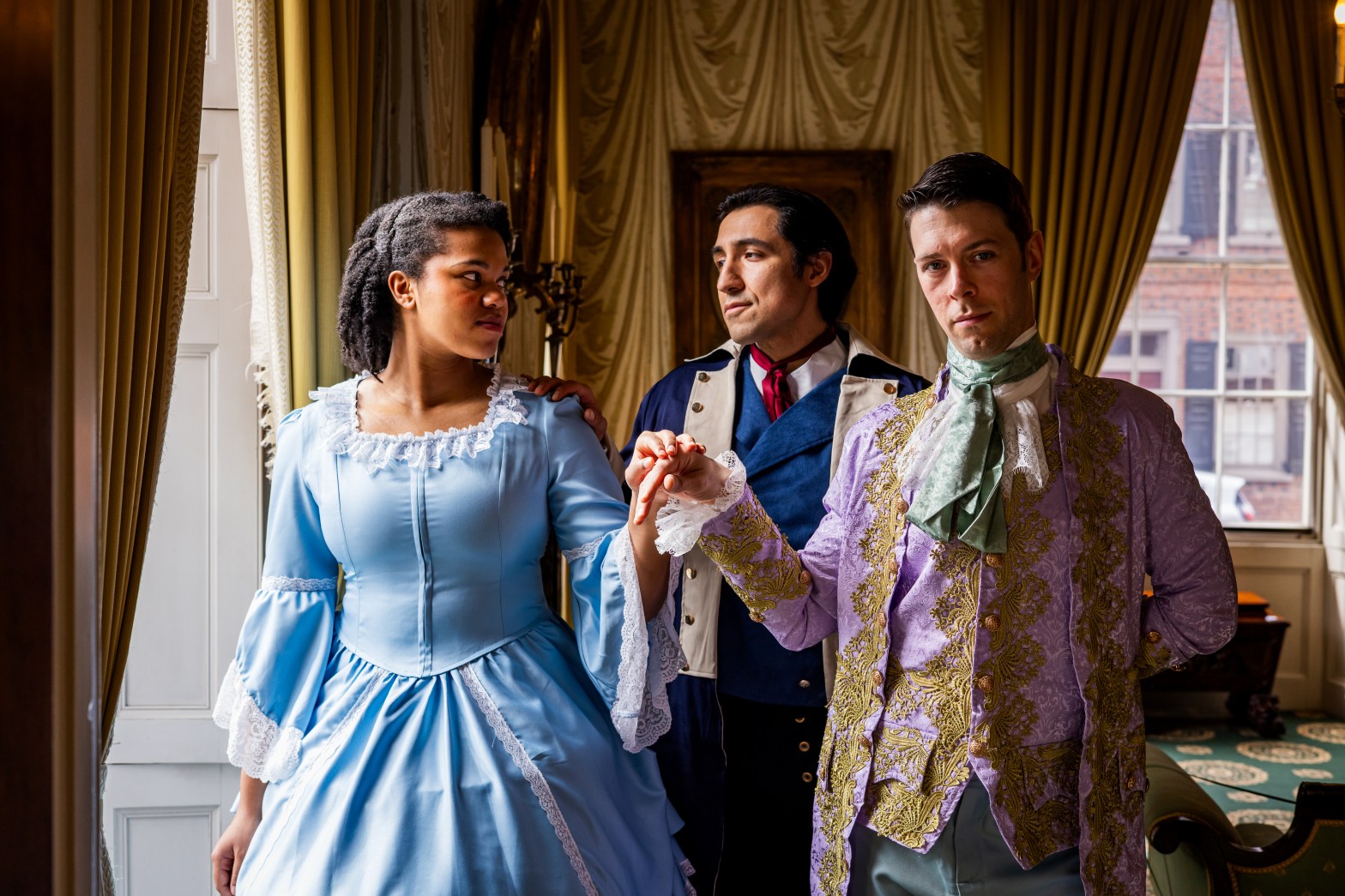
What was theater in America like in the new republic? Did George Washington go to plays? “The Contrast,” being staged at the Louis Bluver Theatre at the Drake by Philadelphia Artists’ Collective, is purported to be the first American comedy. It was written in 1787, and it deals with money and marriage and what value, if any, a woman has.

            It begins with two attractive women, Charlotte (Jenna Kuerzi) and Letitia (Eliza Carson), in fine dress, talking to each other about the upcoming marriage of Maria (Brittany Onukwugha), a young woman, who doesn’t want to marry Billy Dimple but thinks she must obey her father’s wishes. To be honest, I didn’t follow any of this conversation as they were spitting out names and talking fast, with their backs to me in this theater-in-the round production. It was the only time that I was confused, and I did understand it in time.

            Dimple (James Kern) represents the snobbish British-like personality, in contrast to the honorable Colonel Henry Manly (Zachary Valdez), Charlotte’s brother, who served in the Revolutionary War, and has come to the city to aid the veterans of the war, who he calls his family. He is dressed in an unfashionable soldier’s coat.

            After a while, we learn that Dimple also wants to get out of the marriage to Maria but can’t be open about it. He tells Charlotte he loves her but needs Letitia’s money. But soon after that, Charlotte overhears him criticizing her to Letitia. He is a dandy who prefers European ways. He is a two-timer and cannot be trusted.

            Then there is the second story wherein a young man Jonathan (Kevin McCann), Manley’s waiter, is in New York for the first time. A bit of a country bumpkin, he is convinced by the conniving Jessamy (Brandon Tyler), Dimple’s servant, that the newcomer can have any woman he wants if he learns the etiquette of courting from Jessamy. It’s very funny.

            Mary and Manly meet briefly and fall for each other, but Mary’s father dismisses the young man because of his clothing. He also tosses her novels in the fire as he feels they are corrupting her with unrealistic ideas about romance. “Money makes the mare go,” he says. I looked up the old British term- it is a “lighthearted but derogatory way to describe a woman acting in an annoying or stupid manner.”

            The main focus is on the relationships, the hypocrisies, and the points of view of each character… and there is humor throughout. I appreciated the effective manner in which Director Ann Garner moved her actors about the stage after that first scene. She also allowed them to connect with the audience with knowing glances without making it silly. .I’m sure the new Americans loved it… I know I did.

“The Contrast” by Royall Tyler at Philadelphia Artists’ Collective at The Louis Bluver Theatre at the Drake, 302 S. Hicks St., Phila., PA 19102, 215-274-0909, philartistscollective.org,  thru April 26,, 2026

Wilderness Generation at Philadelphia Theatre Company

In this new play by Pulitzer Prize winning playwright James Ijames, four cousins meet at their grandmother’s house to pack her things because she is moving to a smaller senior condo and selling the house. It is in the Tidewater South, and this is the home they visited regularly and loved. Ironically, she is off on a vacation in Cancun but has left a list for them. Coming from Boston and Philadelphia, this gathering at the house triggers memories and secrets, which they recall and reveal to each other. It is a simple but strong play that is on the Philadelphia Theatre Company stage this Spring.

            Ramona, Nicole, and Smitty arrive first. They look at the house’s contents, but mostly just banter about their own lives and the lives of others. Lots of the talk is about sex and they make many sexual jokes. Many were queer related jokes as Smitty is gay. They talk and talk and there is little action, even when the pizza is delivered by Nicole’s boyfriend, Donovan. At times, I felt like I was watching a tv comedy, where every third line was some sort of joke.

            It was the underlying story of each that drew me in. Ramona (Heather Alicia Simms) is divorced, living in Boston with her daughter. She longs for family connection. Smitty (Brenson Thomas) had to hide his sexuality and when he came out, his father rejected him. Nicole (Jessica Johnson) needed to go away for college because she couldn’t deal with being around Micah, the fourth cousin, who they learned would be coming to the house to help with packing-up.

            When Micah (Lindsay Smiling) does arrive, things get more complex as we learn of his life. He, like the others, is seeking connection, but is also seeking forgiveness. There is a nice respite in the second act when they sit down to a game of Monopoly (which they found amidst their grandmother’s stuff). But even the humor of those moments triggered recollections of their past together. We know there is friction between Micah and Nicole, and we learn what happened- a most sad event in their past.

            . I enjoyed listening to these family stories but would have liked it much more if it didn’t seem to be working so hard for laughs. Nevertheless, it works! And while this is a comfortable middle-class Black family, Ijanes speak to us all, and through the skillful direction of Director Taibi Magar, this strong ensemble comes together beautifully as its stories are told.

“Wilderness Generation” by James Ijames at Philadelphia Theatre Co. at Suzanne Roberts Theatre, 480 S. Broad St., Philadelphia, PA 19146, 215-985-0429 boxoffice@philatheatreco.org   thru May 3, 2026

The Intelligent Design of Jenny Chow at Stagecrafters

Jennifer Marcus is a brilliant, Chinese-born 22-year-old woman who was adopted by an American family as an infant. She is a computer genius. But she is  struggling with an obsessive-compulsive disorder, which her mother doesn’t understand. She also suffers from agoraphobia, wherein she is terrified to go outside her home. Although she was brought up in comfort, she feels that she is not understood by her mother and works to find and meet her birth mother in China.

            “The Intelligent Design of Jenny Chow,” at Stagecrafters, opens in the present and we see Jennifer conversing with a bounty hunter.  She wants him to find the whereabouts of Jenny Chow, the robot/clone she built which has disappeared. As we go back a liitle in time, we see that it helped her communicate with that biological mother since she herself fears leaving her home. If it sounds a bit surrealistic, it is, but it is also very realistic. She loves her father but has a difficult relationship with her mother, when the mother learns that her daughter is seeking out her birth mother.

            Jennifer (Regina Zeng) need money to build the robot, so she takes on a job (which can be done at home in front of her computer) with the Defense Department. As I stated at the beginning, she IS a genius. She is also nerdy. She is also arrogant. But she knows how to enlist the aid of others in her quest. There is the pizza delivery man, Tod, (Mekhi Brown), a not very bright pot-smoking guy who has a crush on Jennifer. There is a Morman missionary, a Russian born scientist, and a guy from the Defense Department, all of whom she communicates with on her computer, and all portrayed brilliantly by Steve Wei.

Jennifer earns money and builds while she is always fighting with her mother (Jenn Hsaio), a hardworking woman who is so practical, she doesn’t understand her daughter. Brian Scott Campbell plays her father in a kinder and more loving manner.

            Then there is Jenny Chow (Ilana Huyia Lo), the robot that Jennifer has created to be her and to travel to China and connect with the birth mother who was found by the Morman genealogical researcher.  Jennifer can talk with her through Jenny Chow in China and she can see it all from her computer. If this sounds rather far-fetched, even silly, let me say that it was not. It felt very real. Director Suki Saurus has put together this remarkable ensemble to present Rolin Jones’ play, which won an Obie Award in 2006 and was later, nominated for a Pulitzer Prize in Drama. But it is so much more than a drama. It is sort of a techno-comedy-drama that is both simple and real. I loved the evolution of the story through the development of the robot as we watch Jennifer interact with each of the other beautifully drawn characters.

            This is a powerful play about identity, and family dysfunction in the world of technology. Learn more about these characters and watch what happens when the robot moves, takes on the character of Jennifer, and goes to China. Rarely produced on the American stage, it is a winner!

“The Intelligent Design of Jenny Chow” by Rolin Jones at Stagecrafters, 8130 Germantown Ave., Philadelphia, PA 19118, , 215-247-9913,  thestagecrafters.org   thru April 26,, 2026

Sacco and Vanzetti: A Tragedia Dell’Arte at Curio Theatre

In 1927, Nicola Sacco and Bartolomeo Vanzetti were executed in the electric chair in Charlestown State Prison for being convicted of murdering two men during a robbery, some seven years earlier. They were Italian immigrants, and they were anarchists. Protests around the world delayed their execution for seven years as many thought they were being executed for their Italian heritage and their beliefs, rather than the evidence. Curio Theatre is presenting a world premiere written, directed, and starring John Bellomo at a time in our country today where many in government are seeking to evict immigrants.

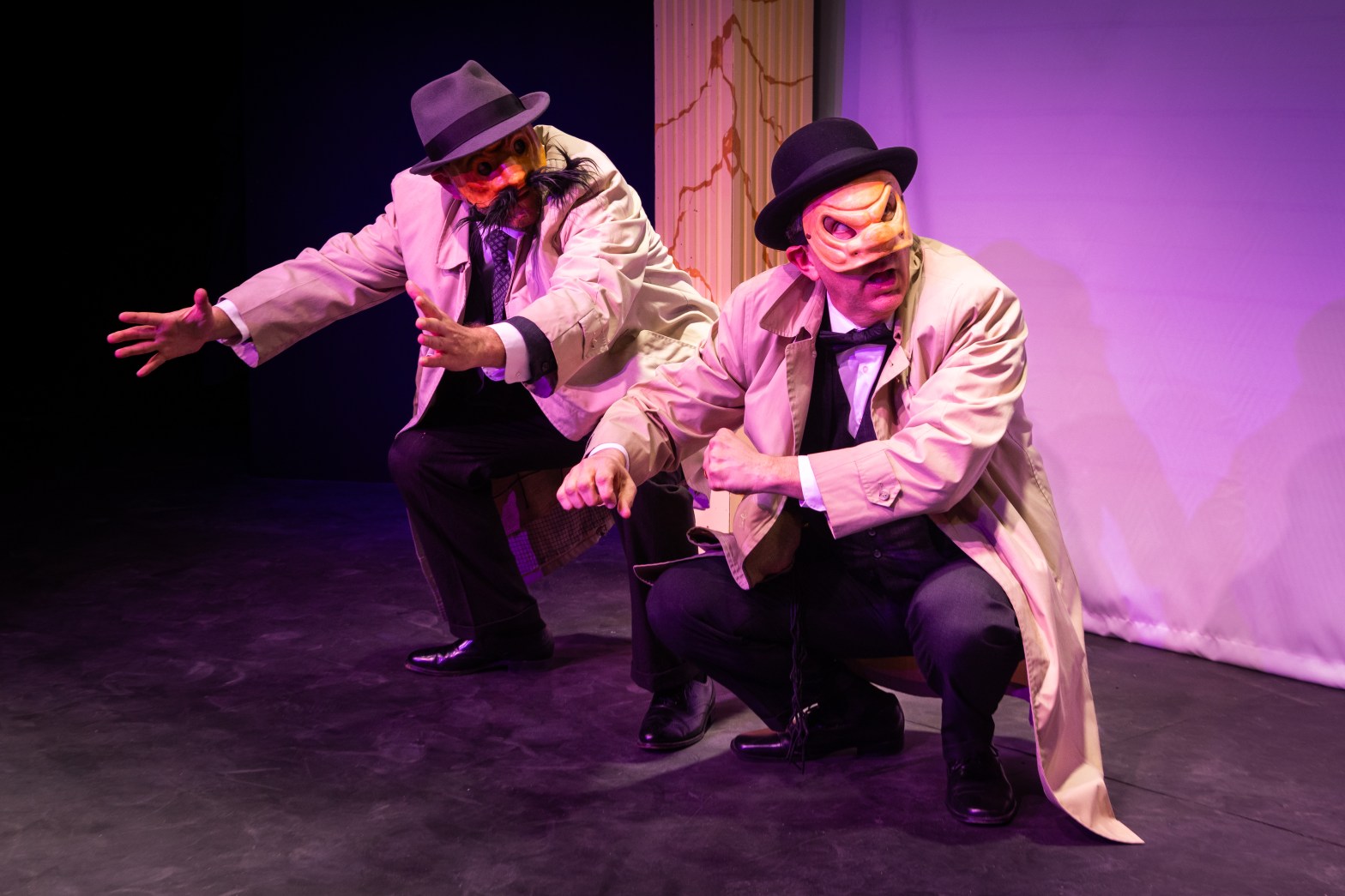
            If you are looking for a straight-forward documentary about Sacco and Vanzetti, this is not the play for you. This is a unique look at those events pertaining to the two men through the eyes of a commedia dell’arte lens. How is this sad chapter in American history a comedy? Commedia dell’arte reveals events but turns them into grotesque absurdities. And the arrest, trial, and execution of Sacco and Vanzetti is both grotesque and absurd! The subtitle of the play, “Sacco and Vanzetti,” is appropriately subtitled, “A Tragedia Dell’Arte.

            The characters in this drama are wearing normal clothing but their faces are covered with ridiculous masks. But these are real people- the attorneys who prosecuted and defended Sacco and Vanzetti and the judge who presided over the case.

            The story begins with their arrest on the street, for no apparent reason. It is presented in a comic manner, perhaps to make it less painful to us, but also to be reminded of the buffoonery of the law in many instances.

            Then there is the trial. The judge is clearly biased as he addresses the jury at the start and also how he talks to the defense attorney. He allows the prosecuting attorney free rein in whatever he wishes to do in the presentation of ‘facts,” which are most questionable. They manipulate the jury and the witnesses. But it was clearly an omen when the judge couldn’t manage to climb up to his seat at the bench and steps consisting, of thick books of the Constitution and the Bill of Rights were placed there to step upon.

            There is plenty of slapstick humor based on the Italian defendants’ inability to understand English. When told to “take the stand,” they grab it and run off with it. Having seen a play about Burns and Allen the previous night, I felt like I was watching a similar routine. I thoroughly enjoyed it.

            I was also glad to see so many young people in the audience. Theater is expensive and the seats are usually filled with folks over 60. Maybe this is a way to enlighten people about painful events about American History. Last week, I saw another sort of surrealistic “comedy”-  about slavery by James Ijames at the Wilma Theater.

            Finally, let me say something about the creator of this odd little masterpiece, John Bellomo. He did an outstanding job of researching the trial and transforming it into a mostly timely piece while using a style of the 17th and 18th centuries, Commedia dell’arte.  He wrote it. He directed it. And he portrayed Nicola Sacco. What a talent!

            The play was so interesting, that when I got home, I found myself looking up more about these two infamous men. Maybe this IS the way to teach history. 

“Sacco & Vanzetti: A Tragedia Dell’Arte” by John Bellomo at Curio Theatre Company, 4740 Baltimore Ave., Philadelphia, PA 19143 , 215-921-8243,  curiotheatre.org   thru April 18,, 2026

Say Goodnight, Gracie at Act II Playhouse

Tony Braithwaite is bringing back to the stage a character he loves, and we love watching him portray- George Burns. In two shows in 2023 and 2024, “Christmas in the Catskills,” he included Burns as one of the many comedians he presented. This time, it is 90 minutes of just Burns, one of the great straight men of comedy, as he reflects upon his life, particularly about the times with his wife and partner on stage, Gracie Allen.

            Usually, standup comedy is performed by one person, but in the days of Vaudeville and radio, there were many duos- Martin and Lewis, Laurel and Hardy, and Abbot and Costello. They even made it to television as did Burns and Allen. In the show at Act II Playhouse, there is no Gracie. She died in 1964, six years after she stopped performing, Burns having lived for another 32 years, dying at 100 years of age. Braithwaite talks with us but he also talks with her, and we feel her presence. He goes to the cemetery regularly to talk with her. We also see images of Gracie and others that are briefly projected on a wall on the set. This is a remarkable play, written by the multi-talented playwright, Rupert Holmes. He collected some of the funniest routines and meshed them with a most interesting story of the lives of Burns and Allen in his play, “Say Goodnight, Gracie.”

            Born Nathan Birnbaum, it begins as he is talking with God and looking back at his life. He lived with his parents and 11 brothers and sisters in a 3-room apartment near the Bowery in New York. When he was 7, his father died and he tried to help support the family by selling newspapers, shining shoes, and selling ice. Then, while working with other boys, they were heard singing and people threw pennies to them. Thus began a career in show business when he was 8 years old.

            He wasn’t doing comedy. He was singing and dancing, but he began working with others as he tried to expand his repertoire. When he met Gracie in 1922, he was without a partner and they decided to work together, with Burns writing the comedy for their sketch. He got no laughs. She got plenty. It was then that he realized that she was the natural comedian, and the rest is showbusiness history as they performed together for 36 years.

            Braithwaite both describes and acts out some of their bits. Burns loved her voice. He loved her acting ability. And he loved the manner in which he could start her going on stage by just asking, “how’s your brother.”  In one bit, he asks her why she was under the bed when he entered the room, and she replies that someone told her to read Dr. Jekyll and Hyde,” and she was doing that. She murdered language so naturally that it’s hard not to laugh at all her funny screw ups.

We travel with the two as they go from place to place around the country, then to radio, and finally tv. There is more after Gracie passes away as Burns’ career continued for three more decades. It’s hard to fathom how so much was packed into 90 minutes! Written in 2003, it was the third longest solo performance show in Broadway history with Frank Gorshin as George Burns. I can’t imagine anyone but Braithwaite in the role. He captures the essence of Burns’ style and his voice. And he keeps us laughing throughout.

Many of the shows are already sold out so I suggest you get your tickets soon to this funny, sweet masterpiece by a master himself, Tony Braithwaite.

“Say Goodnight, Gracie” by Rupert Holmes at Act II Playhouse, 56 E. Butler Avenue., Ambler, PA 19002, 215-654-0200,  act2.org   thru May 3,, 2026

Jelly’s Last Jam at Bristol Riverside Theatre

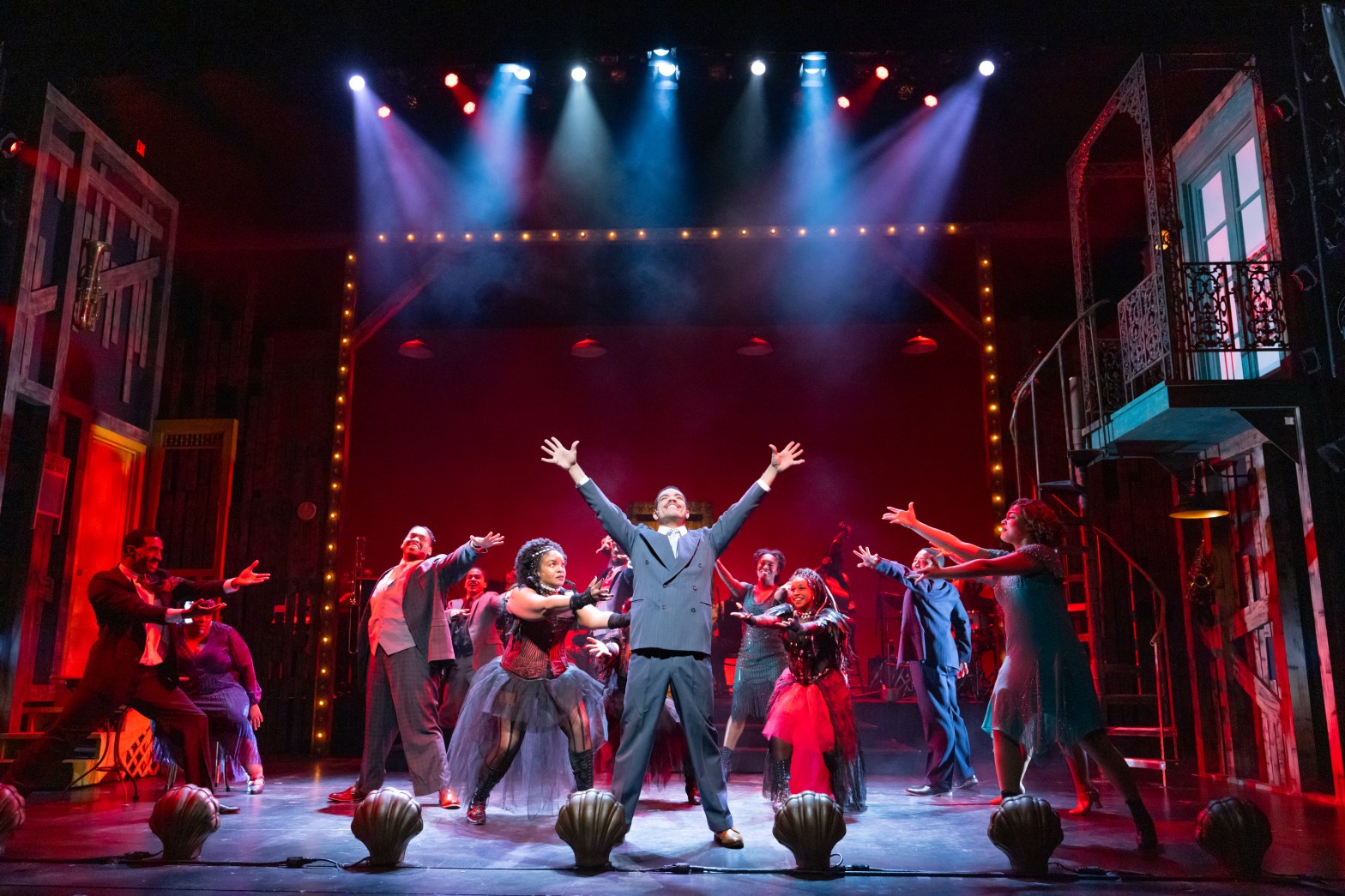
What an interesting title- “Jelly’s Last Jam!” It is not about a condiment to be spread on toast. It is about a man, born around 1890 into a Creole New Orleans community and the music he created. It is about Ferdinand Joseph LaMothe, better known as Jelly Roll Morton, the self-proclaimed founder of jazz in the early 20th century. This award-winning show, with the book about his life, written by the brilliant George C. Wolfe, “Jelly’s Last Jam” opened on Broadway in 1992 and is now appearing on the Bristol Riverside stage.

            It is called “Jelly’s Last Jam” because Jelly Roll would create no more music. It is his last jam because he is gone… dead, and the mysterious Chimney Man (Forrest McClendon) is about to take him through many of the key moments of his life, from time he was kicked out of his grandmother’s house (his father had deserted the family, and his mother had died) because he was working in brothels in New Orleans, to his friendships and lovers as he moved from city to city performing. We travel with Jelly Roll through his life story.

            Jelly Roll Morton was a Louisiana Creole, resulting from a mix of races between African Americans and French White ancestry. The lighter skinned offspring often tried to hide their Black heritage. Throughout his life, Jelly Roll struggled with his color, fearing he wouldn’t be accepted. And at one point, because of his jealousy, he denigrates a Black friend by calling him a nigga.

            If you don’t know much about Jelly Roll’s life, you will learn a lot, even though Jelly Roll himself is denying much of the interpretation. He was always a braggart and didn’t like anything negative said about him. Sadly, during his life, he didn’t get the appreciation he deserved.

            We see his interaction with Anita, whom he didn’t treat with respect. We see his interaction with the White men who control his bookings. And of course, we hear his music. Sadly, I wasn’t familiar with the songs, and I struggle with hearing the lyrics when the band plays loud, and the mics are not turned up. But I didn’t care because what I was watching on the stage was so mesmerizing. The beautiful dancers were extraordinary. Taps choreographer DeWitt Fleming, Jr. deserve an award for what he did with the many dancers. I could have watched them without the songs. The costumes, designed by Levonne Lindsay were gorgeous! And though the actors sat at the piano miming the playing, upstage was the outstanding piano player/conductor/Musical director, Victoria Theodore, who created these remarkable, musical scenes and played the Jelly Roll songs.

            And then there was Jelly Roll himself. Stanley Martin was so convincing in his bravado, his anger, and his passion, that I now understand so much more about this extraordinary musician. The entire cast was first rate but to name the 20 plus actors on stage would make this review too long. Thank you Tyrone L. Robinson for directing this most complicated story and making it a treat to see, learn, and just experience.

Jelly Roll Morton was the piano man long before Billy Joel. Get to Bristol Riverside and see this staging of Jelly’s Last Jam. You’ll be talking about it for a long time. “Jelly’s Last Jam” book by George C. Wolfe, lyrics by Susan Birkenhead, music by Jelly Roll Morton and Luther Henderson, at Bristol Riverside Theatre, 120 Radcliffe St., Bristol, PA 19007, 215-785-0100, brstage.org,  thru April 26,, 2026