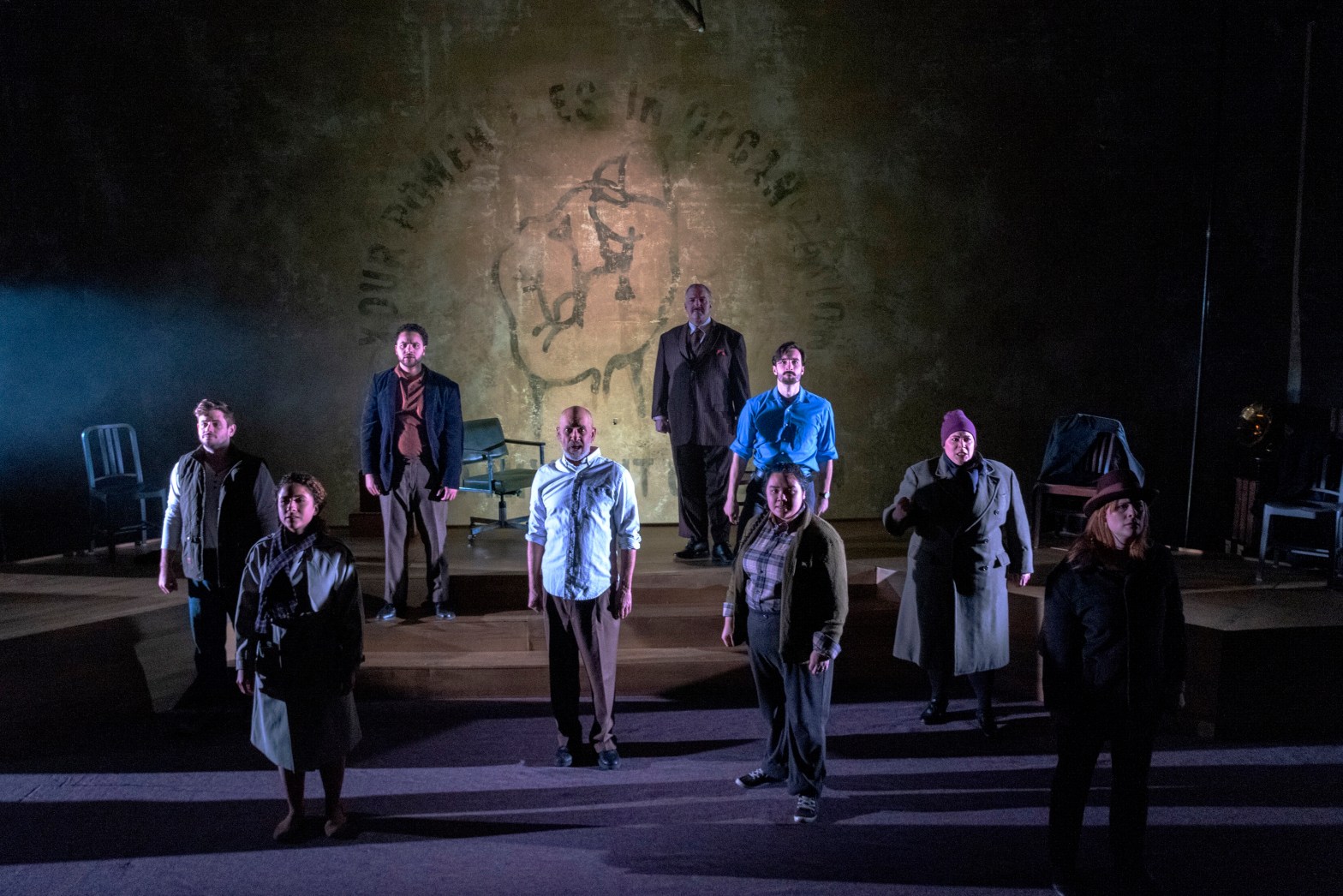
Mary Poppins at Quintessence Theatre

Let me get right to the point. “Mary Poppins,” which is currently on the stage at Quintessence Theatre is a spectacular tour de force and a must see. I don’t usually begin a review like this, but when I went to see the show, I expected a variation of the movie that was full of familiar songs, but nothing like what I saw. The show is not based on the movie but derives from the London West End production that debuted in 2004 and is truer to the stories created by P.L Travers. Travers didn’t like what Walt Disney did to her characters but I’m sure, would have been proud to see the 2004 version and the Quintessence production. She died in 1996.

When I do think of Mary Poppins, I realize that almost 60 years after I saw the movie, I can still sing many of the songs. And those songs are in this show along with several others. But they have so much more depth than Julie Andrews and Dick Van Dyck gave them in the Disney movie. This is not to fault the actors, but to give credit to the manner in which Julian Fellowes wrote the book for the show, based on Travers’ characters.

For those who may not know the story, Mr. Banks (a banker) and his wife are looking for a nanny. He is not an easy man to work for, and nannies have come and gone. In flies Mary Poppins, with her umbrella, to take on the job.

After the first ten minutes, when we realize we are not going to see reincarnations of Andrews and Van Dyck, we become fascinated with this production of “Mary Poppins,” which spends time developing the many different characters‘ lives, that Mary touches. And Mary herself is a fascinating and fun character herself. She is stubborn. But she is also real. She has an edge. You wouldn’t dare put toads in her bed or pepper in her tea. Hanna Gaffney, who plays Mary, doesn’t try to put on a happy face every minute. But she does try to provide a lightness to the real problems faced by all the people in the Banks’ family. Oh yeah, she can sing. She can sing!!!

Bert, the chimney sweep, is another genuine person. Steve Pacek doesn’t try to play him as a man larger than life. And that is another feature of this amazing production- even when some of the characters are rather absurd, it has a depth that goes beyond the comical. 

And it doesn’t stop there. The remaining members of this ensemble cast take on many roles and each character portrayed is superb. Some have depth. Some are ridiculous. All move effortlessly through a simple set this is constantly moving. Also moving are the wonderful props, including the dog and of course, the kite. Director Emily Trask has put on the Quintessence stage a show that will long be remembered.

The show is 2 ½ hours, but it is totally engrossing and a show that everyone of all ages will love. And I’m sure you will be singing silently, the songs that you know while you watch and continue singing them after you leave.

“Mary Poppins” at Quintessence Theatre, 7137 Germantown Ave., Phila, PA 19119, 215-987-4450. http://www.quintessencetheatre.org  Thru December 31, 2022.

Eleanor at Act II Playhouse

Eleanor Roosevelt, wife of President Franklin D. Roosevelt, was First Lady of the United States for 12 years and redefined that office. She was an intelligent, dynamic, active woman who, because of her relationship with her husband,  helped shaped American politics and history. Act II Playhouse has brought to the stage Mark St. Germain’s one-woman show, “Eleanor” with Penelope Reed giving a strong performance in this 90 minute biopic, which is both a history of the times through Eleanor’s eyes, but also a look behind the scenes at her private life and the nature of the relationship between her and the President.

It begins in 1918, when Eleanor is unpacking the suitcase of Franklin and discovers,  in letters from Lucy Mercer, that her husband has been having an affair with Eleanor’s secretary. Divorce would end FDR’s political career, and Eleanor and Franklin are convinced by his domineering mother Sara and by advisor Louis Howe, to remain together. But Eleanor insists upon three things- that she can live her life as she sees fit, that they would have separate bedrooms, and most of all, that he would never see Lucy Mercer again.

FDR, who was Secretary of the Navy, then becomes the vice-presidential candidate in the losing 1920 election. A year later, he is stricken by polio, and can never walk again without assistance and crutches. Eleanor becomes indispensable. She becomes his eyes and ears and they hide his paralysis from the public.

The play is filled with the facts of the history of Roosevelt’s rise to the presidency and the presidency itself. In fact, it is a little top-heavy with history, though my friend, who saw it with me, said she learned a ton. I found the history to be little more than what one can get on Wikipedia. I, would have preferred  learning more about Eleanor herself. I was fascinated to learn that her mother died when Eleanor was 8. Her father, who she calls the real love of her life, died two years later. An alcoholic and probably a womanizer, he committed suicide. 

I wanted to know more- about her relationship with lesbian journalist, Lorena Hickok and with other women.  I wanted to understand Eleanor’s anti-semitism early in her life.  I wanted to know more about how she did connect to Franklin. When she tells us that she was not a very good mother and was distant from her children,  I wanted more information about what she was thinking that could take us beyond the legend that she was.

It is a challenge to condense a person’s life into 90 minutes. I’d seen the outstanding production that Act II did a few years ago with another one-woman show, “Becoming Dr. Ruth,” also written by St. Germain. In the end, the success of such a show depends on the actor. Penelope Reed is much more attractive than Eleanor. She is slimmer. She wasn’t given the famous “overbite” of the First Lady. She didn’t speak like Eleanor in voice or rhythm. But if I didn’t “know” Eleanor Roosevelt from newsreels and from when I did see her on tv when I was a child, I wouldn’t have cared. I felt the same way when David Oyelowo portrayed Martin Luther King Jr., in “Selma.” He was good, but he wasn’t King. Perhaps it is unfair of me to expect Reed, who gives a fine performance, to expect so much.

There is much to learn about Eleanor and the times she lived in Act II’s production. It is presented effectively. I had hoped for something more powerful, more emotional, more personal to enrich it more from playwright, St. Germain.

“Eleanor” at Act II Playhouse, 56, E. Butler Ave., Ambler, PA 19002, 215-654-0200, www.act2.org. Thru November 20, 2022.

The Glass Menagerie at Arden Theatre Company

            After writing plays for eight years, “The Glass Menagerie” was Tennessee Williams first successful play. Opening on Broadway in 1944, it won the New York drama Critics’ Circle Award the next year. Williams would go on to write “A Streetcar Named Desire, Cat on a Hot Tin Roof, Night of the Iguana,” and another two dozen major plays and along with Arthur Miller and Eugene O’Neill, is considered among the greatest American playwrights of the 20th century. But it was “Menagerie” that started it all. Arden Theatre, which already produced “Streetcar” and “Cat on a Hot Tin Roof,” has opened the 2022-23 season with “The Glass Menagerie.” It is a strong production, not falling into the over-the-top acting traps that made the film version in 1950 mediocre and by some critics, a failure..

            The Wingfield’s live in a small apartment in St. Louis. Their income comes from their son Tom, who works in a warehouse in a job he despises. His sister Laura is a cripple who is painfully shy. She fears that she will never attract a “gentleman caller,” that her mother wants for her. Their mother Amanda, on the other hand is constantly reminding them how beautiful she was and had 17 gentleman callers on a single evening. But we are also aware the her husband left the family, never return, many years ago. It is a very fractured family.

            Amanda escapes through her memories. Tom escapes by going out to movies, long into the night. But Laura cannot escape, and her mother convinces Tom to bring to dinner, a man, any man from work, who might remove the burden of her daughter and support them.

Amanda IS a force to be reckoned with. Whether her husband left because he couldn’t deal with her or that she became the way she is, because he left, we never find out. In trying to control their lives, she is constantly telling her adult children what they must do, just as Williams’ mother did. Krista Apple gives a fine performance in portraying Amanda as a real person and not a caricature.

Hanna Brannau is even more powerful as Laura. We feel her struggle in her attempts to move about, in her body posture, and in her anxious face. We understand her struggles without a word, and when she does speak, we listen and we care.

Tom Wingfield is not only a character, Amanda’s son- he is also the narrator, outside the play, observing the goings on with his mother, his sister, and with Jim, the gentleman caller in the second act. Sean Lally is superb portraying Tom- the alter ego of Williams, who grew up with a very troubled mother and fragile sister.

He recalls, then comments upon what they say- what he remembers. He even warns us at the beginning, that this is a memory play, so it might not be entirely accurate..

I did have two issues with the production. As it is a very naturalistic story, the characters often speak rapidly, they speak softly, and I missed several of their words. because on the Arden stage- in the ¾ round- they had their backs to me. Ironically, if this were a film with the camera poised in front of them, I suspect it would have been more powerful than the Hollywood production. But when I have to work that hard to hear, it makes me less engaged in the characters and their stories.

Finally, the set design was not effective. The Wingfields live in a small apartment in St. Louis. The large stage, with a minimal set did not seem to reflect their situation, despite a few props from the 30’s. The play would have been served better by a tighter space with more than just the table and chairs for the dinner and a small sofa. In tightening the space, it also would have brought the actors further downstage where it would have been easier to hear them.

Still, Arden’s production of is a good one. The disillusionment, the disappointment, and the struggles have been brought effectively to the stage by Director Terrence J.  Nolen.

“The Glass Menagerie” by Tennessee Williams, Thru November 6, 2022.   Arden Theatre, 40 N. 2nd Street, Philadelphia, PA 19106, ardentheatre.org  215-922-1122.

Travesties at Lantern Theater

The year is 1917. The place is Zurich, Switzerland. World War I is raging. Henry Carr, a British consular official is thinking about his time there when he encountered the communist revolutionary, Vladimir Lenin, the great modernist author, James Joyce, and Tristan Tzara, a founder and leader of the Dada movement, an anti-establishment artistic style that began that year.

Written and produced in England in 1974, “Travesties” won The Tony Award and the New York Drama Critics’ Circle Award for best play when it was produced on Broadway in 1975. Lantern Theater Company planned to run the play two years ago, but the covid pandemic prevented that. Now, they are presenting it as the opener of their 2022-2023  season.

            The play is a kind of a memoir by Carr as he recalls events as well as he can remember them from some 50 years before. As a result, there are often two or three renderings of the same event. It is not a historical representation of what happened, but a distracted story of how he sees Lenin, Tzara, and Joyce in Zurich. In fact, Carr did perform as Algernon in Joyce’s amateur production of Oscar Wilde’s “The Importance of Being Earnest.” Whether he ever met Lenin or Tzara is left for the audience to decide.

            Nevertheless, Carr’s memory is full of bravado. Of Lenin, he says “I knew him well.” Of Tzara, he tells us he is often asked about the man. Of Joyce, he recalls an absurd conversation full of comedic rhymes. He doesn’t think much of Lenin’s revolutionary spirit, of Tzara’s absurdist approach to art, or of Joyce’s writing. But in various retellings of the story, he compromises his own ideals in order to win the affection of the beautiful, Cecily.

            The stories of each of the men are fascinating. In a way, it is a history lesson for the audience. But that is also the most difficult thing about the play. It is almost three hours long with one intermission. Will today’s audiences sit through such a long play with so much exposition? To be honest, I found it challenging myself, particularly the lengthy first act- 90 minutes. Leonard C. Haas as Carr goes on and on and on. He talks fast and it is tedious and tiresome. He is talking at us, not to us and though the play is punctuated with many humorous, many clever lines, it needs to be delivered in a more realistic manner.

            Then, Tzara (Dave Johnson) enters and the tiresome monologue becomes a tiresome dialogue. As I listened, I could hear the brilliance of Stoppard’s words, but I wish more attention in this production was paid to the subtleties and insightful observations of the playwright. The heaviness of the play was finally lifted with the entrance of Joyce. Tony Lawton made James Joyce real for me. He had a naturalness that engaged me whenever he spoke. Lenin (Gregory Isaac) and his wife Nadya (Lee Minora) were also effective and real.

            The real treat of the play was Campbell O’Hare as Cecily. While she is the foil for Henry, she is much more. She is sharp-witted, edgy, funny, and also the target of Henry’s affections, but she has passions of her own. She is a delight to watch as her relationship with Henry is told again and again and again.. The cast is strong when they act as an ensemble, but Director Charles McMahon needs to get more from them  when they are lecturing each other and  “educating” the audience.

            If it was confusing at times, we know it was just as confusing for Henry, who says at the end, “I learned three things in Zurich during the war. I wrote them down. Firstly, you’re either a revolutionary or you’re not, and if you’re not you might as well be an artist as anything else. Secondly, if you can’t be an artist, you might as well be a revolutionary… I forget the third thing.”

            A postscript: Lantern Theater must be applauded for an amazing playbill. It is full of most interesting information, which if you can’t read it before the show, you must read it after.

“Travesties” at Lantern Theater Co., St. Stephen’s Theater, 10th & Ludlow Streets, Phila., PA 19107, 215-829-0395, www.lanterntheater.org Thru October 9, 2022.

Prisoner of Second Avenue at Act II Playhouse

Neil Simon is clearly the most popular American playwright in the last half of the 20th century. With a career that began writing comedy sketches for tv in the ‘50’s, he turned to playwriting and created over 30 plays that ran on Broadway and almost as many screenplays, usually from adaptations from his plays. Full of gags and one liners, the plays also had a social significance reflecting the times. One of those, “Prisoner of Second Avenue,” written in 1971, now graces the stage at Act II Playhouse in Ambler.

            Mel Edison, 47, has a successful job, a lovely New York apartment, two kids in college, and a loving supporting wife, when things fall apart. His home is no longer a haven- the toilet doesn’t work, the air conditioning overcools, the street noise is unbearable, and the neighbors are noisy. On top of that, he’s just been burglarized- he’s lost everything from his tv and his liquors to his suits. He becomes a prisoner in his own home. On top of that, he’s just lost his job. His becomes angry. He becomes paranoid, he becomes depressed. He has a nervous breakdown. But Simon’s play is not a depressing one. It is full of jokes and the audience is laughing constantly at Mel’s responses to everything.

            Director Tom Teti has assembled an outstanding cast led by Tony Braithwaite and Sabrina Profitt as the beleaguered man and his wife. They are the only two characters in the first act. But then, Mel’s siblings arrive in the second act to try some sort of intervention. Three sisters and a brother, and they are a riot. Zinger after zinger as they assess the situation. They care for their brother but also, try to figure out what they can and will do to assist, based on the cost of the treatment he may need.

            Twenty-two years later, Simon wrote a play, “Laughter on the 23rd Floor.” This one might easily have been called Laughter on the 14th Floor.” Still, underneath all that laughter is a seriousness that is always present and gives his plays the power that propels it beyond a simple sitcom mentality. There are constant audio reports of the crime wave that is sweeping New York.

 There are a few times when the depth is lost in the funny jokes. But that is Simon’s style and it is minor. If there is one adjustment to consider, I would tone down Mel’s volume a notch to let us see what is inside him a bit more. But Braithewaite is one of the finest actors around, so good that I didn’t even mind his not playing the show without a New York accent. He pulls off every role I’ve ever seen him perform. And with the rest of the ensemble, they do a wonderful job in bringing this Neil Simon classic to the stage.

“Prisoner of Second Avenue” at Act II Playhouse, 56, E. Butler Ave., Ambler, PA 19002, 215-654-0200, www.act2.org. Thru Sept. 25, 2022.

Together Off-Broadway: Merman & Martin at Act II Playhouse

Two Broadway legends, Ethel Merman and Mary Martin appeared together on television in 1953 to celebrate the 50th anniversary of the Ford Motor Corporation. Rivals for the great roles, they became friends and traveled and performed together for years. In “Together Off-Broadway:  Merman & Martin, Act II Playhouse has put together a 70 minute show that is outstanding as we learn about these great stars while being thoroughly entertained by the songs they made famous.

            The act, was originated by Meredith Beck and Sarah J. Gafgen, the actors who play Martin and Merman, and they performed it around the greater Philadelphia area at various retirement homes. It was expanded into the current show by Act II’s Artistic Director Tony Braithwaite and Music Director Dan Matarazzo.

            Beck and Gafgen sing the songs of Cole Porter, Irving Berlin, and the Gershwins- the very songs they sang in the Broadway musicals- “My Heart Belongs to Daddy, Doin’ What Comes Naturally, I Can Do Anything Better than You, I’ve Got Rhythm.” I sat there realizing that I knew every song they sang, not from the theater, but from the LP’s. And these two performers were extraordinary!

            Gafgen didn’t just look like Merman, she had the power and the range of the singer. Ethel Merman was the original Rose in Sondheim and Styne’s show, “Gypsy. “Everything’s Coming Up Roses,” which she sings in it, became her signature song..

            Mary Martin, as Nellie Forbush in Rodgers and Hammerstein’s “South Pacific,” sang so many classics-“I’m Gonna Wash that Man Right Outa My Hair and “I’m in Love with a Wonderful Guy.” Beck nails all the Martin songs, including “Never Never Land” from “Peter Pan,” which Martin played on Broadway and twice on live tv in the ‘50’s.

            They each had a run playing Annie Oakley in “Annie Get Your Gun.” They entertain us as they sing “I Can Do Anything Better than You,” competing with each other.

            The show at Act II is more than song. We learn what Merman felt about her fourth and last husband Ernest Borgnine- the marriage lasted a few weeks. We learn how Marin had a child when she was just 17 years old- Larry Hagman. We see them waiting for the results of the 1960 Tony Awards where they were pitted against each other for “Best Actress in a Musial.” It is so much fun to watch them!

            And then we learn of all the movie roles that they didn’t get, roles which they created on Broadway. Betty Hutton played Annie Oakley. Rosiland Russell played Rose in “Gypsy,”  Julie Andrews played Maria von Trapp in “The Sound of Music,” the role originated by Martin on Broadway.

            On the stage with these two virtuosos is Dan Matarazzo, the pianist. He blends  seamlessly as he accompanies Beck and Gafgen, playing so softly at times, that we can easily hear the gentlest of songs without missing a word. And the costumes designed by Janus Stefanowicz were beautiful.

            Two more comments. I wonder what the response would be to younger audiences who don’t know the songs or know Ethel Merman and Mary Martin. In a way, it makes me sad that they don’t know these great women and the great songwriters, and I hope they come out to see the show.

            As for criticism, I only wish that the program had more information about the development of the show, about Merman and Martin, as well as a list of the songs they sang. But you don’t really need it if you just sit back and listen and be carted off to Broadway.

“Together Off-Broadway: Merman & Martin.” Created by Meredith Beck, Sarah J. Gafgen, Tony Braithwaite, and Dan Matarazzo.  Thru August 7, 2022. Act II Playhouse, 56 E. Butler Ave., Ambler, PA 19002.   act2.org   215-654-0200

Camille at Quintessence Theater

In 1848, 23-year old Alexandre Dumas fils wrote a semi-autobiographical novel about his love affair with a courtesan who was suffering with tuberculosis, then called consumption. Four years later, he turned “Camille”  into such a successful play opening in Paris.  Giuseppe Verdi put it to music the next year. Thus was born the famed opera, “La Traviata.”

            Lest I lead you in the wrong direction, the author of the play is not the well known  author of “The Three Musketeers,” Alexandre Dumas, but his illegitimate son. The word “fils” is attached to the son’s name- it is a translation from the French, meaning “son.”

            Quintessence Theatre has produced the original play on its intimate theater-in-the round space with a fine cast, led by Billie Wyatt as Camille. She fights her illness as she struggles with how to handle her life as she is pursued by two men. She doesn’t trust her judgment, but soon falls in love with Armand (Dax Richardson), while trying to fend off Count de Varville (Lee Thomas Cortopassi).

            There are other relationships we learn about through talk… and there’s plenty of talk. In fact, there’s very little action in the play and it is often difficult to absorb all that the ten characters are saying, particularly when he or she has their back to your side of the audience and they talk softly without mics. Though their stories are interesting, they go on and on. We can’t see the passion of the characters and it is not film, where the camera can move when the actors don’t. We do have the wonderful costumes designed by Anna Sorrentino to look at, fortunately. Director Steven Anthony Wright could have been more creative in the staging of the play with this talented group of actors. But slowly, very slowly, the story emerges.

            One theme of the play is jealousy. We watch the other two couples as they toy and tease each other. We see Armand’s jealousy of Varville. But the crisis comes when Armand’s father steps in and tries to convince Camille not to run off with his son, lest it wreak havoc for Armand’s sister, who would be shamed and unable to marry her fiancé.

            The play is 2 ½ hours long and in today’s theater world, that’s a long time to sit through conversation after conversation and many monologues. Perhaps it is just me. I haven’t even attempted to see a 2 ½ hour play by the great William Shakespeare in several years. After all, “Camille” is a major play in the history of theater. I am curious to see the musical that Verdi turned the play into and wonder  if it will hold my attention more. It was one of the most performed operas for well over a hundred years.

“Camille”  at Quintessence Theatre, 7137 Germantown Ave., Phila, PA 19119, 215-987-4450. http://www.quintessencetheatre.org  Thru July 3, 2022.

This review appeared late because I contracted Covid and was out of circulation.

Flyin’ West at Quintessence Theater

This is the story of four African-American women who left the South after the failures of Reconstruction, and headed west. Three sisters and an older friend that they met in the all Black town of Nicodemus, Kansas, are trying to try to find a better life for themselves. 

The American West was the hope of many souls. With the support of the Homestead Act,  doors were open for those who would venture west, to start anew …  if they could handle the demands of the challenging environments in a raw, loosely settled land. But this story begins after the move. It takes place in 1898, some years after the four settled in the backwater town of Nicodemus, Kansas. It is not the fantasy west of Kit Carson, Buffalo Bill, Wild Bill Hitchcock, or even Annie Oakley. But although this story is historical fiction, these people are more real than those western legends. These women represent those pioneers who ventured west to begin a new life, where a black skin was not a detriment. Pearl Cleage’s fascinating play is less myth and more about real people.

Fannie, Sophie, and Minnie bought their property a few years earlier. Living with them is Miss Leah, as she is older and needs assistance. Minnie actually left a to return east to Memphis and has now come back with her husband, Frank. Seems simple enough–it’s not. 

During the 1890’s, the land that they bought was cheap. The Kansas settlement was uniquely African-American. But now, the land has risen in value. White speculators are trying to buy out the early settlers, thereby changing the nature of the town where those pioneers achieved independence. And Frank, son of a white man and a Black woman, who seeks to pass for white, is one of those men who wants to make money by forcing the sisters to sell Minnie’s share.

That is the edge of the conflict, but what drives the play are the old Miss Leah, once a slave who was forced to give up the children she bore, and Sophie, the sister who wants no part of the white world and stubbornly fights against the likes of Frank. They are strong in different ways and that is the beauty of the tale.

Under the direction of Zuhairah McGill, the portrayals are powerful. Deanna S. Wright as Sophie is mesmerizing. It’s hard to take our eyes off her to see her reaction to all that transpires. There is kindness in the likes of one of the men played by Phillip Brown just as there is abuse that spews from Frank (Dax Richardson). And McGill herself plays the both simple and complex, dramatic and comedic role of Miss Leah. She’s great! 

The story is riveting. It explores racism and sexism in America at the end of the 19th century. Cleage has created a fine piece of drama and Quintessence presents it superbly. 

“Flyin’ West”  at Quintessence Theatre, 7137 Germantown Ave., Phila, PA 19119, 215-987-4450. http://www.quintessencetheatre.org  Thru July 3, 2022.

Fairview at The Wilma Theater

“Fairview,” by Jackie Siblies Drury, currently at the Wilma Theater, is perhaps the most complex play I’ve seen on the stage in years. It begins in what seems to be a very normal African-American household, as they are about to celebrate the birthday of Grandma Suze. Family is coming in from out of town and Beverly, the mother is preparing for the event as she banters with her husband, Dayton. It almost feels like a tv sitcom.  But in short order, everything goes awry- from the food to the silverware to getting word that one son might not make it. This is life, and it is no less complicated than real life, but it is not the guts of play.

We, the audience, are constantly trying to figure out precisely what actually is happening. Often, I turned to my friend who came with me to the play and she just shook her head with a baffled expression. 

It seems like every character is ambushed by changing facts or a new understanding of the underlying struggles that that they and we all face. But the real victim is the audience, as we are cleverly thrust into chaos. Drury knows that most of the audience is White and she chooses not to give a naturally developing story but a surrealistic one. Things don’t fit. Relationship are not real. “You think you understand us,” she seems to be saying. “I think not.” I agree.

The characters are all interesting. They are fun and make us laugh. And they are  multi-racial. How can that be? This an African-American family, isn’t it? 

  There is one scene, behind windows where White people peer through  windows as the Black family sets up for the birthday. Are they trying to understand something? They even ask each other what race they would choose if they could be any race but White. One could not help but wonder what race the members of the audience would choose to be if they had the choice. But the discussion at the window is long and a bit overbearing, even though we can watch in the foreground, the family repeating the dinner table setup of the first scene.

In the third scene, daughter Keisha is clearly disturbed when one of the White women who was at the window, appears as the girl’s grandmother. She is confused. So are we. Then, the son finally arrives. He too is White. What is going on? What does it mean?  It is complex. You’ve never seen a play like this. I certainly haven’t… and it’s fascinating.

We are told that at the end of the play (spoiler alert), that the audience will be invited on stage, into the set, to try to connect better with the substance of the characters, the play, and race itself. Many went up there…maybe to get a Fairview.

“Fairview” at The Wilma Theater, 265 S. Broad Street, Philadelphia, PA 19107, 215-546-7824  www.wilmatheater.org  extended thru June 26, 2022

American Jade at Bucks County Playhouse

           Memoirs are a form of autobiography that go beyond just the story telling of what happened in a person’s life. They are filled with the writer’s reflection on the events, and they show us how the memoirist felt about his or her life. The most popular ones are usually about celebrities- show business, the political life, sports. And in the recent decades, they have become the most popular book in the publishing world. Bucks County Playhouse is producing a new memoir in a different form, on the stage, as one of those writers is also a performer and relives her story. It is a departure from the bigger shows and musicals usually on that New Hope stage and it is enjoyable, intriguing, and a learning experience for me.

            The story is written by and starring Jodi Long, a most accomplished actor in film, television, and on the stage. She chronicles her life from her earliest accomplishments (when she was cast at the age of seven by famed director, Sidney Lumet) to today, some 60 years later. But what makes it most fascinating are the tales she tales of her parents. Jodi Long’s mother is a Japanese-American, her father is of Chinese descent.

            Jodi grew up in Queens, New York.  Her parents were performers of a Vaudevillian style, her father an accomplished dancer, and they traveled the country in the 1940’s and 50’s wherever there was a chance to entertain. They even appeared on the “Ed Sullivan Show.” But there is so much more to the story. Her mother, who grew up in Oregon, was in an internment camp because of her Japanese heritage- this, while Jodi’s uncle, her mother’s brother, was fighting the Nazis in Europe.

            She loved both her parents, but the marriage didn’t work out and they divorced.  She had to establish relationships with new step parents. But she was rescued by her talent, first going to the High School of Performing Arts, then as a theater major to a New York State College at Purchase, before going on to a successful career.

            I can go on and on telling you what I learned from Jodi’s memoir. How her father, who couldn’t speak Chinese, faked words to give his audience the impression of a native Chinese man. In fact, he came from Australia and was of Chinese and Scottish descent. How her mother gave up show business when she divorced. About the different productions, successful and failed, that Jodi worked in. But it best to hear it from her, on the Bucks County stage, about her personal journey through life as an Asian-American, who was probably more American than most Americans.

            The only bit of criticism I had for the piece was the beginning of first act of the two hour play. Jodi was simply telling us what went on. I liked it better when she more dynamically took on the characters of the people in her life and showed us. It is a new play and will probably keep evolving, but it still leaves the theater-goer enriched. I always like that.

“American Jade” by Jodi Long. Thru June 11, 2022. Bucks County Playhouse, 70 Main St., New Hope, PA 18938. Buckscountyplayhouse.org   215-862-2121