An Act of God at Act II Playhouse

Tony Braithwaite is one of my favorite Philadelphia actors because he can play so many different types of characters without absurdly stretching the limit. So I was most intrigued when I learned he be would portraying God in Act II Playhouse’s comedy, “An Act of God.” Written by Emmy Award Winner comedy writer for his work on “The Daily Show with Jon Stewart,” David Javerbaum, the play featured Jim Parsons when it opened on Broadway in 2015. I can’t imagine anyone doing it better than Braithwaite.

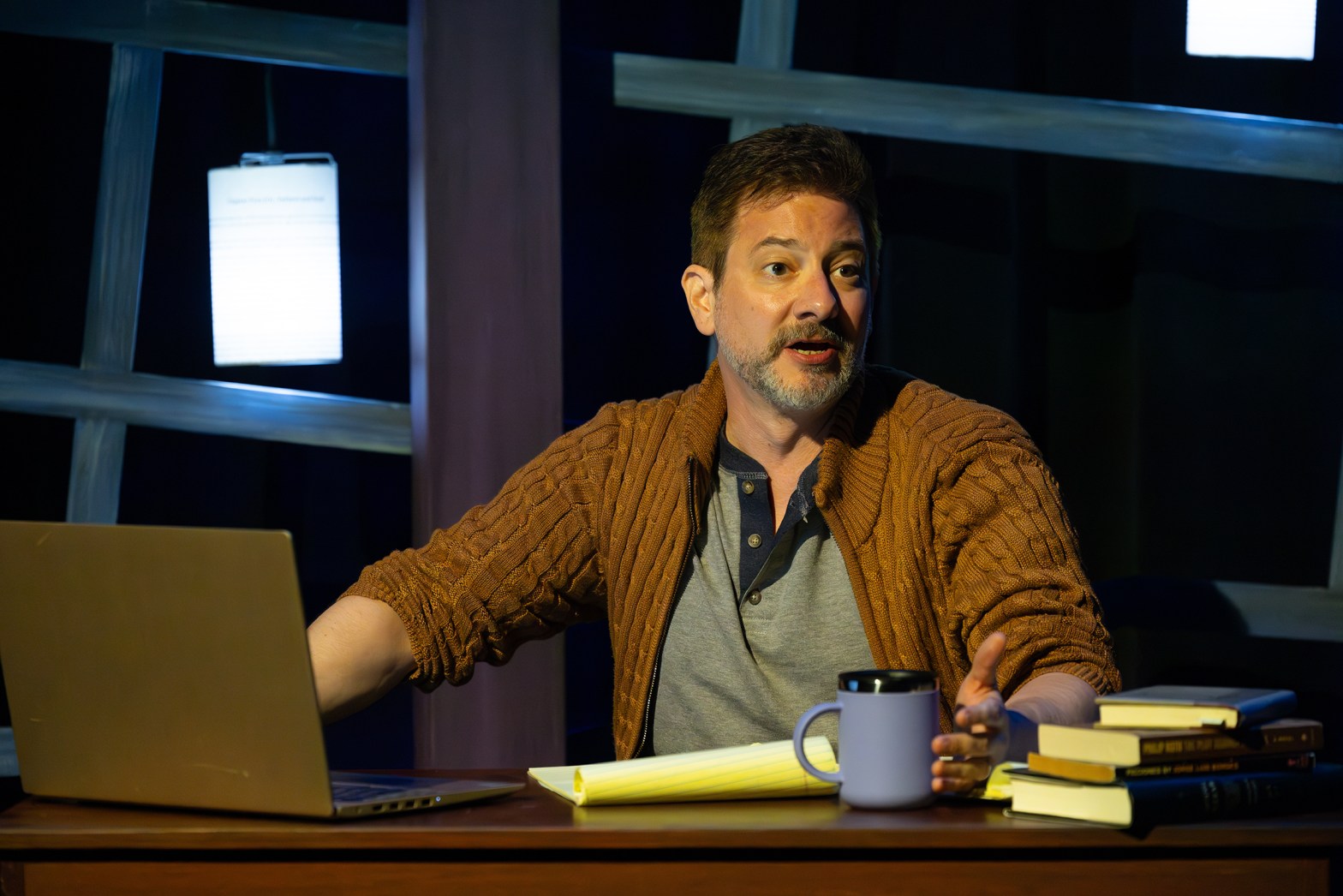
            When the play begins, God (Braithwaite) is dressed in a white suit as he explains that he has chosen to appear in the body of the Act II actor (Braithwaite) who is at home, sleeping. He tells us and the two archangels who accompany him, that he has come to Earth to straighten out the misconception that religions have about him. He is coming with a new set of Ten Commandments.

            He talks about the challenges posed by evolution. He complains about the God-given right to guns and why bad things happen to good people. He asks that we stop saying God bless you when ever someone sneezes and about his issue with the song “God Bless America. Neither does he like the terms, goddammit and goddamned! He talks at length about Abraham, who he asked to sacrifice his son… until he changed his mind. He talks about circumcision. He talks about Jesus, who he at first didn’t think was too bright and was not an only child, but a middle child, between Zach and Cathy. He is annoyed with the athletes who are always thanking him when they succeed, as they kiss the cross and look to the heavens. It is all preposterous!

            As for the new commandments, one is to Honor Thy Children. Another is “Thou shalt not tell others whom to fornicate.” And he emphasizes “Thou shalt not seek a personal relationship with God.”

            But God doesn’t just complain- he is funny when he talks about the world. He is very funny while giving us so much to think about. There are many smart jokes and clever innuendoes. At times, we feel like we are watching a brilliant stand-up comedian. Other times, he responds to Archangel Michael’s (Paddy May) probing questions while he takes comfort in Archangel Gabriel’s (Reneee McFillin) support.

            And we see that even God has a temper. Even God doesn’t know what is always happening. Even God has trouble making decisions. I don’t want to spoil the tons of jokes that come at us, but as I indicated above, they are not a slapstick sort of humor. They are just fun and funny! We all just laughed and laughed during this wonderful 70-minute play.

“An Act of God” by David Javerbaum at Act II Playhouse, 56 E. Butler Avenue., Ambler, PA 19002, 215-654-0200,   act2.org    Extended thru September 8, 2024

Somewhere Over the Border at People’s Light

With a title like “Somewhere Over the Border,” you can’t help but wonder if it is about immigration or is it a take on the song, “Somewhere, Over the Rainbow.” It turns out that this musical is about both. Reina is a 17-year-old girl in El Salvador in 1978 who has just given birth and wonders if her country is the best place to raise the child. She eventually decides to flee to the United States, leaving all behind (including the baby) where she hopes she can find a better life and eventually bring her family with her. It is a trail far more intimidating than the Yellow Brick Road from “The Wizard of Oz,” though she does meet others who want to go with her. People’s Light presents this beautifully written tale, with on-stage musicians performing hip-hop, rock, and more traditional theater music as this superb cast of 6 shares this journey with us.

            The story is told to us by The Narrator (Arusi Santi), one of the musicians. But in effect, each character is a narrator, as we understand their many struggles and hopes.

            El Salvador is a dangerous place to grow up and live in the 1970’s. Hearing idyllic stories about what life is like in America, Reina (Isabella Campos) dreams of a better life. She has a supportive brother and lives with a cantankerous mother. One day, at the market, she meets a neighbor whose daughter has escaped to San Diego and is living the good life. Unfortunately, there’s no way to enter legally so she must raise a hefty sum of money to sneak across the border.

            She is lent money by that neighbor, by the man she works for, and from her brother,  and she begins her trek. She is told how to meet a contact person to whom she will pay the money, the man who will smuggle her across the border. She leaves only a note for her mother. En route, she meets three others who also have personal reasons for wanting to get to America. But rather than a scarecrow, a tin man, and a lion, these are real people with real motives for wanting to emigrate and I won’t spoil the story by telling you too much about them. The banana farmer, the innkeeper, and the nun will all join her, each coming up with the money they need for the payoff.

            This first act was filled with song and humor that keeps us on the edge of our seat while also making us laugh with the comedy in the script by Brian Quijada (whose mother fled from El Salvador before he was born). This talented man also composed the most entertaining songs that revealed the plot and allowed us to see what the characters were thinking. In relating the inner thought, he used rap. Other times, old fashioned rock told the stories. And then, the were the soft songs that every lover of old musicals could relate to- all masterfully performed by the band.

            The first act, an hour and twenty minutes of the two-act play was flawless. While there were clear comparisons with the film, they were understated, and we could appreciate the struggles that the travelers faced without it being thrown in our face. The second act was not as powerful. Expecting lots of drama, I was disappointed in how the 40-minute second act sped through the events of the crossing and the aftermath, including her disappointment in America and what followed when she sought to bring her son there many years later. That first act was so good, I wanted more!

            Still, I highly recommend this remarkable and unusual play. We care about the tales of each character as well as understand why so many people seek refuge in America. You will come away talking about this for a long time!

“Somewhere Over the Border” by Brian Quijada at People’s Light, 39 Conestoga Rd., Malvern, PA 19355, 610-644-3500, peopleslight.org   Thru August 11, 2024

off by one at People’s Light

Myra is trying to deal with the death of Douglas, a poet she met many years ago and she is struggling as she tries to send texts to the man’s son. But she has inadvertently sent the texts to a young woman, Fran, who she doesn’t even know, because she sent the messages to the wrong area code- she is off by one digit, sending it to 213 rather than 212. And that is the name of the new play, “off by one,” a world premiere by Joseph Dougherty at People’s Light in Malverne.

On another part of the stage is Douglas, a lonely old man who is not dead yet but is reflecting on the inevitable in the cabin-like home he bought 30 years earlier, at the far end of Long Island, after his wife died. He is a poet, who never achieved the recognition he sought. He is smart. He is insightful. But he is clearly nearing the end of his life. Time is fluid as we move back and forth before and after he died.

What is so fascinating about this play is that even though much of the it is built around Douglas (David Strathairn) and his decline, it is the response of Fran (Claire Inie-Richard) that drives the play as she strives to learn about Myra and contacts her. Fran’s boyfriend Matthew (Aubie Merrylees) is none-too-pleased with Fran’s attempt to find a special meaning in her life by connecting with Myra. They argue. He’s a pragmatist. “The universe doesn’t care,” he says. “It’s about what is and isn’t.”

But life is complicated. Each person tries to find meaning in their own special way. Douglas’s life as a poet, then as a hermit while he still tried to write and publish, is haunting. And there is that summer, decades before, when Myra came to his place to help him organize his writing. What really happened? It is a story unto itself.

Also complicated is Fran’s life. She is a dreamer and thinks there is much more meaning in life since getting those texts meant for someone else. She believes she has received them for some mystical reason. She fights with Mathew who is rather inflexible and but she finds joy when she connects and then visits Myra.

It’s one of those plays where we wonder what would have happened if … There are fascinating, albeit confusing times, when memory and time are significant parts of the story.

The play is 1:35 long, without an intermission, but I am sad to say, it felt much longer. Ironically, I would prefer that playwright, Dougherty make it a two-act play and give us more- more about Douglas and his relationship with his wife Carol before she died, more about his relationship with his son, more about Myra. But most off all, I would like, what seemed to be two separate plays, to have been better integrated.

Strathairn, a popular actor from film and television, was great. All the actors were superb. The set by Daniel Zimmerman was strong. And the ideas in the play were most interesting. It’s worth a look even though I hope Dougherty will continue to develop the play.

“off by one” by Joseph Dougherty, at People’s Light, 39 Conestoga Rd., Malvern, PA 19355, 610-644-3500, peopleslight.org   Thru July 7, 2024

The Climb at InterAct Theatre Company

Marge is a successful photographer and professor of photography.  Tiffany is a former student of Marge’s who has become the subject of all Marge’s photographs since they met. They fall in love and are married. But now, six years later, Tiffany is questioning her whole relationship and takes off on a month-long backpacking hike by herself as she tries to figure out if she was and is really loved, or only a prop, a muse in Marge’s life. InterAct Theatre has put on its stage the world premiere of C.A. Johnson’s “The Climb. And it is a fascinating look at art/photography and both the makers and subject of that art.

            Two other characters in Johnson’s play help bring out the complexity of Marge (Sam Rosentrater) and Tiffany (Ciera Gardner). One is a new student of Marge’s, Bella (Claris Park), who is fascinated with the history of photography and with her professor’s work. The other is Ike (Trevor Fayle), a man Tiffany meets on the hike. He is a nice guy who talks a lot, but she is not interested in him as she planned for this trip to be a silent hike.

            As a photographer and former theater director myself, I was fascinated by the questions raised in “The Climb.” How much of a fine photograph is the product of the photographer or is the model just as important in the final work of art? Who is in control? What does a portrait say? In the lobby of the show, there are many famous works of art (portraits) displayed. How much do we know about these muses? Tiffany is asking those questions of herself. Is she more than an object? She climbs the mountain with Ike, but her climb is far more complex.

            Marge too is struggling. She genuinely loves Tiffany, but she has also used her to enhance her own reputation as a photographer. As mentor to Bella, she learns as much from Bella as she gives to the 19-year-old student.

            It was Marge who originally introduced Tiffany to hiking and there are flashbacks to that trip as reminders of that first picture that she took of Tiffany that changed the lives of both of them. And though Marge seems unable to take any photos while Tiffany is gone, Bella urges her to shoot. But she takes a photo of the young girl, and Bella, sensing what might happen, rebels.

            There are so many other interesting points raised in this drama. Is Marge’s love for Tiffany real or is she a narcissist who is using Tiffany, as my friend who saw the play believes? I love theater which raises questions but doesn’t try to resolve them. In fact, the term male gaze is used. That is when a man objectifies a woman for his own needs. Though she is a woman, is Marge seeing with the male gaze?

            Then, there is Ike who is genuinely trying to get to know his fellow hiker. But Tiffany wants nothing to do with him for she sees him in a paternalistic way that she neither needs nor wants. Will the hiking change that experience? So many questions in this finely crafted play by Johnson- from what is art to who we are.

“The Climb” by C.A. Johnson  at InterAct Theatre Company at The Drake, 302 S. Hicks St., Philadelphia, PA 19102, 215-568-8079  interacttheatre.org  Thru June 23, 2024

Father Comes Home from the Wars at Quintessence Theatre

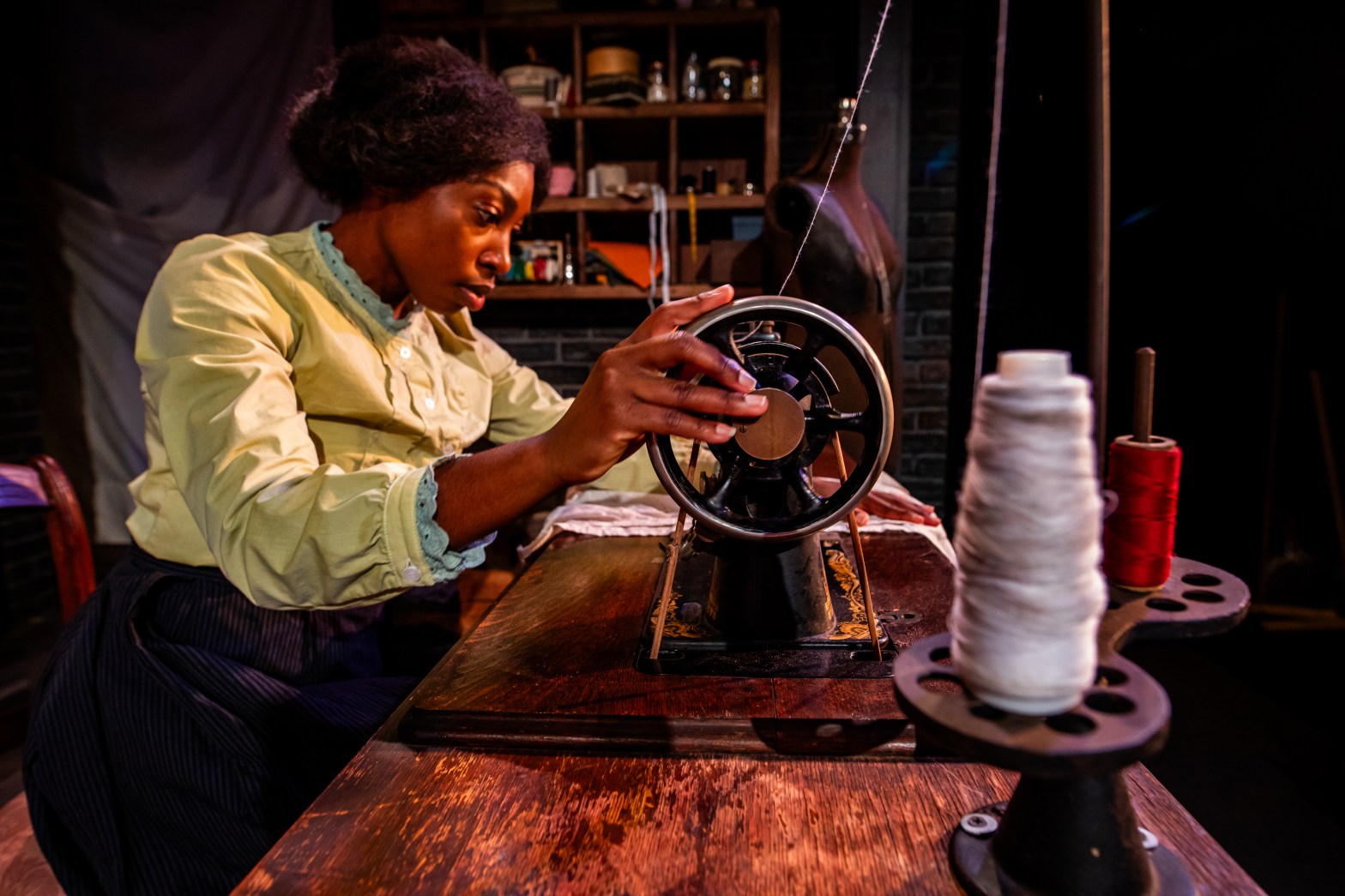
            It is the summer of 1862 in West Texas as the U.S. is in the midst of the Civil War. Hero is a slave on a plantation when he is told by the owner, his master, The Colonel, that if he joins him and the Confederate Army, he will be given his freedom. It is a moral dilemma for Hero to fight for a cause that keeps his people enslaved. It is the first of many challenging and awkward decisions made by the characters in Suzan-Lori Parks brilliant three act play at Quintessence Theatre,

            As the dilemma confronts him, the others who live at the shack on the plantation, are betting spoons and shoes as to whether or not he will go. There is a comic tone at first. He gets advice from the old man (Monroe Barrick) who we think at first is his father (his father was hanged for trying to escape) and from the Penny (Deja Anderson-Ross), who we learn later, is his wife. On top of that is his dog, Odd-See, who has been his best friend and confidante. It has run away after an uncharacteristic kicking by Hero.

Alone in his thoughts, Hero (Kelechi Udenkwo) shuffles back and forth trying to decide, changing his mind constantly, unsure that even if he goes, will Colonel honor his promise. “I’ll be helping out on the wrong side” he says one minute before deciding to go. But then, he worries about what his life would be like with no one telling him what to do as a free man.  Will it really be better? He is even on the verge at one point, of having his foot cut off, so he won’t have to go. And the decision must be made before the sunrise. Enter Homer (Eric Carter), with a complicated set of issues from when he tried to run away.  He confronts Hero. They have a difficult past. If you are beginning to hear tones based on Homer’s epic poem, “The Odyssey,” you are correct.

The second act takes place in a forest. The Colonel has captured a wounded Northern Captain Smith (Donovan Whitney) and has him locked in a cage. Two white men discussing the morality of the war from different perspectives. Hero is off gathering wood for the fire. Will he return? In short order, he does, and the captain doesn’t understand why because both armies are within ten miles of their location.

The Colonel hopes to gain recognition from his commander for his capture. But the conversation amongst the three men is so honest, so real, that we are mesmerized by what they are saying and thinking about color, about life, about each other. I won’t attempt to repeat their talks and what happens to each as it must be experienced afresh by the playgoer.

In the third act, we are back at the slave quarters in West Texas. It is a year since Hero left. The owners are gone. There are a few runaways hiding there, planning to head north. Penny, who had been hoping to see her husband again, keeps asking the question- is he dead? She takes some comfort from Homer who wants to flee north with her and the runaways. 

Once again, so much is revealed, first through the dog, who has found his master, then through the confrontations Parks has created.

Throughout the play, with the exception of the cage in the second act, the stage is bare. We don’t need any set to feel the power of the many struggles before us. The acting is so genuine. Director Raelle Myrick Hodges has expertly put together this masterpiece. If there was one issue I had with the production, it was when some of the actors, with their backs to me, talked fast with their southern dialect, and I missed the finely crafted words of Parks, a Pulitzer Prize winner for her drama, “TopDog/Underdog.” “Father Comes Home from the Wars” is a play you will be talking about for a long time.

“Father Comes Home from the Wars” by Suzan-Lori Parks at Quintessence Theatre, 7137 Germantown Ave., Philadelphia, PA 19119, 215-987-4450, quintessencetheatre.org   Thru June 23, 2024

Forever Plaid at Act II Playhouse

Though the show, “Forever Plaid” was created 35 years ago and has been performed around the world, it is a musical that I’d never seen. I only knew it was something about the “boy bands” of the 1950’s and a kind of musical review. It is so much more than that as presented at Act II Playhouse. I will go so far as to say I wouldn’t have gone to see the show had I not been reviewing it. It would have been a great loss for me.

            On February 9, 1964, a 1959 Mercury convertible was carrying four young men to a major gig to perform their songs. This all-boy band was hit by a school bus carrying Catholic school girls to the Ed Sullivan show to see another boy band- The Beatles. The four, who were hit by the bus, performed under the name, The Plaids. They were all killed. We don’t see the accident.  It is told to us by the four who have returned to this day to give us the concert they never had a chance to perform. And they do perform!!!

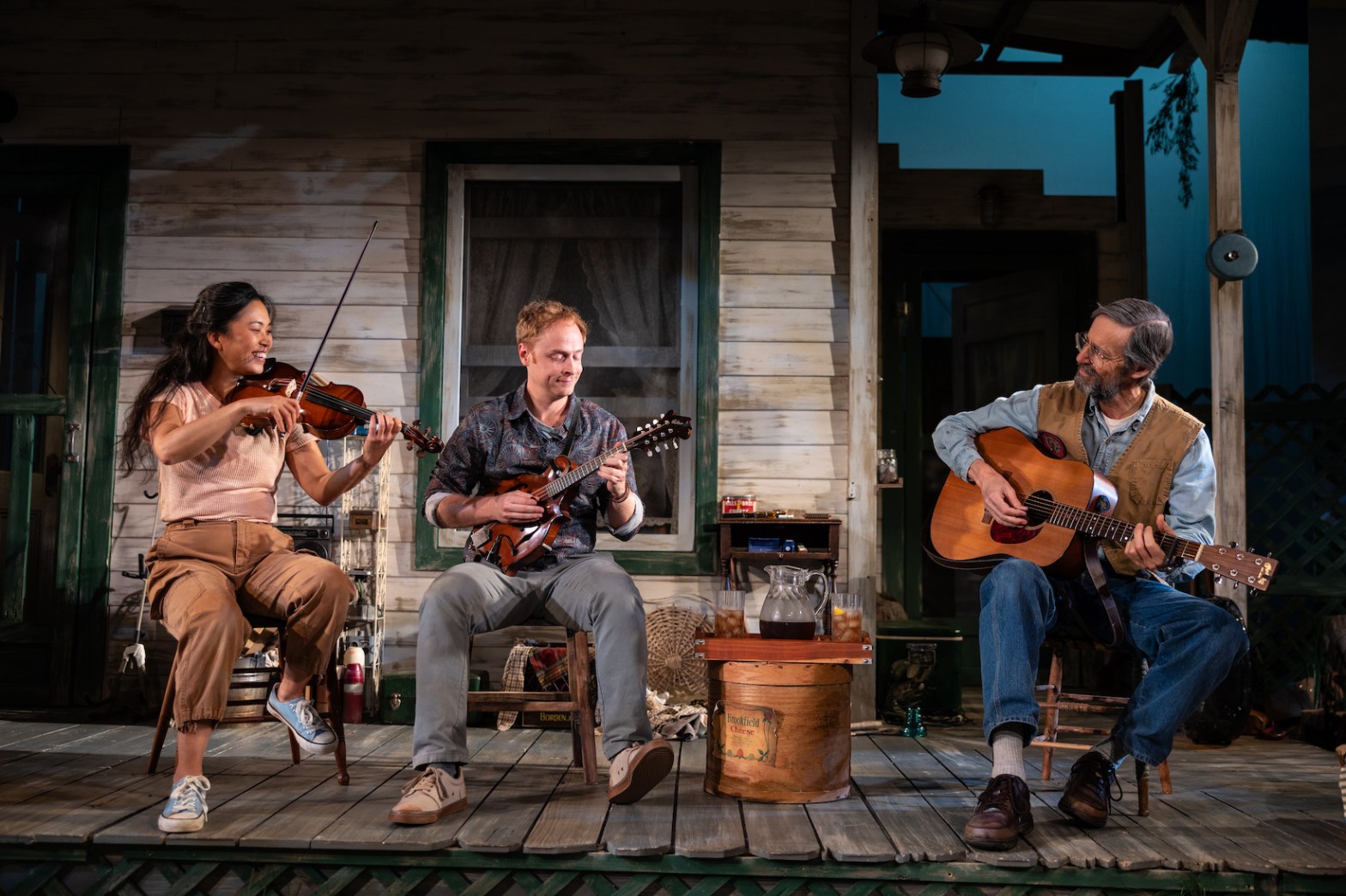
They recreate the classic songs of the 1950’s and early 60’s with such expertise, you would think that they were the original artists. “Three Coins in a Fountain, Moments to Remember, Heart and Soul, Catch a Falling Star, Lady of Spain. They sing the songs of their heroes, The Four Freshmen, The Hi-Los, and The Crew Cuts among others. They sing a Beatles song, there is a tribute to Perry Como, and there is a hilarious 3-minute tribute to The Ed Sullivan Show. I could go on and on. I was surprised that I remembered the lyrics of so many of the songs and was singing with them… in my head. But they are more than just any barbershop quartet.

Liam Snead, Thomas Smith, Matthew Wright-Conti and Michael Indeglio (who also directed this 90-minute masterpiece) are real people with beautiful voices. In Act II’s intimate space, we can see the joy on their faces as well as the confusion when they take a wrong step or move to the wrong spot on the stage. Stephen Casey’s choreography is both simple and beautiful. And the on-stage accompaniment by pianist Dan Matarazzo and bassist Hans Hibbard is soft and strong. We never miss a word of the songs from overly loud music.

I don’t know how Michael Indeglio managed to direct this piece and star in it. I could never act in a play that I was directing. You must have eyes in the back of your head to be performing and still watch the others on stage with you. Such a talent!

I can see why Stuart Ross’s play continues to draw large audiences. It is a timeless story of dreams that were unfulfilled in life but have a chance to happen forever. And it is done with so much joy and so many comedic touches. I am so glad to have seen it.

“Forever Plaid” by Stuart Ross at Act II Playhouse, 56 E. Butler Avenue., Ambler, PA 19002, 215-654-0200,   act2.org    Extended thru June 23, 2024

Hurricane Diane at People’s Light

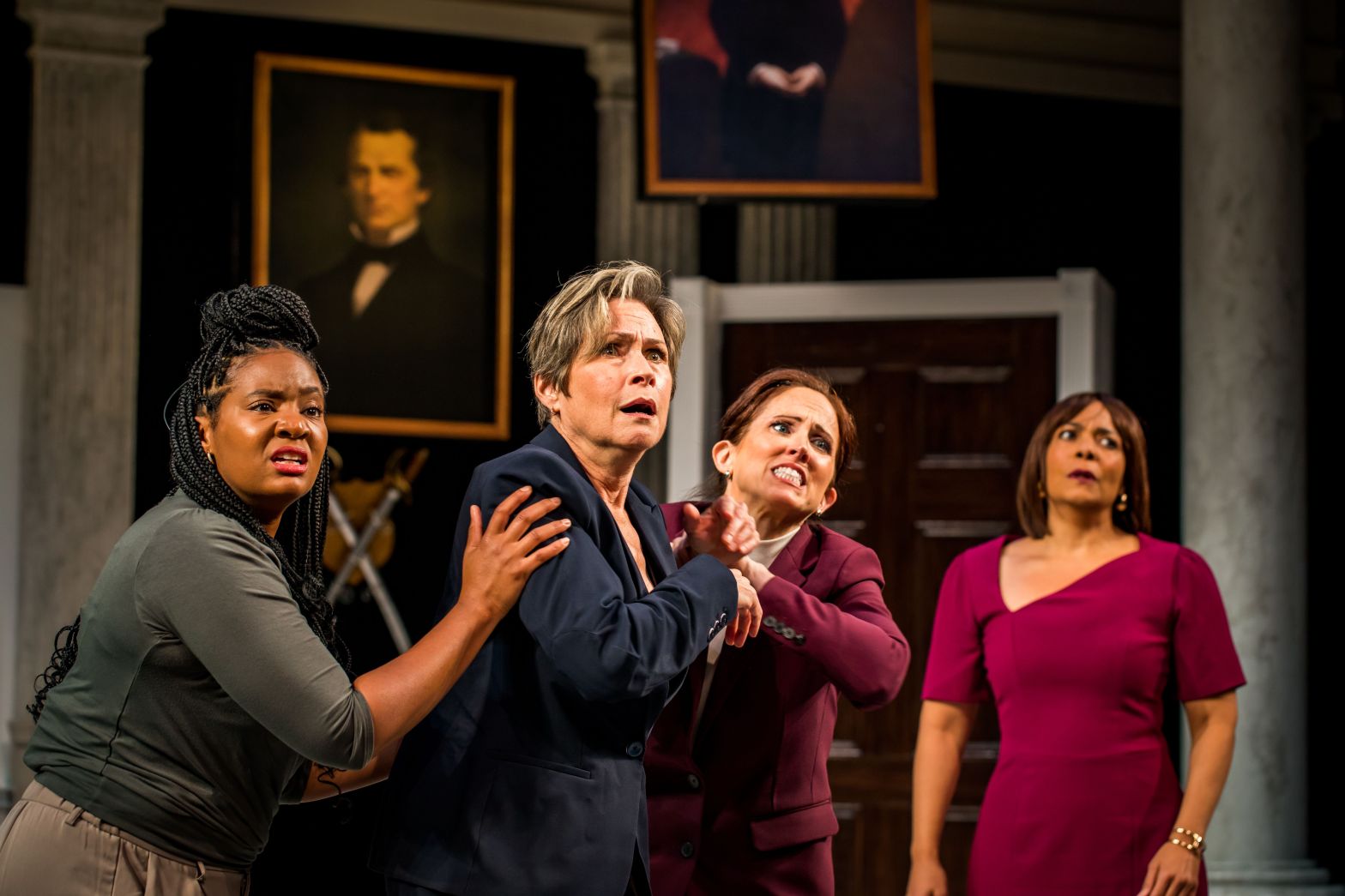
Dionysus was the Greek god of vegetation and fertility. In her Obie winning play, “Hurricane Diane,” Madeleine George has the god look down upon the modern world and, seeing it about to be destroyed by man’s poor treatment of the planet, decides to come to Earth to save it. Able to inhabit different bodies, he arrives in New Jersey as a she- Diane. And she comes as a landscaper, trying to persuade four suburban housewives who live on a cul-de-sac, to change their properties and to create a sustainable agricultural ecosystem- permaculture. It’s a strange premise to begin a story, but the play soon takes on many more dimensions, some rather interesting and some rather silly.

            The four women have their own stories. Carol (Terri Lamm) just wants her yard to look good- curb appeal. And she wants a new wrought-iron bench. Diane tries to convince her otherwise.

            Beth (Julianna Zinkel) has been struggling since her husband walked out on her a few months earlier. She can’t even bring herself to mow her lawn and it is very overgrown. That appeals to Diane. Beth is susceptible to Diane’s arguments and also, to her sexual advances. Dionysus’ powers also include pleasure.

            Renee writes for a gardening magazine and is fascinated with Diane’s ideas. Married now, she had many affairs with women before and previously identified as gay. Those sexual feelings are aroused again by Diane.

Pam (Suli Holum) is a sexy Italian woman who is hard to convince of anything until Diane turns on the charm (probably as a man, though it is not fully clear).

These four friends met regularly to talk about their lives and their families before the arrival of Diane. And in order to succeed in her mission, to save the planet, it seems to be determined that she must have all four go along with her plan.

Though the play won the best writing award for Madeleine George at the 2019 Obie Awards, I found the production at People’s Light to a rather limited look at stereotypical women that seemed more like a television show- lots of overacting. That these women needed to be convinced by a god to save the planet was presented as just silly- no need to overact. It is a comedy about serious stuff. But I didn’t find it very funny. As for the portrayal of Diane by Rami Margron, I found it shallow. Perhaps if Director Molly Rosa Houlahan explored the subtle nuances of the script more effectively, it might have worked better.

If you want to see if Diane saves the planet, you can check it out. There were even some people laughing at times, so maybe you will find it funnier than I did.

“Hurricane Diane” by Madeleine George at People’s Light, 39 Conestoga Rd., Malvern, PA 19355, 610-644-3500, peopleslight.org   Thru May 19, 2024

Torch Song at 1812 Productions

“Torch Song Trilogy” by Harvey Fierstein premiered in New York in 1982. It consisted of three shorter plays performed in three acts. It revolved around Arnold Beckoff, a Jewish drag queen and torch singer in New York City.  It was four hours long. In 2018, Fierstein revised the play, cutting it to 2:45. 1812 Productions is presenting this dramatic comedy about a man seeking love and connections in a humorous but very poignant manner.

            It is the 1970’s, and Arnold Beckoff (Jamison Stern) is hoping and struggling to meet the man of his dreams. He finds anonymous sex in the back room a place called International Stud, to pass the time, until he meets Ed (Gregory Isaac). A relationship ensues, but Ed is conflicted, He is bisexual, and is hiding it from the woman in his life, whereas Arnold is not.

            Though Arnold dresses in drag to perform, he is not presented to us in a stereotypical manner, but rather as just another guy who wants to find love. It is a complex play as he is also dealing with his Jewish mother’s disapproval for not only his life style, but his entire life.

            Fierstein asks many questions that anyone in a relationship might ask- “Do I love him enough” and “What rights do you have when you love someone?” And at what point do you actually say, “I love you.”

            This play is also about friendship. What boundaries dare we cross in a friendship? Can two people who have been lovers move on and become friends?

            Then, there is the mother, Mrs. Beckoff (Grace Gonglewski). While Fierstein gives her lots of comic lines, the relationship between mother and son is complicated and effects Arnold greatly.

            And there is more. We meet Ed’s woman, Laurel (Karen Peake), who, as she learns of what is going on with her man, tries to figure out her own next move. We also meet David (Elliott Colahan) in the second act. He is a misfitting gay teenager who Arnold seeks to help. There are many complicated situations expressed with both humor and gravity. Arnold is only one of the many here who seek love.

            This profound piece of literary art, expertly directed by Bill Fennelly, is beautiful and will most definitely be around for another 40 years. Don’t wait. See it now.

“Torch Song” by Harvey Fierstein,  1812 Productions, at Players and Players Theater, 1714 Delancey, Philadelphia, PA 19103, 215-592-9560, info@1812 productions.org   Thru May 19, 2024

It’s Only a Play at Act II Playhouse

This is a copy of the review that first appeared in Broad Street Review after opening night. After the first weekend, it was sold out for the entire run.

Terence McNally was one of America’s greatest playwrights whose career spanned some six decades and who received Tony awards for “Master Class, Love, Valour, Compassion, Kiss of the Spider Woman, and Ragtime.” His work dealt with the struggles of life and the challenging connections between people. He wrote plays and musicals that continue to be performed all around the world. But “It’s Only a Play,” written in 1978 under the title “Broadway, Broadway,” starring Geraldine Page, closed in previews in Philadelphia. It would be seven more years before the comedy was rewritten with a new title, opening off-Broadway in New York with Christine Baranski. It was a huge success. Act II Playhouse has brought “It’s Only a Play” to its intimate theater in Ambler, but it’s not the 1985 show- rather it’s the result of further revisions by McNally to bring it up to date and that came to Broadway in 2014. It’s an outstanding production. And it’s very funny.

            The play begins in the hotel suite of the producer of the new play, “The Golden Egg,” by Peter Austen, which just opened that evening at the Ethel Barrymore Theater.. His old friend, James Wicker, who has flown in from California, has arrived first, and he fills us in about how bad the play, and particularly the lead actor, was. Wicker had to turn down the role which was written for him because he was locked into the tv show he had been in for nine years. In short order, he is joined by the bellhop (an aspiring actor), the producer, Julia Budder, the lead actress in the play, Virginia Noyes, the playwright, Peter Austen, the director, Frank Finder, and a theater critic, Ira Drew. If this seems like a lot, it’s not. McNally gives each a unique comedic element that keeps us engaged and laughing as they discuss the quality of the just-performed play and are reminded- it’s only a play.

            They are all together to await the early reviews of the play, hoping for success so that it may have a long run on Broadway. Budder is sweet, but somewhat of a simpleton making, malapropisms. Nevertheless, she had the money to invest in the play. Noyes is an experienced actress with lots of issues and wears an ankle monitor because of her criminal record and drug addiction. Finger is a talented young director but also a bit of a thief. And Drew is simply a mean critic who has a nasty word for everyone. Each of the characters was fun to observe.

            There are jokes about Hollywood versus New York and about tv and film versus live theater. There are jokes about the famous people that were in the audience for the show that night. There are intellectual jokes and bad jokes. Yet this isn’t a slapstick comedy. It is a smart one. We are laughing at the situations presented and about the lies they tell.

            When the first act ends, the reviews are just starting to appear. The laughter doubles in the second act. Comedy is such a personal thing and what appeals to one person may not translate into laughs for another. I wondered whether this play would appeal as much to a younger generation as it did to me and to the mostly senior audience in attendance. Still, the amazing ensemble is captivating with every word.

            Tony Braithwaite, with his acerbic dry humor, heads the cast, as he portrays the visiting friend. The critic, played by Teti, has a curmudgeon-like quality that is cruel, but crazily funny. My favorite was E. Ashley Izard, the brash, yet insecure actress, as she deals with the reviews as well as her anklet and drug issues. This is a hilarious ensemble, with different comedic styles, put together by Director Kevin Glaccum, and it couldn’t have been stronger.

“It’s Only a Play” by Terrence McNally at Act II Playhouse, 56 E. Butler Avenue., Ambler, PA 19002, 215-654-0200,   act2.org    Thru April 14, 2024

The Good Person of Setzuan at The Wilma Theater

“The Good Person of Setzuan” is a drama written by German playwright Bertolt Brecht about a poor but kind prostitute in China in the 1940’s. Brecht was living in exile in the U.S. at the time, having fled from Nazi Germany, when he completed the play. It was first presented on the stage in Switzerland in 1943 and published ten years later. By then, Brecht had been interrogated by HUAC as a Communist and left the U.S. the day after. Among his other notable works were “The Threepenny Opera, Mother Courage, and The Caucasian Chalk Circle.” The production on the Wilma stage is from Tony Kuchner’s adaptation in 1997.

            Three men arrive in Setzuan, China and seek shelter for the night. They encounter the water seller, Wang (Jungwoong Kim) for recommendations. He tries many places but is turned away until he talks to, Shen Te (Bi Jean Ngo), a young prostitute, struggling financially, who agrees to take them in. We soon discover that these men, dressed as if they are going for a vacation in Miami Beach, are actually gods who have been searching for a good human being. They reward Shen Te’s generosity with enough money to leave her profession and open a tobacco shop- her dream.  

            She is good towards all, and soon turns her store into a refuge for poor homeless people. Everyone uses her and takes advantage of her kindness until, unable to manage anymore, she creates and disguises herself as her own cousin, her male alter ego. It is a fascinating story. Unfortunately, I did not enjoy the loud, absurdist Wilma production, though I did love the set by Steven Dufala.

            To begin the show, we meet the water carrier, a kind of narrator. He speaks in Chinese and is translated simultaneously on speakers.  I couldn’t understand more than half of what he was saying. On top of that, he is accompanied by drums and chimes and bells throughout, making it even more difficult. The loud musical accompaniment continues throughout the long play. It is three hours and forty-five minutes with only one intermission. It is exhausting, working so hard to understand what is happening.

            And although Bi Jean Ngo did a fine job portraying Shen Te and her male cousin (and was perfectly comprehensible when the sound effects were dimmed), the rest of the cast was creating a rather over-the-top ridiculous narration of the story, which I did not fully understand until I got home and read the play. “The Good Person of Setzuan” is a profound piece that deals with the issues of greed and morality. Brecht is also challenging capitalism by suggesting it leads to corruption. I didn’t get this from the production on the Wilma stage. There, I only saw a silly and tiresome presentation by an overacting ensemble. The substance and stories are buried under Director Justin Jain’s heavy-handed direction …. Read it instead.

            “The Good Person of Setzuan” by Bertolt Brecht, translated by Wendy Arons, adapted by Tony Kushner at Wilma Theater, 265 S. Broad St., Philadelphia, PA 19107, 215-546-7824  wilmatheater.org    Thru April 21, 2024