The 25th Annual Putnam County Spelling Bee at Arden Theatre Company

Six rather quirky kids are competing for the title of spelling bee champion in the gymnasium of a Putnam County school.  These young adolescents are joined in the competition by four invited audience members. It is hosted by two “moderators” who are rather quirky themselves. Billed as a musical comedy, “The 25th Annual Putnam County Spelling Bee,” while filled with humor, is far more complex as it explores the issues of childhood in a most insightful manner.

            I knew nothing of the play before I went to the Arden Theatre. To be honest, I didn’t expect much from a musical with that title. Even the first song, though sung beautifully by Miss Peretti (Patricia Noonan), didn’t prepare me for the complexity of the struggles of the kids. As for the kids, they are wonderfully played by adult professional actors.

            One girl struggles to measure up to the competitive goals of her two fathers. Another is so smart, she has no life away from intellect, wishing for more. She feels like she must always win… or else. Still another is dealing with the abandonment of her father. One kid has so many hang-ups, it would be impossible to begin listing them. He denies his own struggles.

            Watching these fine actors portraying kids with the growing pains of adolescence is surprisingly realistic and we are thoroughly engaged. Then, there are the host and hostess of the spelling bee. He is a loser and a bit of a jerk, but he is also a riot when he gives the definitions of the words that the kids are asked to spell. She, a former winner of the bee, makes strange comments as each speller is summoned to take their turn.

            I wouldn’t say that the William Finn’s music was memorable, though his lyrics were powerful. The book, originally conceived by Rebecca Feldman and written by Rachel Sheinkin, was mesmerizing, as it waved the serious material with so much comedy.  Developed by writers from the world of improv, modern productions are encouraged to create contemporary material to include. While the kids had challenging words to spell, one of the audience participants in the bee is asked to spell SEPTA.

There were so many profound moments of childhood that are still relevant today.  The exploration of ambition and competition played out in a spelling bee is just the surface- we feel their angst. But we also cannot help but laugh at the riotous goings on. Director Amina Robinson has done a wonderful job bringing this show to life!

“The 25th Annual Putnam County Spelling Bee” at Arden Theatre Company, 40 N. 2nd Street, Philadelphia, PA 19106. 215-922-11222   ardentheatre.org   extended thru June 25, 2023.  

Hello Dolly at Act II Playhouse

            In 1954, “The Matchmaker,” by Thornton Wilder debuted in London. About a widow who brokers marriages in Yonkers, New York at the turn of century, the play came to Broadway a year later with Ruth Gordon. A 1958 film adaptation starred Shirley Booth and included Shirley MacLaine, Anthony Perkins, and Robert Morse, before David Merrick and Jerry Herman created the musical, “Hello Dolly” in 1964. That’s a lot of history and few people know more than the film, starring Barbra Streisand which came out five years later, unless they were fortunate enough to see this funny, energetic, touching musical in its many Broadway revivals. The current production on the smaller, more intimate stage at Act II Playhouse, is outstanding!

            Dolly Gallagher Levi is the matchmaker. She is a widow herself as she tries to find partners for young and old. Beautifully adorned, she hides from everyone the fact that she has little money. In fact, she has business cards for dozens of different jobs, though basically, she is a meddler. There are so many engrossing stories that unfold on stage.

 I’d seen the movie some 50 years ago but remembered little of the details, which themselves, are most interesting. And while I knew the song “Hello Dolly,” I didn’t realize how many of the other songs I knew- (“It Takes a Woman” and “Before the Parade Passes By” to name two). Jerry Herman’s lyrics fit seamlessly into the musical and move the story effortlessly. There is so much to see.

From the start, we see the wonderful costumes by Millie Hiibel. They adorn the cast of 14 assembled by Director and Choreographer Stephen Casey, who brings us right into the lives of these people while entertaining us with their songs and dance. And unlike a larger theater where we listen to the voices through miking, we don’t need them because we are so close to the action.

I wondered how such a grand musical would work on a small stage. It is superb. We can see the expression on each performer’s face. While we listen to the songs and watch them dance, we can feel their enthusiasm because we so close. It is a visual treat. And the ensemble and the supporting actors outstanding. That leads me to Jennie Eisenhower who plays Dolly.

I read in the program of her extensive experience on the stage and of her six Barrymore nominations and two Barrymore awards. In portraying this larger-than-life character, she was spectacular. Her moves, her glances, her talk, her voice- it was hard to take my eyes off her. She didn’t play Dolly, she WAS Dolly. I can’t envision anyone playing the role better than she.

I can’t imagine a finer production of a musical this season.

“Hello Dolly” at Act II Playhouse, 56 E. Butler Ave., Ambler, PA 19002,  215-654-0200, www.act2.org.  Thru June 18, 2023

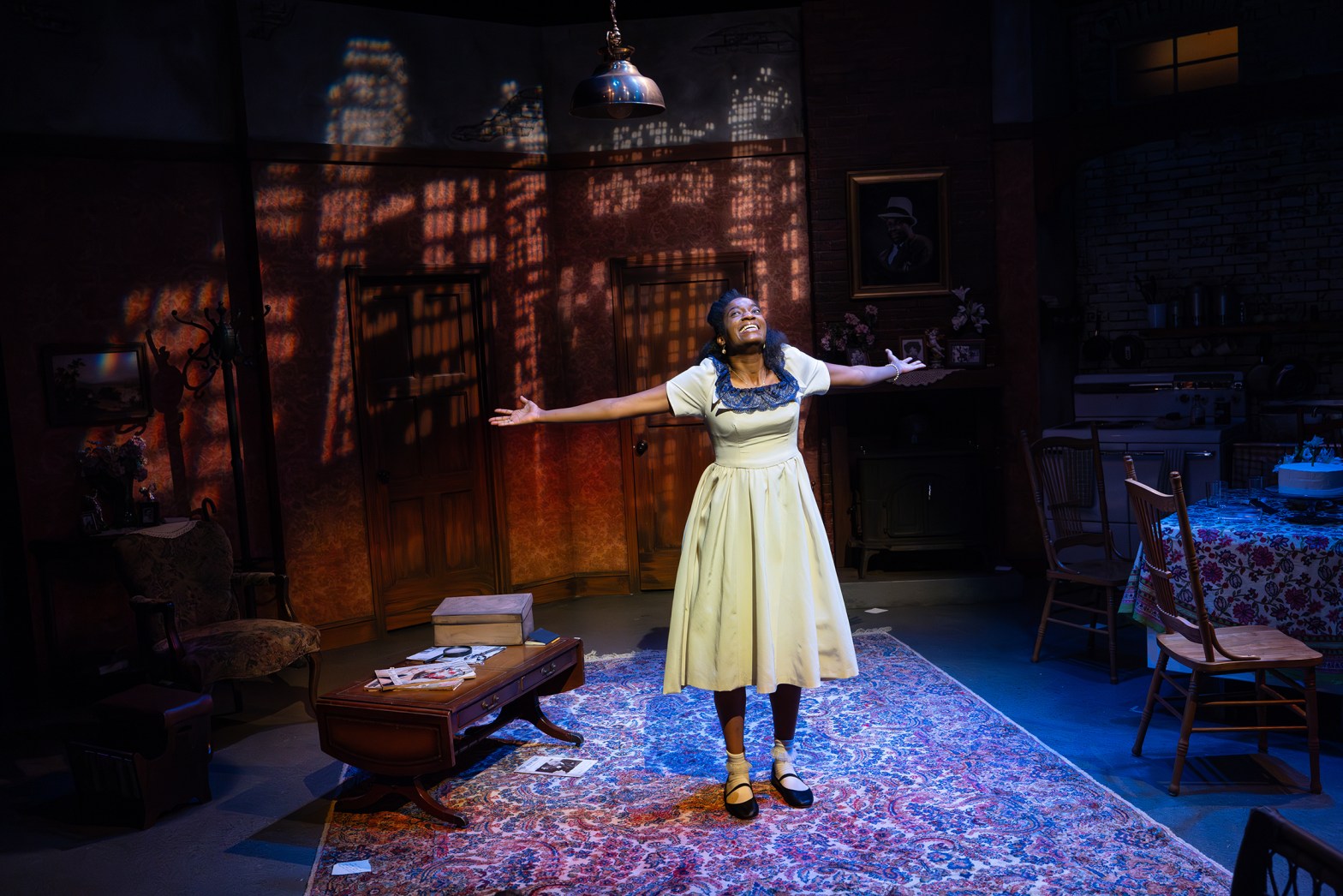
Written By Phillis at Quintessence Theatre

How many of you have ever heard of Phillis Wheatley? Sadly, I knew nothing of this 18th century enslaved Black American poet’s existence until Quintessence Theatre brought her to my attention with the world premier of Paul Oakley Stovall’s play, “Written by Phillis.” What a fascinating and brilliant young woman!

            The play begins with a grad student in an elective class, struggling as she tries to do her research on some unknown poet called Phillis Wheatley. “Who the hell is she?” she mutters to herself. She is soon to learn as Wheatley’s story unfolds to her and to us.

            The name Phillis Wheatley is actually a composite of Phillis, the name of the slave ship that brought the girl to Boston at the age of 7 in 1761 and of Wheatley, the name of the family that bought her.

            While the young girl was working at all the household chores assigned to her, the family took a special liking to her. She was taught to read. She was educated like the Wheatley’s own children. She soon started to write and had written many poems by the time she was a young teenager. We get to hear many of them as the story evolves and she recites them to us. Learned in classical literature and the Bible, she will eventually write of the immorality of slavery. But they are also about life and death. The depth of her poetry is remarkable for someone so young.

            The Wheatleys love her work and want to get Phillis published but unable to find a place in America, they send her to England with their son. Before what almost seems like a tribunal, she must convince the older white men that she really did write the poetry. Though it is humiliating, she rises to the event. Asia Rogers gives a powerful and poignant performance as the young poet.

            But the play is more complicated than her poetry. It is about her relationship with her owners, which she also considers her family. She interacts with free Blacks and when she is in England, she will have a choice to make as to whether or not to return as a slave.

            I loved the story that playwright Paul Oakley Stovall has written, full of fascinating history. He clearly did a ton of research. But I had some problems with the production. The supporting actors were portrayed in a rather two-dimensional style. A favorite of mine on the Philadelphia stage, Phillip Brown, even played two significant characters the same way. As a former director myself, I usually blame the director for such gaffes.

            In directing on the theater-in-the-round space at Quintessence, Cheryl Lynn Bruce allowed actors to plant themselves in one place too long and often, while they talked with their backs to us, it was hard to hear. It was even challenging to hear Phillis reciting her poems when she was turned away from me. We older folks in the theater (and today, there are plenty of us) need not to work hard to hear what is going on in front of us, if there is no action accompanying the words.

            The play was 1:40 minutes without an intermission. The last 15 minutes dealt with Phillis Wheatley’s life after she was given her freedom and with her life with her husband. It felt like an afterthought. I would have preferred either a two-act play with more about her or a shortened play with information about those last ten years in an epilogue, projected on a screen.

            Nevertheless, I enjoyed and loved learning so much about Phillis Wheatley. And if you like poetry, you’ll love it even more.

“Written By Phillis” by Paul Oakley Stovall & Marilyn Campbell-Lowe at Quintessence Theatre, 7137 Germantown Ave., Philadelphia, PA 19119, 215-987-4450, quintessencetheatre.org   Thru June 4, 2023

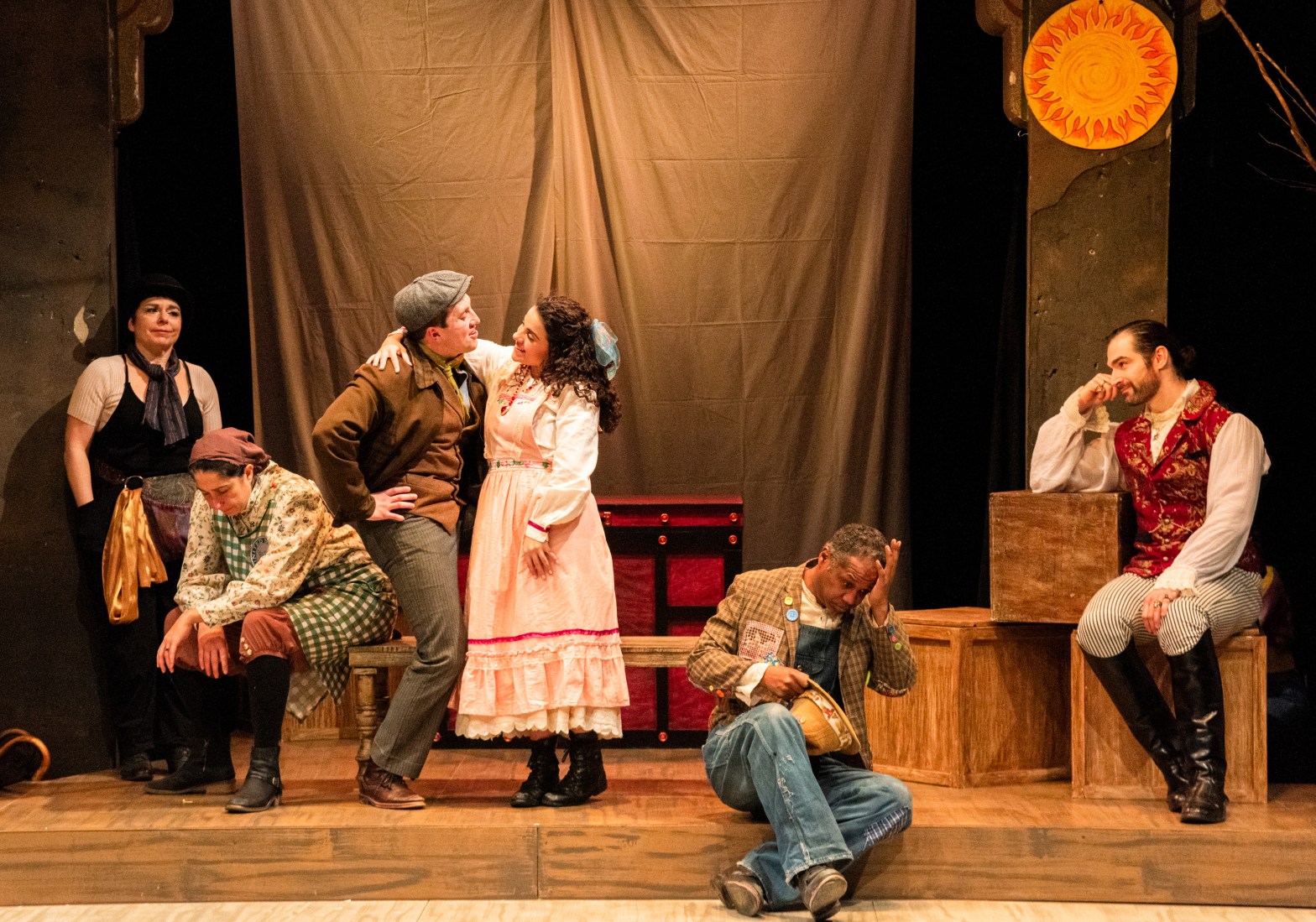
The Play That Goes Wrong at 1812 Productions

            “The Play That Goes Wrong”, written in 2012, is probably one of the most successful comedies of the past ten years. It’s been on the London stage most of that time and ran on Broadway for two years before going to off-Broadway.  It’s toured across the U.S. and Australia. The story is a spoof of the British murder mystery play. It is now on the Philadelphia stage thanks to 1812 Productions.

            An amateur theater company is mounting a play, “The Murder at Haversham Manor.” Before the lights go down, we in the audience watch as the crew is trying to do final adjustments to the set, particularly, securing the broken mantelpiece. For a moment, we’re not even sure the play has begun.

            Then, when the play within the play does begin, we see a man, Charles Haversham, sprawled out on the sofa, dead. Soon, he is surrounded by his fiancé, his butler, his best friend, and then, the inspector, called to investigate the case. While the story gets more and more complicated, this play written by Henry Lewis, Jonathan Sayer, and Henry Shields is  not a drama but an absurd comedy. Everything that can go wrong does go wrong.

            People don’t enter on cue. Lines are forgotten or mispronounced and are often recited after the action they are meant to describe. Props are misplaced. The actors try to make do with other props that don’t fit the purpose. Set pieces collapse. The body of the dead man’s hand gets stepped on and he reacts. The fiancé gets knocked out. The stage manager replaces her, script-in hand. And when the fiancé recovers, they battle over who should continue the role. They lose their place in the script and wind up repeating a sequence several times. It is a mess!

            Describing all the chaos does not do full justice to what is happening on stage. You have to see it, to experience it. In the hands of actors less than the ensemble Director Jen Childs has put together, the play might not work. These professionals are spectacular as they portray less than competent actors. So much happens so fast and they never miss a beat as the characters they portray miss many.

            The set and the props are also an integral part of the comedy. As things fall apart and fall down, as things get misplaced, there must be a huge crew working behind the set. It’s silly and it’s smart. Yet a woman who left at the intermission told me, “it’s just not my cup of tea.”

            Comedy is such a personal thing. What’s funny to one person may not appeal to another.  Usually, I prefer more subtle humor.  But this over-the-top comedy is so well done, I was mesmerized by 1812’s outstanding production. The timing alone is staggering. You can’t stop yourself from laughing.

            P.S. Inside the program is a second program, the one of the play within the play that is being mounted. It’s a fun read.

“The Play That Goes Wrong” by Henry Lewis, Henry Shields, and Jonathan Sayer by 1812 Productions, at Players and Players Theater, 1714 Delancey, Philadelphia, PA 19103, 215-592-9560, info@1812 productions.org   Thru May 21, 2023

abandon at theatre exile

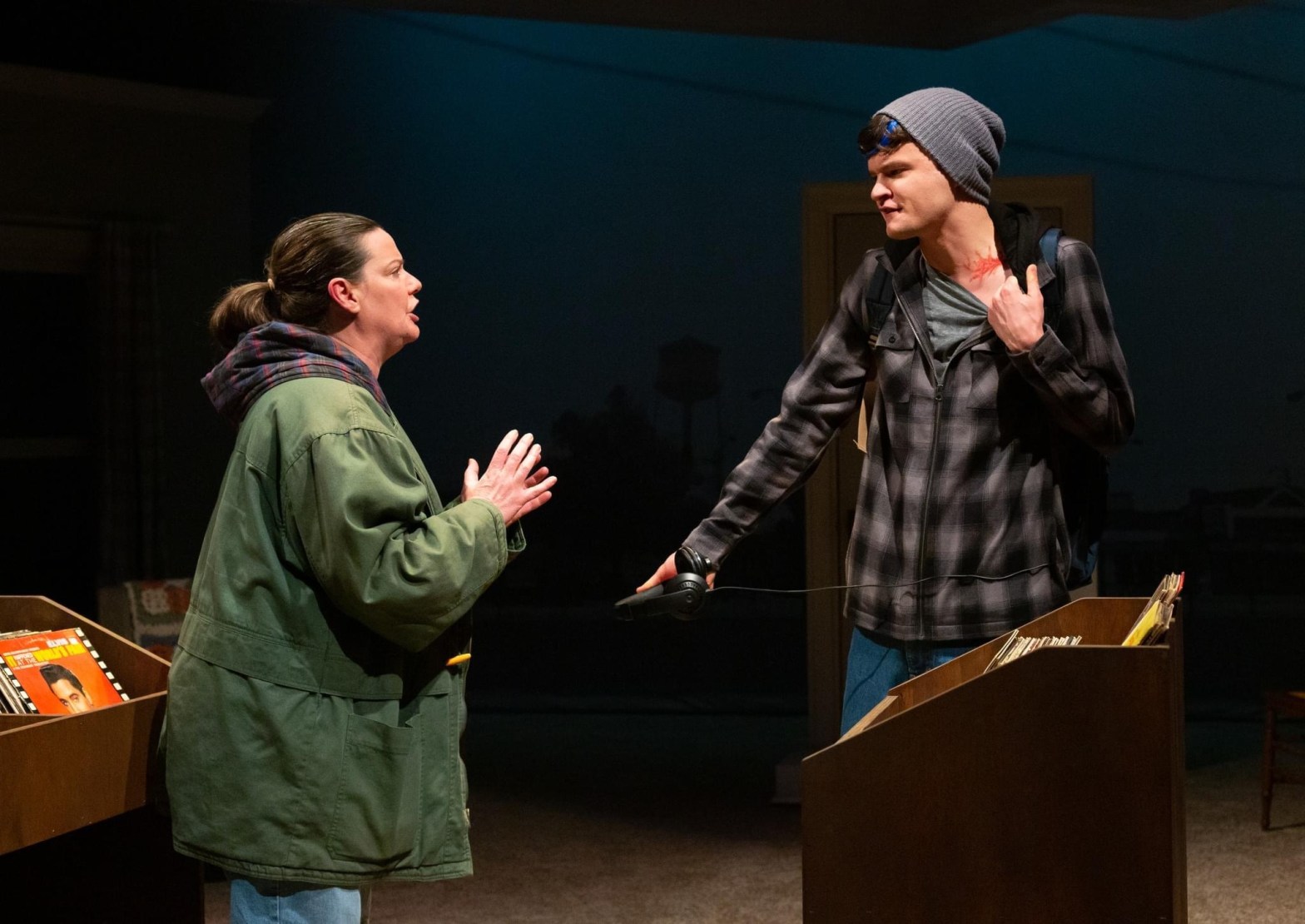
A young man, alone on the streets is cold and hungry. He’s been tossed out of his home by his brother and tries seeks refuge by breaking into an elderly woman’s home. Joshua is lonely, he is scared, he has been abandoned.

            James Ijames’ newest play, “Abandon,” is making its world premiere at Theatre Exile. This complex play, which seems straight-forward at first, is actually many stories. The woman in the home broken into is dealing with her own guilt for abandoning her son some years before. Though the son, Gabriel (Brenson Thomas), is with her on stage and even provides occasional comic relief, we soon realize that he is not actually there- he is just a ghost of himself. He has died. Did she kill him?

The play opens with Louella, in the kitchen, preparing a shopping list. She talks with her son about what she is getting. They talk about the soap operas she’s watched. We have no idea yet, that he is not really present. She is trying to figure out how to atone for the injustice she had done to him.

Melanye Finister does an incredible job in portraying Luella, the old woman, a most complex person. On the one hand, she is intensely religious. On the other, she smokes weed and even gives some to Joshua at one point after she gets to know him.

But there is a mystery on the other half of the stage. It is from that darker side that Joshua (Jared Chichester) is beaten, then tossed out by his brother Chris (Carlo Campbell), who remains sprawled out in a drunken stupor for much of the play.

            Luella’s son, Gabriel, is flamboyantly gay. He is bold. He paid a price for not hiding his sexuality from his mother. Returning as a ghost, it is no longer an issue as he interjects his thoughts when they are alone as well as when she is with Joshua.

            In a way, Joshua is the core of the play. He is a lost soul, but he is gentle and kind despite his difficult life. Most of all, he is timid. He grew up in a home where he got no attention and didn’t know the date of his birth. Will he ever get the strength he needs to survive?

            Just as Luella couldn’t deal with her son’s homosexuality, Chris had the same issue with his brother, who he discovered having sex with another man. Chris is a brutal man who tyrannizes Joshua. These are parallel stories on a kind of parallel stage, with radically different outcomes.

Joshua is sheltered by Luella, though she is prepared to use a baseball bat at first to fight him if necessary. But he is not a threat to her, and they connect on many levels.

It is the one-dimensional brutishness of Chris that doesn’t measure up to the complexity of the themes. I felt it was the weakest part of the play.  Perhaps it was just me, rooting for the connection between Chris and Joshua.

Still, the 85 minute play was riveting as Director Brett Ashley Robinson brings to life Ijames’s  fine play as it explores the depths of loneliness, acceptance, and redemption with four outstanding performances.

“Abandon” by James Ijames at Theatre Exile, 1340 S. 13th St., Philadelphia, PA 19147, 215-218-4022,  boxoffice@theatreexile.org   Thru May 21, 2023

Songs for Nobodies at People’s Light

Every now and then, you walk out of a theater so blown away by the show, you can’t imagine anything better. Such was the case at People’s Light where I saw “Songs for Nobodies.” I had known that one woman was to portray Judy Garland, Patsy Cline, Billy Holiday, Edith Piaf, and Maria Callas, singing some of their songs, but I wasn’t prepared for the brilliant script by Joanna Murray-Smith or the commanding performance by Bethany Thomas.

            The show is much more than song. It begins with a toilet attendant reflecting on the nature of happiness. Is it real? Do you only realize it in retrospect? She is bemoaning the desertion of her husband when Judy Garland enters, after taking a break from her concert. They connect and soon, she is on the stage with Garland. And as we hear Garland sing “Come Rain or Come Shine,” we are reminded that life is “just one of those things” and that “days may be cloudy or sunny.”

            The second sequence is also about destiny. We meet Patsy Cline who sings “Stand by Your Man” even though “you’ll have bad times,” even though “you don’t understand.” But playwright Murray-Smith gives us so much more than the song. We learn that the last concert Cline sang was a benefit concert for an esteemed disc jockey who’d just died. Sadly, in her haste to leave Kansas City to get back to her young children, Cline died in a plane crash. She was 30 years old.

            We learn about Billie Holiday by a writer who wants to escape from the fashion pages to write seriously. After pleading with her editor at The New York Times, she is given the opportunity to write an 800 word essay interviewing Holiday. The great jazz singer, Holiday who at one point, after not responding to questions, asks the writer “what do happy people sing about?” She then sings the song that made her famous, “Strange Fruit,” a song banned in many places as it talks of “Black bodies swinging… from poplar trees.”

            There are stories about French singer Edith Piaf before we hear her sing “Non, je ne regrette rien.” (No, I regret nothing). Despite remaining in France during the Nazi occupation, she managed to help others escape. At 4’8”, her powerful voice was legendary.

            Maria Callas is the last of the divas in this 1:40 play. A great operatis soprano, Americans know her better as the woman left by Aristotle Onassis to court and marry Jacqueline Kennedy.  Callas too has a story as we learn of her shortened career. Here, she sings an aria from Verdi’s Tosca about a woman whose beloved, faces torture and execution.

            From the five “nobodies” that tell most of the story, to the five extraordinary vocalists, Bethany Thomas does it all. Close your eyes and you hear the operatic voice of one, the power of another, and softness of another. Her range is breath-taking. You would swear that you are hearing the original artists. She is amazing and is worth the price of admission alone.

            I never enjoyed learning so much as Thomas portrays the nobodies while they interact with the singers and inform us of their lives. Who’d have thought that five vignettes could do so much!

            After playing in Chicago at the Northlight Theatre where it got rave reviews early in 2020, the play was scheduled to be on the People’s Light stage that summer, but covid changed everything. Now, with Thomas and director Rob Lindley, they are presenting the show that was in Chicago, on the Malvern stage.

“Songs for Nobodies” by Joanna Murray-Smith at People’s Light, 39 Conestoga Rd., Malvern, PA 19355, 610-644-3500,  peopleslight.org   Thru May 21, 2023

Eternal Life Part 1 at The Wilma Theater

            When you see the silly poster outside the show that is currently running at the Wilma Theater, it is easy to think that this new play by Nathan Alan Davis is little more than fluff. Nothing could be farther from the truth. “Eternal Life Part 1” has many funny moments, but it is so much than that. It is a profound story, centering on a family, but dealing with many of the existential questions of life.

            The play begins simply. An affluent couple are debating whether or not to keep the new home they’ve just bought and whether to settle there or in one of their other homes.  We see the conflict between the perfectionist husband and the wife who wants to be more rooted, lest she be forgotten. She says she wants to be immortal. It is the beginning of a discussion on what the point of life is and of one’s destiny.

            If it sounds too intellectual, it’s not- it’s very real… except when the other major character is present, which is most of the time. That character is a goose! Yes, a goose who wanders about, first watching the action, but then, interacting with the people. She was there when the couple arrived and remains through the years. First, wandering about the yard, then taken in as a pet, she becomes part of the family. Sarah Gliko brilliantly portrays this feathered bird as it moves about the scenes and into the audience. She is mesmerizing.

            The nameless couple (played by Jenn Kidwell and Steven Rishard) agrees early on to have a child. We observe them at different stages as the difficult child (Brandon J. Pierce) becomes an obnoxious adolescent, then a more mature college student. Whiny as he is, the scenes are very funny but realistically honest. The goose is observing with us.

            Then they are the snowflakes- the father snowflake, the mother snowflake, and the child snowflake. They represent the family. Or are they the family? Sounds confusing? It’s actually very simple, very basic and we can decide for ourselves.  The snowflake can land anywhere… or can it.  It has so its own destiny, a metaphor for what can happen to any of the characters, to any of us.  

            Feelings, yearnings, fears, love, frustration- they are all packed  into this most non-linear, almost surrealistic play. I will not begin to say I understood all that was going on, what with the goose and the snowflakes, but I thoroughly enjoyed what I was watching, and didn’t care. It worked in a way I’ve not experienced before in the theater. Oh yes, the cast was outstanding and the direction by Morgan Green was superb! It’s a chance to go to the theater and let go.

“Eternal Life Part 1” by Nathan Alan Davis at The Wilma Theater, 265 S. Broad Street, Philadelphia, PA 19107, 215-546-7824  www.wilmatheater.org   thru April 30, 2023

Lady Day at Emerson’s Bar & Grill

            Billie Holiday, who died in 1959 at the age of 44, is an icon in the music world. With her voice and unique style, she gave powerful and sensual representation to songs she sang during the height of the jazz age. Lanie Robertson has created in 90 minutes, a powerful play with some of Holiday’s greatest hits but also with poignant moments in Holiday’s life in “Lady Day at Emerson’s Bar & Grill.” Produced in 1986, it has appeared across the country for decades and has won numerous awards. It is now on the stage at Philadelphia Theatre Company.

            The play takes place in an old South Philly bar, a few months before Billie’s death. She is accompanied by Jimmy Powers (Will Brock) on the piano. She is banned from performing in New York because of a drug conviction. Holiday (Laurin Talese) is a drug addict and alcoholic, consuming alcohol throughout her performance. Between the songs, she tells us her story.

            Billie’s idols were Bessie Smith and Louis Armstrong and she sang along with them at home as the victrola played. Smith died the year Holiday married for the first time- at sixteen. Her husband, she tells us, was her first and her worst. He got her hooked on drugs. But he didn’t give her what she wanted most, a child.

There were many more stories and anecdotes, including when she traveled with Artie Shaw and his band (the first Black woman to work with a white band) Shaw had to pay extra for her to eat in the restaurant but only in the kitchen. Unfortunately, I couldn’t hear Talese clearly as she often talked softly and rapidly, often mumbling, and though I was sitting a stone’s throw from the intimate stage, I missed much.

            Talese does have a lovely voice and it is wonderful listening to the songs Holiday made famous like  “I Wonder Where Love Has Gone, What a Little Moonlight Can Do, Crazy He Calls Me,” and the legendary song, “Strange Fruit,” about a lynching in the south. Billie  often got into trouble for singing that song but insisted on singing it to make sure the story was told. However, Talese’s voice did not resemble that of Holiday’s, which had a rugged, yet intimate feel.

            How much does an actor have to resemble and perform like the person she is portraying? I ask myself that question whenever I see a one-person show about someone famous who we remember. Talese does a credible job, but I never felt like she was Billie Holiday. But then again, who can be Billie Holiday?

            Still, the feeling that scenic and lighting designer Thom Weaver has created of a bar in S. Philly with the audience right there beside the stage is outstanding. And the accompaniment of Music Director Will Brock who plays for Holiday is perfect. A few words of advice- one for the director, Jeffrey L. Page and one for the audience. Slow the rhythm and increase the volume of his star. And if you plan to attend, sit at one of the tables up close to make sure you hear it all.

“Lady Day at Emerson’s Bar & Grill ” by Lanie Robertson at Philadelphia Theatre Company, Suzanne Roberts  Theatre, 480 S. Broad St., Phila., PA 19146, 215-985-0420, www.philatheatreco.org Thru April 30, 2023.

Radio Golf at Arden Theatre Co.

August Wilson was an African-American playwright who chronicled life in the Black Pittsburgh community, in which he grew up, in a series of ten plays . Two of them, “Fences” and “The Piano Lesson,” won the Pulitzer Prize. Each play is about another decade of the 20th century, with “Radio Golf” taking place in the 1990’s. It premiered in 2005, the year Wilson died. It is an extraordinary play getting an outstanding production at The Arden Theatre Company.

            The play revolves around Harmond Wilks, a Harvard educated man, who inherited his father’s real estate agency- he is also seeking to become Pittsburgh’s first Black mayor. He is about to embark on redeveloping the Hill District, an area that has fallen on hard times. There are plans for a 10-story high rise with 180 apartments. There are also deals in the making that will include a Whole Foods, a Starbucks, a Barnes & Noble, and a golf driving range. Only an old abandoned house remains on the property and is scheduled for demolition… until an old man appears, who is painting the house.

            While this is a story about progress versus tradition, it is also a tale of what it means to be an African-American at the end of the 20th century. Two of the other four characters in the play, Wilks’s wife Mame and his friend Roosevelt, seek to rise in the world through their connections with white politicians and businessmen. She hopes to get an important job and he wants to connect with a shady, but rich investor, to get a share in the purchase of a radio station at less than market value because he would qualify for the minority tax incentive.

            On the other side are Sterling Johnson and Joseph Barlow. Johnson, also an old friend of Wilks, is a brutish guy who is often on the wrong side of the law. He brags that once he robbed a bank just to see what it was like to have some money. He is an independent construction worker who constantly challenges Wilks while he seeks work from his friend.

            The final character we meet is Joseph Barlow, the old man who is painting the house that is about to be torn down. He has a strange and mysterious past. He clearly seems crazy. But is he? He claims that it is his house and he is painting it for his daughter, though no one has lived there for years and it had been bought by Wilks at a sheriff’s sale.

One significant symbol in the play and in Wilks’s life is golf. He has a little putting green in the office. His friend Roosevelt also loves golf. Wilks hangs a picture of Tiger Woods on the wall beside the one of Martin Luther King Jr., that he’d put up earlier. Later, the oddball Barlow,  though he has no interest in golf, grabs and pockets a golf ball when no one is looking.

Will a golf driving range replace the old football field? Will a modern apartment building replace the blight in the area? Will the house at 1839 Wylie be torn down?

That is the essence of the story, but Wilson’s play is far more than story. His characters are what make this a a must-see play. The greediness of Mame and Roosevelt, the crudeness of Johnson, and Barlow’s powerful  drive to survive in an alien world-  Wilks must figure out the best course. Then, there is  the wonderful humor Wilson injects throughout the play in the many riveting stories. But what makes the play even greater is the unsaid larger picture.

How does a Black person differ from a Negro in the year 1997? It is reminiscent of the contrasts between King and Malcolm X, decades earlier. This time, Hammond Wilks is at the center of a personal dilemma.  He is an American and proud of it. But what does that mean?

“Radio Golf”  is the fifth August Wilson play produced by The Arden Theatre Company. It was one I was not familiar with. It is exquisitely directed by Kash Goins with an  extraordinary ensemble. I can’t wait for the next one.

“Radio Golf” by August Wilson.  Thru April 16, 2023.   Arden Theatre, 40 N. 2nd Street, Philadelphia, PA 19106, ardentheatre.org  215-922-1122.

Mistakes Were Made at Act II Playhouse

Felix Artifex is a third rate theater producer who is trying to secure a Broadway production for what could be the biggest deal of his career. He has some financing from an unusual source and is trying to secure a contract with a popular movie star to be in the play about the French Revolution, written by a young, unknown playwright. “Mistakes Were Made” by Craig Wright,  which takes place in Felix’s office, consists of 75 minutes  of phone calls to and from everyone- from his ex-wife and his co-producer to the playwright, the star, and others ,while his unseen secretary, Esther, takes the calls and relays the information to Felix.

Also in the office is Denise, the large fish in a tank by the wall, who he talks to and constantly feeds despite warnings from Esther that the fish shouldn’t be fed. Essentially, it is a one-person show and though Felix talks with so many people on the phone, we never hear their voices- only his reaction to their wants and needs as he tries desperately to put together the production.

What we quickly discover is that Felix will go to any length to make this venture happen. We watch as he mollifies Johnnie Bledsoe, the star, who doesn’t want to play King Louis but seeks to have the play altered to include a child (played by him) and even eliminate King Louis from the tale. Felix tries to persuade the young playwright to rewrite the play. And he lies to everyone about the progress he is making. It is not one call after another, but three and four calls at a time.

While the mistakes in the title of the play refer to mistakes regarding the French Revolution, it is clear that there are a myriad of mistakes regarding the writing, the casting, the financing (which depends upon the sale of flocks of sheep in Arab lands being threatened by a revolutionary group) of the  production Felix is trying to mount. There is even a hint at a mistake Felix made regarding his daughter’s death. On top of that are the silly mistakes- Shakespeare made a mistake in not making his king the main character or the constant mistaking the name of Robespierre who Felix calls Pierre.

It is a very intense evening and it is challenging to follow all the calls that are on the many different phone lines coming in to the office, let alone the people Felix is putting on hold. It is funny for a while, but then becomes a bit overwhelming and tiring. There is a human element that is lacking in Wright’s play. He’s driving the story along one track when it could use more variation. We want to know more about Felix, about his family. We want to see not only his bravado but his angst.

Tony Braithwaite is masterful as Felix in the way he handles the barrage of phone calls and he has a superbly understated knack for handling the many comedic elements of the play. I can’t think of another actor who could pull off such a piece. But his acting wasn’t enough to carry the play for 75 minutes I just wish I could do what Felix is trying to do in the play with the young playwright- convince the author of “Mistakes were Made” to rework the play.

“Mistakes Were Made” by Craig Wright at Act II Playhouse, 56, E. Butler Ave., Ambler, PA 19002, 215-654-0200, www.act2.org. Thru April 16, 2023.