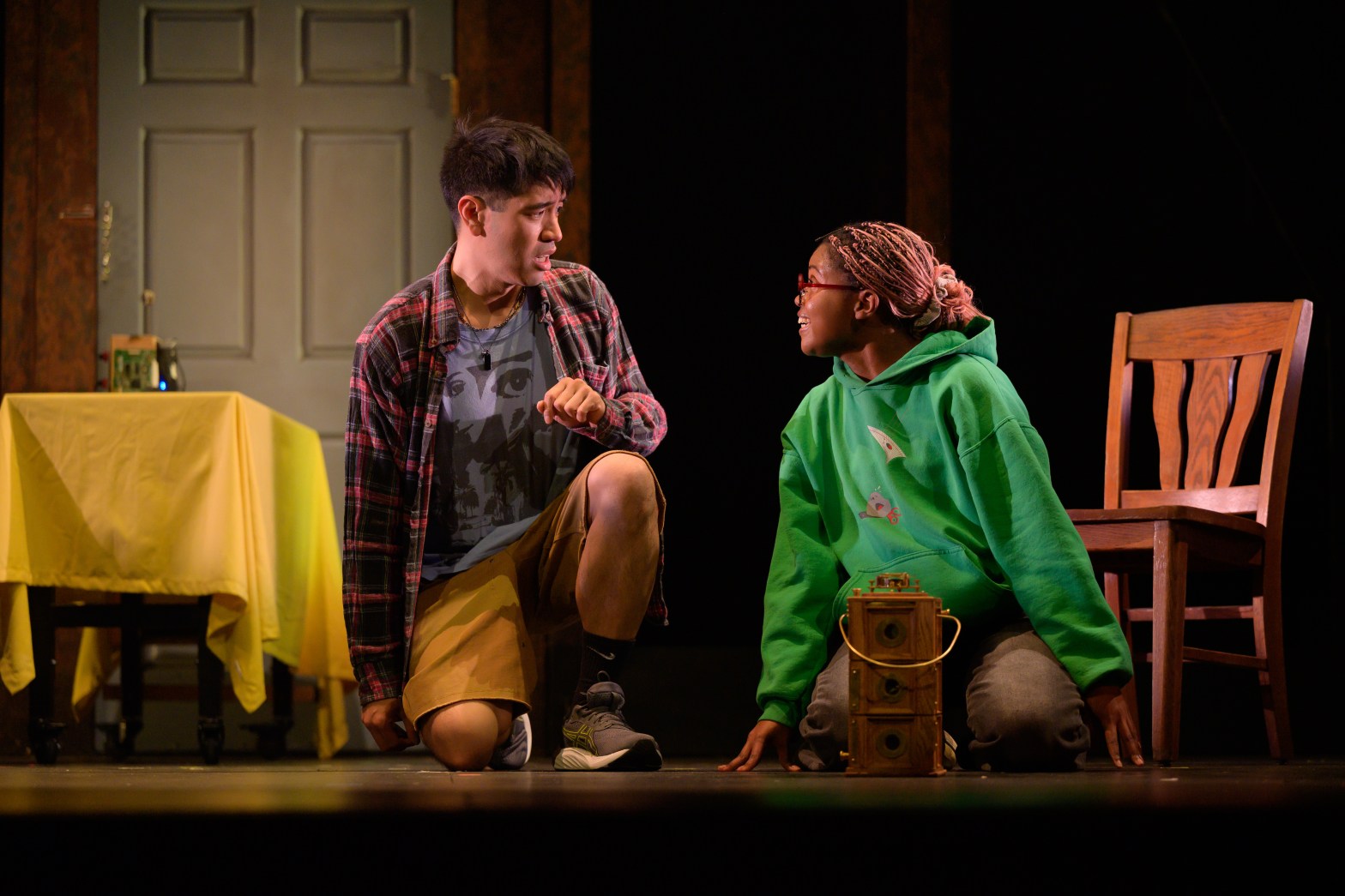
Giovanni’s Room at Quintessence Theatre

James Baldwin wrote the novel,” Giovanni’s Room” in 1956.  It is about an American man in Paris, waiting for his fiancé. He meets an Italian man named Giovanni, which brings back all the homosexual feelings he had growing up. The novel deals with sexual identity, masculinity, and bisexuality long before it was in mainstream literature. It was never turned into a play until recently when co-playwright Benjamin Springer convinced the Baldwin Estate that he would use as much original dialogue as possible. With Paul Oakley, Stovall as co-playwright, “Giovanni’s Room” is getting its world premiere on the Quintessence stage. It is extraordinary!

David is in Paris alone. He had asked Hella a to marry him but unsure, she took a side trip to Spain to think about it. Meanwhile, he gets invited to go out drinking to a bar- a gay bar. As David is a very attractive young man, he gets hit on by almost everyone there. He resists them all until he meets Giovanni, the Italian bartender, who he falls for. He is confused as he thought he left that attraction for the same sex long ago. He moves into Giovanni’s room but still questions his own sexuality and even has a brief encounter with another woman.

            Who is he? There is no lengthy monologue which we don’t need anyway. We watch him as he interacts with the different people he meets. Some tell him that he needs a woman to guide him while others push their male sexuality on him. He even interacts with his past self. What does he want? Is he just playing it safe? So many questions raised in the first act as we closely watch his face trying to understand his situation and his life.

            At the intermission, I chatted with a gay guy who told me that he lived a “straight” life until he came out when he was 31 years old. Is that what David is facing? When his fiancé arrives in the second act, it is clear that he loves her. He desires her. What is he to do? Can he remain friends with Giovanni?

            This is such a powerful story as it explores not only the life of David, but also of Giovanni. The transformation of the novel into the play is seamless. And Stovall, who also directed the play, does an extraordinary job shuffling the 16 characters played by 11 actors on and around the stage that is surrounded by three sides of audience seats. The characters range from absurd to painfully real and they all create the environment which David has entered. Every moment is riveting!

            Ethan Check and Micheal Aurelio head the cast as David and Giovanni- they are so powerful- one subtle, the other forceful. The whole cast is outstanding as they tell a serious story with humor and panache. It’s the best play of the season!

“‘Giovanni’s Room” by James Baldwin,  adapted by Benjamin Sprunger & Paul Oakley Stovall at Quintessence Theatre, 7137 Germantown Ave., Philadelphia, PA 19119, 215-987-4450, quintessencetheatre.org   in repertory with “Antony & Cleopatra” ”Extended thru  June 29, 2025

Glitter in the Glass at Theatre Exile

            Chelle is an artist who grew up in Baltimore in a slum across the street from a park where she just learned that they have removed the statue of Robert E. Lee.  Specializing in installation art, she applies for and receives a grant to create something to replace the Confederate Civil War monument. In time, she buys the house in which her family had rented an apartment, but she has trouble coming up with an idea for the park. The pedestal (also called plinth) on which Lee stood, remains empty.

            Chelle is a very complex person, constantly trying to come to grips with not only the world around her, but of the history for Black people that preceded her. What is freedom, she asks herself and her brother- it is not the same as happiness she exclaims at one point. He is around as he prepares for the big Juneteenth celebration in the park. And as she struggles for years to come up with an installation to replace the statue that was removed, she is trying to come to grips with the difference between a monument and a memorial. The foundation wants something now!

            When she does create a work of Barack Obama that no one recognizes, it is soon torn down by locals- this in a neighborhood that is beginning to change via gentrification. The question raised is who judges the quality of her work. Is it just the White establishment?

            She even struggles to remodel her family home and hires a decorator, but do the decorator’s ideas match her own?  It is another struggle. She toys with images of Lee and of the Confederate flag.

            There are talks with her brother who accuses her of not being Black enough and that she’s spent too much time with Caucasians. I found it fascinating when I learned that the word cowhand was altered to cowboy after the Civil War when Blacks and Latinos rose to the position.  

            There is so much power beautifully expressed in this most thoughtful play by R. Eric Thomas. But I had problems with it- not the writing but the directing and the overacting. In the first act, Chelle and her brother Willard (Danny Wilfred) are constantly shouting at each other. On two occasions, they are standing upstage and just loudly arguing while in profile. I wish they could show us more how they felt instead of telling us. And often, Wilson portrays the stereotypical representation of a gay man with affect. it took away from his own significant ideas and words.

  And Thalis (Kishia Nixon), the decorator, is also going for the comedy most of the time too as if there needed to be a laugh on every third line. It felt like a tv sitcom. Just too much silliness. Still, Jennifer Nikki Kidwell was a powerful force as Chelle as she lets us know about so much of her feelings, her challenges, and of her art.

“Glitter in the Glass” is a powerfully profound piece that needs to let it speak to us with less bravado.

“Glitter in the Glass”” by R. Eric Thomas at Theatre Exile, 1340 S. 13th St., Philadelphia, PA 19147, 215-218-4022,  boxoffice@theatreexile.org   Extended thru June 22, 2025

Rodgers & Hammerstein’s A Grand Night for Singing at Act II Playhouse

Rodgers and Hammerstein created some of the greatest musicals to hit the Broadway stage in the 1940’s and 1950’s. “Oklahoma, Carousel, South Pacific, The King and I, and The Sound of Music” are classics that live on today. Hammerstein wrote the book for each story as well as the lyrics and Rodgers created some of the best-known music to accompany the songs. “Rodgers & Hammerstein’s A Grand Night for Singing” at Act II Playhouse is running the show which was adapted for the stage as a musical review by Walter Bobbie. I thought it would be good since I knew so many of the songs. It exceeded my expectations. With the direction and choreography by Stephen Casey, it was outstanding.

            Three women and two men perform parts of the many songs of Rodgers & Hammerstein. But they don’t just perform, they act out the songs. Though dialogue wasn’t added to this show, the body language and facial expressions tell it all. Along with the dance numbers, you can enjoy this show even without the music. And as for the music, what can I say?  Over 30 songs in 90 minutes- it was GRAND!

            I sat in my seat singing along in my head with the singers as I knew the lyrics to so many of the songs. I surprised myself in how much I remembered from movie versions of the shows that I saw sixty years ago. But the performance did another thing for me as I sat watching and listening. I paid close attention to the lyrics. They pose many profound questions that we have all contemplated. You will see each song in a new light.

            The themes of insecurity, sincerity, honesty, and of course love, as well as lack of love prevail. I’m not going to begin to name the emotional impact of the lyrics that I didn’t realize when watching them in the larger musical productions with all that was going on.

            On top of that, you could hear every word of every song on Act II’s intimate stage without amplification because of the gentle accompaniment on the piano of Dan Matarazzo.

            Casey’s direction and choreography, as I’ve already noted, was brilliant. Kevin Toniazzo-Naughton’s booming bass voice was powerful. Renee McFillin’s movement and facial expressions as well as her singing are enough reasons to attend. The whole ensemble was remarkable.

            Don’t look on this as simply an homage to Rodgers & Hammerstein. Go because it will make you sing and feel and laugh as you watch this fantastic show.

Note:  Among the songs are “I Can’t Say No, Many a New Day, Shall We Dance, The Gentleman is a Dope, Don’t Marry Me, That’s the Way it Happens, Do I Love You Because You’re Beautiful?, Love, Look Away, A Hundred Million Miracles, This Nearly Was Mine”

“Rodgers & Hammerstein’s A Grand Night for Singing” adapted by Walter Bobbie” at Act II Playhouse, 56 E. Butler Avenue., Ambler, PA 19002, 215-654-0200,   act2.org   thru June 29, 2025

Alibi: An Agatha Christie Story at Bristol Riverside Theatre

            Hercule Poirot was the famed detective created by Agatha Christiie in 1920 who then appeared in 33 of her novels and over 50 of her short stories. Many were adapted into plays and later, into movies. Her play, “The Mousetrap,” ran for 62 years before it temporarily closed in 2020 due to Covid. “Alibi” was the first adaptation of a Christie story, “The Murder of Roger Ackroyd,” in 1928, though it was done by Michael Morton, an established playwright of the day. Christie diddn’t like the adaptation and from then on, did them herself. Amy Kaissar returned to the original Christie story to create this current adaptation which is much truer to the original. With an outstanding cast, Ken Kaissar has directed this mystery thriller on the Bristol Riverside stage.

It begins with a bang! Mrs. Ferrars has just committed suicide. She was the widow of an abusive husband and had poisoned him. Now, she was planning to marry Roger Ackroyd, a wealthy widower in the rural town of Fernly Park, where the story takes place. It is narrated by the local doctor, James Sheppard, who will become Poirot’s assistant in the investigation. He had been asked to dinner by Ackroyd who wanted to discuss with him things that may have led to Ferrars’ death. But then, Ackroyd is discovered later that evening with a knife in his neck. Ackroyd’s niece enlists the help of Detective Poirot who has retired and recently moved to the village.

            Who would want Ackroyd dead? Poirot goes about talking to everyone as he gathers information. From Ackroyd’s financially needy nephew and his stepdaughter to his sister-in-law and others in the household, everyone has a motive. And Poirot points out that each character is hiding something of major consequence. His investigation into their stories is revealing and his style is highly amusing. He dismisses seemingly important evidence but dwells on things that others have overlooked.

            The story also pivots around time, down to the minutes, when people came and left Ackroyd’s home as Poirot tries to pinpoint the movements of every character. There are so many parallel stories that you must pay attention to every word of every character. It is a bit challenging. But the cast, led by Danny Vaccaro as Dr. Sheppard and Benjamin Lloyd as Poirot, is top notch. Lloyd IS Poirot! And the rest of the ensemble is equally strong as we understand the struggles and motivations of each.

            When I was a kid growing up in New York, I went to many plays both on Broadway and off. If a play were three hours long, it had two intermissions. I only wish this 3-hour production had two as well. So often, at the intermission, I would go into the lobby and discuss what was happening on stage with whoever I came with. But that is me and I understand that most theatergoers are not seeking the extra intermission.

            And as for Amy Kaissar’s adaptation, which remains true to the original story, Alibi”” is a most interesting and entertaining play. I’m sure it would make Agatha Christie proud.

“Alibi: An Agatha Christie Story” adapted for Bristol Riverside by Amy Kaissar at Bristol Riverside Theatre, 120 Radcliffe St., Bristol, PA 19007, 215-785-0100, brstage.org,  thru June 15, 2025

The 39 Steps at Lantern Theater Company

            “The 39 Steps” is one of the famous spy thrillers by Alfred Hitchcock. The 1935 film was loosely based on the novel written by John Buchan some 20 years earlier. It has been adapted many times over the years and Lantern Theater is presenting actor, comedian, writer Patrick Barlow’s creation from 2006. It is an outrageous comedy while it retains the seriousness of the story in the film. Lantern Theater is presenting it with four actors, two of whom play many roles.  

            Richard Hannay, tired and bored one evening, decides to go out to a performance at the London Palladium. In the audience he encounters Annabella, a beautiful and provocative woman who attaches herself to him, claiming that she is running from a very mysterious spy ring that is after her. In short order, she goes to his flat for what seems like a romantic encounter, but and winds up in his bed, but with a knife in her back. Suspected of murder, he flees, the police always just a step behind. He takes a train to Scotland.

            What follows are the close calls with the police and with the spies that are after him and want him dead. He winds up in several locations along the way. The story is an interesting one, but what is most compelling about this production is the incredible, creative staging of the play of Director Charles McMahon. From the very first train ride out of London, created with a screen with images for the passing countryside, to the movement of the characters as the train turns and stops and starts, we are fascinated with every moment.

            Jered McLenigan is superb as he portrays Hannay with dignity and style, but in some ways, the lead was no more than a foil for Dave Johnson and Eli Lynn, who played dozens of roles, slipping in and out of character and costumes on a dime. It was a treat to watch them as they assumed different English and Scottish roles. I never expected to laugh so much at a thriller, but the inventions created by McMahon were extraordinary. And the costumes of Levonne Lindsay were fantastic!

            Lee Minora, in a few pivotal roles, completes the ensemble of four- the best ensemble I’ve seen on any stage in years.

            Go for the story. Enjoy the flow. Sit back and be ready to be experience this most inventive piece of theater. I think Hitchcock would be laughing too.

“The 39 Steps” adapted by Patrick Barlow from the noel by John Buchan and the film by Alfred Hitchcock at Lantern Theater Company at St. Stephen’s Theater, 923 Ludlow St., Philadelphia, PA 19107. 215-829-0399   lanterntheater.org   extended thru June 22, 2025

Monsieur Chopin: A Play With Music at People’s Light

What do you know about Chopin? It’s probably more than I do.  Let’s see… He was a pianist who composed tons of music for the piano. He was Polish and lived in the 19th century. That’s about it. So that when I heard that People’s Light was presenting a play with music, a one-man-show written and performed by Hershey Felder about Chopin, I was most curious. Would I be bored as he talked of his life and played the composer’s works? No I was not.  It was a mesmerizing experience watching and listening to Felder.

            Fryderyk Chopin was a most complicated man. He was a dreamer. And he channeled his emotions into his music. A prodigy as a boy, he grew up in Warsaw, though he moved to Paris when he was 19. His younger sister had died two years before and it was a most traumatic experience for him. . We learn of his early romance and later about his 9-year affair with the writer, George Sand, whom he loved. We also see how he survived the turmoil and revolutions in his homeland by creating and performing.

            Chopin loved to perform, but not at concerts. He preferred the intimacy of the French salons (where he met Sand).  And he loved teaching, which is how he supported himself. In fact, he treats the whole performance as if we are students in his salon and he is giving lessons about music and about his life.

            I’m not a connoisseur of classical music, but when he played the nocturnes, the waltzes, the etudes and the polonaises, I simply loved it. And watching him play was as exciting as listening to him. Felder, an accomplished pianist, is also a superb actor.  

            He gives us a look into the soul of Chopin and how he turns his emotions into music. It is clear that Chopin’s works are challenging to the most accomplished pianists. As I watch Felder, I can see why. And surprising to me, I even recognized some of the pieces.

            Along the way, we learn of Chopin’s feelings about Bach, Liszt, Beethoven and others. We also see how his dreams are at times seem hallucinatory. What is real and what is not? There are question and answer session with his students (we, the audience) wherein he tells us that today he’d probably be labeled bipolar.  Felder’s answers to the many questions asked of him, shed even more light on Chopin. He is so talented, having written and performed plays about Tchaikovsky, Rachmaninoff, Irving Berlin, and Leonard Bernstein. 

            I only wish that the 2-hour show had an intermission so I could digest all that I learned. But Hershey Felder is such a remarkable talent, I would love to see every show of his!

“Monsieur Chopin- A Play With Music” ” by Hershey Felder at People’s Light, 39 Conestoga Rd., Malvern, PA 19355, 610-644-3500, peopleslight.org   Thru May 18, 2025

Rift, or White Lies at InterAct Theatre Company

            Two brothers- a good one and a bad one. One is a liberal English teacher; the other is a convicted murderer and a member of a white supremacist gang in prison. Estranged for many years, circumstances have brought them together as they try to navigate some sort of connection. Do they have any common ground? Can you be friends with a brother… anyone whose beliefs you despise.

            “Rift, or White Lies” at InterAct Theatre, is based upon playwright Gabriel Jason Dean’s actual struggles with his life in dealing with his incarcerated brother, in prison for murder. In the play, they are nameless. The program lists the two brothers as Inside Brother and Outside Brother, referring to the inside and outside of the prison. The two actors that portray the brothers alternate roles each night. I saw Jared McLenigan as the Inside Brother and Matteo Scammell as the Outside Brother. Both were remarkable, and I understand when they reverse roles, they are equally powerful, though it is a different experience for the audience.This role switching was suggested by the playwright, and I can’t imagine a better director than Seth Rozin to have guided this powerful story.

            The play begins with a prison visit after no contact for four years since the murder

separated the brothers. The set is just a table and two chairs. They talk. We come to realize that they are in fact, half-brothers, a year apart in age, with the same father. The younger one is finishing his college degree.

            After that first meeting, they don’t meet again for 12 more years. Outside Brother has become a respected teacher and author. Inside Brother is still coarse, What was hinted at at first becomes an ominous cloud as we learn of the molestation of the boys by an uncle when they were very young. It led to drunken binges at first, and then a failed marriage because Outside Brother didn’t want to have kids. We can read into his psyche for the reasons.

            Inside Brother has become a leader in a white supremacist prison gang. He hates people of color and gay men. What brought him to this? Can we understand his phobias? Why did he kill a man? Is it because he is afraid of what men might do to him, so he becomes as bad or worse than them? A traumatic childhood creates different scenarios for different people.

            The next scene is five years later, and it is a tele visit. We see that there is some understanding between the two as Outside Brother agrees to follow a physical routine of Inside Brother in exchange for Inside Brother’s reading books by Black authors- in particular James Baldwin.

            The rift between the two appears to be narrowing, but Inside Brother lies to his brother and that threatens any bonding. Will they ever connect? Will they ever change?

            McLenigan and Scammell were outstanding in portraying the two brothers who wound up on different paths. I regret that I cannot not see it again with their reversing roles. There is a very subtle statement there, reminding us how life’s circumstances effect who we are, and we can just as easily be our brother.

            While it was a very talky play, I was fascinated by the interaction of the two as more and more gets revealed. In fact, I wanted to better understand their characters. I never understood why Inside Brother was the racist that he was. I was confused by the father’s relationship with the mother of Inside Brother and with his own sons. I wanted more. I also wanted to learn more about the relationship of the boys as they were growing up. Dean’s story is brutally real, and though I wish it had more clarity, this unusual play is still a commanding work that needs to be seen.

“Rift, or White Lies” by Gabriel Jason Dean at InterAct Theatre Company at The Drake, 302 S. Hicks St., Philadelphia, PA 19102, 215-56 8-8079 interacttheatre.org  Thru April 27, 2025

Birthday Candles at People’s Light

            Ernestine Ashworth celebrates her birthday with a birthday cake every year, from the time she was 17 until the age of 101, though the actress never physically ages. In 90 minutes on stage in her kitchen, we see her life in about two dozen brief scenes as she interacts with her mother, her husband, children and grandchildren in one of the most powerful, yet subtle explorations of a woman’s life. People’s Light is presenting this extraordinary journey by playwright Noah Haidle.

            It begins with 17-year-old Ernestine (Teri Lamm) arguing with her mother about how she doesn’t want to be typical- she wants much more out of life. She wants to find a special place in the universe for herself.

            We watch her deal with adolescence, with a spouse, with kids, and with life and death. They are the problems we all face, and they change as we change. Will she or the other characters in this smart play ever fulfill their hopes and dreams?

            What appears to be a comedy as kids deal with parents and vice versa, we soon realize that the comedy of life is also the tragedy of it. What or whom can we count on? Perhaps life is nothing more than the goldfish, with a 3-second memory that was a gift to Ernestine and which she replaces regularly throughout the play.

            Another thing that strangely binds some of the women as they deal with the stress of relationships is nail polish. But the big uniter is the birthday cake which Ernestine prepares every year as her growing and aging family comes to celebrate with her.

            The younger generation criticizes the older generation until they became the elders and get criticized by their kids. Mental illness, divorce, finding careers, and death are always problems that confront Ernestine. Has she fulfilled her destiny and realized her hopes and dreams? Have any of us?

Some scenes are 6 or 7 minutes- others are less than a minute. But time continues to pass, and relationships change as new children are born, age, and become part of the fabric of this family’s tale.

            In addition to her family over the years, there is also Kenneth, Ernestine’s awkward neighbor who has a crush on her.  Many of the actors who play these roles effectively double and triple as their descendants without a significant change of costume! It is a remarkable piece of theater to see so much life compressed into an hour and a half.

            Director Abigail Adams has done an extraordinary job in bringing what can be most complicated and confusing stories to the audience in such an effective and interesting way with this wonderful ensemble. I would be remiss if I didn’t mention each one- Claire Inie-Richards, Kevin Bergen, Ian Merrill Peakes, Jacob Orr, Juliana Zinkel, and of course, Teri Lamm.  They were all great! It’s a unique piece of theater, and I loved it.

Birthday Candles” by Noah Haidle at People’s Light, 39 Conestoga Rd., Malvern, PA 19355, 610-644-3500, peopleslight.org   Thru May 4, 2025

Dial M for Murder at Act II Playhouse

Though “Dial M for Murder” was written as a stage play in Britain in 1952, most people know it from the 1954 film directed by Alfred Hitchcock with Grace Kelly and Ray Milland. It is a most powerful crime thriller dealing with blackmail, infidelity, and a murder plan. With a new twist by Jeffrey Hatcher to Frederick Knott’s original play, it has experienced a revival in the past few years, and Act II Playhouse has brought it to its stage this Spring. What a scary and exciting adventure it is with their five extraordinary actors!

Tony Wendice suspects his wife, Margot (Anna Marie Sell) has been cheating on him and develops a plot to have her killed and inherit her fortune (which is why he married her in the first place). Her former lover has recently arrived from America, and Tony wonders if Margot still loves the woman (In the original, it was a man but that is insignificant- it’s about cheating, not gender). He had previously discovered in his wife’s bag, a serious love letter from the ex-lover, Maxine Hadley (Jessica Delacanton). It was stolen and Margot got a letter demanding a large ransom for the return of the letter.

In a seeming side story, Tony (Jamison Foreman) has called a man in order to buy an auto. When he arrives at Tony’s home, we soon see that Tony knows a lot about the man, Lesgate (Mark Swift), and tries to force him to murder Margot.  

It is an involved plot that depends upon the relationships but also about the keys to the home, the telephone, fingerprints, lying, and alibis. And it is not merely talking about these things- we are mesmerized as we watch the movements of Tony as he devises the plot and its aftermath.

We study the faces of all as we try to figure out what they are thinking and what will happen next. There are so many twists and turns in the one room where it all takes place. Needless to say, things go wrong.

 I enjoyed every moment of the story- every twist. In the second act, we meet Inspector Hubbard (Paul L. Nolan), who tries to unravel the growing mystery. Even if you are not a devotee of this genre, you will be entranced. That’s because of the fine direction of Kate Brennan and her extraordinary cast that kept it so real! They didn’t try to play it in an over-the-top fashion like many theaters do today.

There is so much more to the story, but I dare not reveal more lest I be a spoiler. See it for yourself and watch this classic story, made famous by the Alfred Hitchcock film, come to life at Act II Playhouse.

“Dial M for Murder” adapted by Jeffrey Hatcher from the original by Frederick Knott at Act II Playhouse, 56 E. Butler Avenue., Ambler, PA 19002, 215-654-0200,   act2.org   thru April 27, 2025

Antony & Cleopatra at Quintessence Theatre

William Shakespeare had written 38 plays when he died at the age of 52 in 1616. My first exposure to him was when we read “Julius Caesar in my 9th grade class. It was a challenge to read as it was written in Early Modern English, also known as Elizabethan English, which lasted until the mid-18th century. When I go to see a play by a French or Russian playwright, I see a translated version. But alas, when I go to see one by The Bard of

Avon, I must do the translating in my head as I watch the performance.

            Of the many plays by Shakespeare, I was most familiar with Hamlet, MacBeth, and Julius Caesar. Growing up in Queens, New York, I often went to free performances of Shakespeare in Central Park. I even took a course in Shakespeare in college. (I got a B). But alas, that was a very long time ago. The only thing I knew about Antony and Cleopatra is what I got when I saw the film with Elizabeth Taylor and Richard Burton in the early 1960’s. As a result, I was most curious to see the production of “Antony & Cleopatra.”

            This play is being performed in repertory with “A Midsummer Night’s Dream” at Quintessence Theatre. But while I was entranced by “Midsummer,” I found “Antony & Cleopatra,” performed by the same twelve actors, unsatisfying for many reasons.

            Shakespeare’s play is about the political maneuverings of the triumvirate running the Roman empire after the death of Julius Caesar. His great nephew Octavius Caesar, Lepidus, and Mark Antony share power. There are alliances, wars, and outright murders. And then there is the love affair between Antony and Cleopatra, which greatly effects those alliances. The stories are there- the deliveries are not.

            All the information we get about what is going on comes by way of lengthy monologues or dialogues that are challenging to follow. Talk, talk, talk without much action in the first hour and a half act. And with the challenging Elizabethan English, I found that when I missed a few lines in a row, I drifted away from the play until something happened- unfortunately not often enough. The problem was less about the words then about the way the actors spit them out. I saw a few people sleeping in the audience.

            There was little nuance. Actors just ranted on and on. I didn’t feel the chemistry between Antony and Cleopatra, essential to the play. I was most disappointed. Were they really in love? Was she a seductress? You’ll never know from this production. Director Alex Burns, who so effectively directed “Midsummer,” let the actors drone on and on. And ironically, Lee Thomas Coropassi, who was so great in “Midsummer” as Puck, was anunconvincing Octavius. I also found it difficult to follow the changing characters playing several roles, as they did not create separate personae for those characters.

            William Shakespeare has explored so many powerful and meaningful themes in his many plays. But a really good production of those the plays requires much more than actors just spouting them out as if they were holy. It is an effort to watch it for three hours.

“Antony & Cleopatra” by William Shakespeare at Quintessence Theatre, 7137 Germantown Ave., Philadelphia, PA 19119, 215-987-4450, quintessencetheatre.org   in repertory with “A Midsummer Night’s Dream” Thru April 27, 2025