MacBeth at Quintessence Theatre

When I first read William Shakespeare’s “MacBeth” in high school, I was terrified. I had trouble understanding the English language of the times.  But I got through it with the aid of Cliff’s Notes. Had I seen the play instead of reading it, I might have understood it better. Now, the play, Shakespeare’s shortest tragedy, is on the Quintessence stage. Sadly, I hadn’t prepared myself by reviewing the tale which I hadn’t seen in over 40 years, and I found myself lost in the language once again.

             Three witches visit Scottish General MacBeth and his friend Banquo and tell them that MacBeth will become King of Scotland. He is excited and so is his wife. He decides to expedite his ascent to the throne and murders Duncan, the current king. But the witches also tell them that Banquo’s heir will be a future king. That becomes a problem for MacBeth.

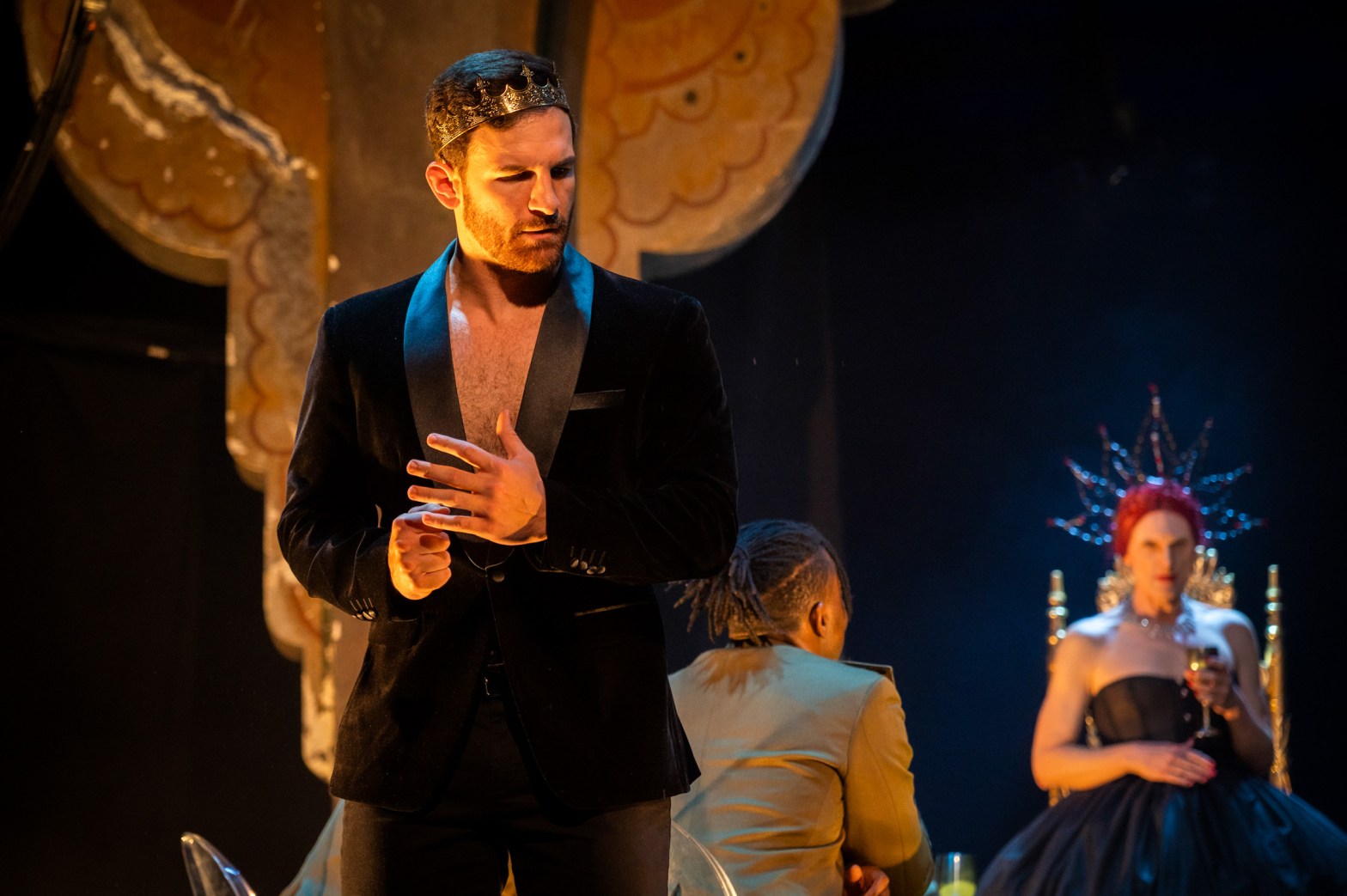
            The plot gets more and more complicated as various allegiances and several ruthless murders take place. Knives and swords are in constant use, and the fighting scenes are well choreographed. So too are the scenes with the three witches, costumed in black with spooky masks. And in keeping with the productions of plays during Shakespeare’s times, all the roles were played by men- the witches as well as Lady MacBeth.

 I did not care for Scott Parkinson’s portrayal of the very complex queen, wife of MacBeth. It was rather flat… two dimensional.  It didn’t come alive on the stage. Actually, that was a problem I had with almost all the characters, including MacBeth himself. They simply and boldly recited their lines, but I didn’t get the feelings I usually get in such a powerful, emotional play.

When I don’t care for a production, I often ask the person I came with whether he or she liked it. This time, it was my friend who was a professor of literature at Temple and Manor Colleges for over 40 years and often taught “MacBeth.” It didn’t work for her either.

            When I read the director’s notes after the play, I saw that director Alex Burns’ goal was “to move away from method acting and realism, and to focus on heightened language…” I felt as though I was in a reading of the play, not a performance. It didn’t feel like the bard’s shortest tragedy. I wonder what Shakespeare, an actor as well as a playwright, would have thought of it.

            If you go, be sure to read a summary of the play in order to better understand what is going on on the stage, as you will miss some of the information recited in Shakespearean tongue. You won’t get it in the acting.

“MacBeth” by William Shakespeare at Quintessence Theatre, 7137 Germantown Ave., Philadelphia, PA 19119, 215-987-4450, quintessencetheatre.org   Thru April 21, 2024
The Lehman Trilogy at Arden Theatre Company

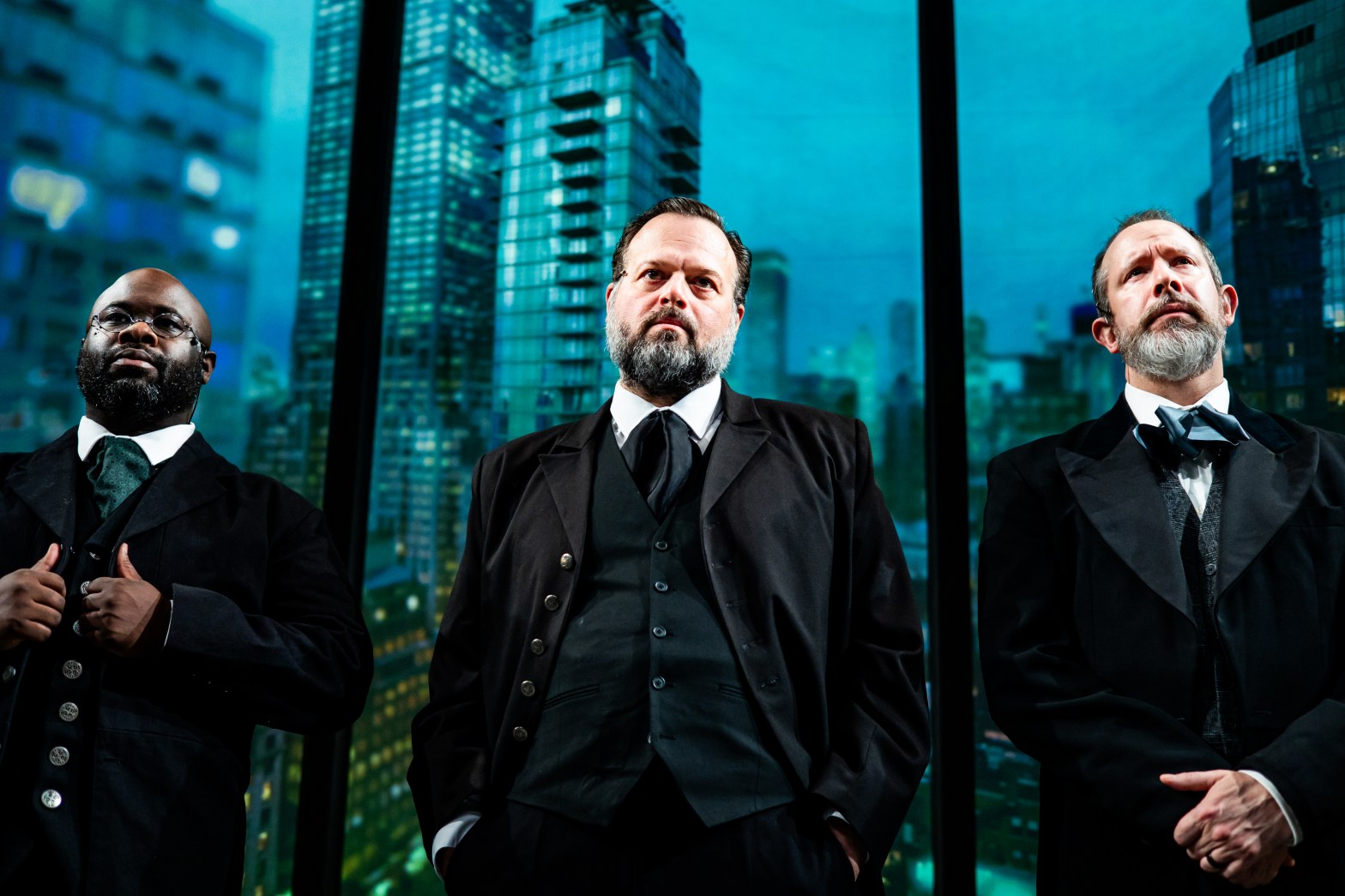
From 1844 to 1850, three brothers emigrated from Bavaria to the U.S., settling in Montgomery, Alabama. From a dry goods store to one of the largest investment companies in the world, these brothers created an enterprise that invested in businesses throughout the U.S. and the world. “The Lehman Trilogy” traces the evolution of the company for a century and a half through the family and its descendants that took those risks. Three actors portray the Lehmans, their kids and grandkids, and even their wives, who didn’t even change their costume (a vested suit)- they simply talked to each other and to us, the audience as we came to understand the history and evolution of a business that was the personification of an American dream of immigrants. Three hours and three acts with two intermissions, yet it was mesmerizing as I sat there, not wanting to miss a word of their stories.

            It begins with the collapse of the company in the financial crisis of 2007-2008, but that is only a very small part of the story. There hadn’t been any Lehmans running it for decades, and this is the story of the people and their responses to the events of the times. The Civil War, devastating fires, and the Crash of the Market in 1929 had major effects on the direction of the company. These are the stories of a family that responded to those events.

            There are lots of details about how the Lehmans wound up in the cotton trade, about how they moved their base after the Civil War to New York, and about how they wound up financing other products- first coffee and railways, then oil, cinema and even television were things they invested in. Eventually, the most lucrative product invested in was money itself. In each case, a younger generation of Lehmans had to convince their parents to adapt to the changing times. There is much story to digest. And we do.

            This Philadelphia premier, staged by Arden Theatre Company, features Scott Greer, Charlie DelMarcelle, and Akeem Davis. The Lehmans were Jewish. None of these actors are Jewish. Davis is African-American. Director Terry Nolen is not Jewish. It doesn’t make a difference. They understand theater. They know how to create. They told stories so believable without overplaying their characters. They are great! The press release says that they played over 50 characters… And it all worked! It all worked!! Each character they portrayed moved the company forward as we observed the evolution of a branch of American capitalism.

We knew many of the events that are described in the play, but we didn’t know the players. Playwright Stefano Massini gives us that story that was hours longer before Ben Power adapted it down to a perfect three hours. 150 years in three hours is pretty good as it takes us forward in time. At the end of the play, I spoke to two people who had seen the play on Broadway. Both said that this production was better. I’m not surprised. It is a tour de force!

“The Lehman Trilogy” by Stefano Massini, adapted by Ben Power at Arden Theatre Company, 40 N. 2nd Street, Philadelphia, PA 19106. 215-922-11222   ardentheatre.org   extended thru April 14, 2024

the ripple, the wave that carried me home at People’s Light

            The play begins with Janice Collen, alone on stage, telling us that she hates water. She understands that it is necessary for life, that the body is made up of 60% water… but she still hates it. Janice, an African-American woman, grew up in landlocked Beacon, Kansas in the 1960’s and 70’s. She escaped the state and her family to move to Ohio where she had her own family. But now, she is being pestered to return to her birthplace to speak at an event to honor her father.  This memoir-style play, “the ripple, the wave that carried me home,” is the story of Janice’s relationship with her parents, who were major activists in trying to overturn the racism of the day that manifested itself in the segregated swimming pools, and her relationship with water.

            From the time she was a child, Janice acted in her parent’s interests and became a spokesperson against racism. She also became an active swimmer. There were three “public” pools in Beacon but only one was open to Blacks. When there was a protest at one of the White pools and Blacks entered the water, they shut it down for days after for “sanitation.”

            Four boys, who were friends and wanted to swim together (two Black and two White), but couldn’t do so at a pool, went to a local lake where three of them drowned because of the unsafe conditions. It led to a more active pursuit of integrated swimming pools, largely and sadly, to no avail.

            Janice herself was an avid swimmer, taught by her mother. They used to go at sunrise to the White pool where a friendly manager let them in long before it opened on Saturday mornings, for Janice to swim. Returning from the pool one time, they were pulled over by a patrol car who told the mother to get out of her car. It was a scary and scarring moment for Janice to watch what happened.

            But this is much more than the story of racism. It is a tale of being the daughter of an activist whose life is so much about fighting injusticee than caring for his daughter. She moves away after college, hoping to never return… until after her father has died. This the same year that the Rodney King incident and trial is going one. She is asked to return home for a ceremony honoring her father at a pool naming event. Besides having mixed feelings about returning, she is bothered by the fact that they are not also honoring her mother, who worked just as hard to fight the segregation of the day.

In spite of all the interesting information that I got from the play, my only objection was that often, it did not feel like a play, but rather a little like a lecture at times. I wanted more theater. Show me, don’t tell me. The cast of four was superb when they enacted the scenes. Janice (Patrese D. McClain) was an excellent narrator, but I have to work harder as an audience member in order to follow the narrative. And one hour and fifty minutes without an intermission, was quite challenging for me.

Nevertheless, I found the play most powerful and moving. I just wished that there was an act break to give me a chance to digest it all.

“the ripple, the wave that carried me home” by Christina Anderson at People’s Light, 39 Conestoga Rd., Malvern, PA 19355, 610-644-3500, peopleslight.org   Thru March 24, 2024

Faith Healer at Lantern Theater Company

A man, Francis Hardy, the faith healer, comes out onto a nearly empty stage and talks to us. He does not preach. He does not try to convince us of his healing powers. He does the very opposite- he reveals all the phoniness of the profession, the acting, the bogus shamans. This is the first of four monologues that comprise the play “Faith Healer,” written by Brian Friel in 1979 and brought to the stage by Lantern Theater Company.

            We listen as Hardy explains the profession and his attraction to it. But it is also about the man himself- his childhood, his relationship with his partner Grace, and with his manager, Teddy. There are descriptions of his travels from Ireland to Wales and Scotland and the people he tried to “cure.” He is not sure of his own “power” and he tells us that he fails nine out of ten times. There is so much information in this first scene, even though it is interesting, that it is a bit overwhelming to stay focused and absorb it all.

            Things start to become clearer in the second scene when Grace replaces him on stage. We learn from her that she is in Frank’s (Francis’) wife and not just his partner. She tells us of her troubled family and of her attraction to her husband. And unlike Frank, who says she is infertile and unable to bear children, we learn of the miscarriages and still born child. We quicky realize that we are listening to two different interpretations of the same events, including the preaching he’s done over the years. At the intermission between scenes 2 and 3, I could hear many in the lobby talking with each other, trying to clarify what happened and what was true.

After the intermission, we meet Teddy. He provides an outside look at the relationship between Frank and Grace. We see what he has done to push the struggling career of his client. Things become clearer…or do they? Is his interpretation of life’s events, punctuated with more humor, any more accurate?

Then, there is one last scene. Frank returns with more information, to gives us his interpretation one more time, with a few additions and changes.

Ian Merrill Peakes (Frank), Genevieve Perrier (Grace), and Anthony Lawton (Teddy) do a superb job in relating their interpretations of the events with just enough lilt of the Irish accent without overplaying it and making it harder to understand. And Peter DeLaurier has established the perfect pace for this unusual piece. But the play is telling us what happened, not showing us, so it asks a lot of the audience to listen without seeing what has occurred. And I know that if Friel presented this play to a potential producer today, he would be asked to reduce it from 2½ hours to 90 minutes- this to a world-famous playwright who has won all kinds or awards and his been called “the Irish Chekhov.”

While I enjoyed the development of a most interesting story by three fine actors, let me warn you- be prepared to be confused.

“Faith Healer” by Brian Friel at Lantern Theater Company at St. Stephen’s Theater, 923 Ludlow St., Philadelphia, PA 19107. 215-829-0395   lanterntheater.org    thru March 3, 2024.

The Flatlanders at 1812 Productions

A couple that has been together for 14 years has decided to tie the knot. On their way from Philadelphia to the Poconos where their marriage will take place in the company of a dozen friends, a snowstorm intrudes, and Michael (Scott Greer) crashes into a tree demolishing their car and only finds refuge after climbing the snow-covered road with his bride-to-be in his arms. He finds, what is clearly someone’s vacation home but there is no one there. Fortunately, they manage to break in. That is the start of Bruce Graham’s newest comedy, “The Flatlanders” staged by 1812 Productions at Plays and Players Theatre. Yes, this is a comedy, and it is funny, poignant, smart, and honest, and superbly directed by Matt Pfeiffer.

            Michael and Ronnie (Jennifer Childs) know each other well, after having been together for so many years. But they are stranded in a house with no power, no internet, and no Alexa. They can’t reach anyone outside. They have only each other and in the 75 minute play, they learn more about the other than they had known in years.

            We see that he is a hypochondriac. He always thinks the worst of any physical condition. He is also tight with money and complains that she wastes it by failing to turn off the lights at home.

            She is a fanatic with pillows. She has tons of them at home and when she first arrives at this house, she needs to rearrange them. She is also constantly on various forms of electronic media. She rarely remembers what he tells her unless it is in the form of a text or e-mail- even when they are in the same room- now, they must communicate directly.

            Each in turn questions whether or not they should marry. Her parents had a bad relationship long before they divorced, and she fears marriage might not work- she’s already had one failed marriage.  His parents had a good marriage, and he wonders if he can establish the same with her.

            This is just the tip of the proverbial iceberg as Michael and Ronnie air out all their issues with each other. But this is not “Who’s Afraid of Virginia Woolf?” This is a comedy. But it is not a silly, over-the-top comedy. Graham’s dialogue is real. We can all identify with his characters’ stories while we are laughing about them. Can they weather the storm?

There is an extra level of humor when Michael emerges from the basement with a box sex toys that the homeowners kept in some sort of “dungeon” down there. It brings out still another element in the pair’s personalities.  

            Bruce Graham has written so many extraordinary plays since I first discovered his work three decades ago. And this one, in the hands of two of Philadelphia’s greatest actors (Greer and Childs), is another must see!

Play is a co-production with Delaware Theatre Company, so if you miss it at 1812 in Philly, you can see it from April 17 to May 5 in Wilmington.

“The Flatlanders” by Bruce Graham by 1812 Productions, at Players and Players Theater, 1714 Delancey, Philadelphia, PA 19103, 215-592-9560, info@1812 productions.org   Thru February 18, 2024

My Mama and the Full-Scale Invasion at The Wilma Theater

Sasha Denisova’s 82-year-old mother is living in Kyiv, Ukraine, when the Russians invade in 2022. She has lived her whole life there, and when her daughter, a successful playwright living in Russia flees that country and tries to get her mother out of the vulnerable Ukraine, her mother refuses to leave her home, even to go to a shelter.  Born in an underground shelter when the Nazis were bombing the country, she tells Sasha, “I’m not going there. I was born there.”

            In fact, the entire real conversations between mother and daughter take place via texts as Sasha has fled to Poland. And from these snippets of talk, Denisova has created a play about the invasion as told through what she imagines her mother is going through in Ukraine. It is accompanied by visual projections throughout the play giving us the people, the places, and the events which support her story.

 We join Mama in her home and learn of the life she led up to and during the invasion, and they are fascinating stories. Narrated by Sasha, she is part of many of the stories and is even told that Mama thinks that at birth, babies were exchanged, and she is not Mama’s daughter. She does have trouble living up to her engineer mother’s expectations as she is more an artist.

            But Mama is the eternal optimist. That optimism is turned into stories of shooting down Russian drones with pickle jars. Sasha envisions her mother having talks with the President of France, Macron and with U.S. President, Joe Biden. And Holly Twyford does an outstanding job in giving us the full range of the situation. There is lots of comedy injected into very serious situations. But therein also lies the problem for me.

            There is a third character in the play. Lindsay Smiling portrays the Man, who takes on several roles, from Mama’s husband to Biden himself. And he plays them in an over-the-top fashion which is unnecessary in this finely tuned script. Director Yury Urnov has Suli Holum, who plays the daughter, also overacting, when the words are powerful enough without so much embellishment. Though not quite the Theater of the Absurd style of the 1950’s, there is an absurdity that often feels forced and diminishes the tragedy of the play for me.

            The friend I saw the play with loved it. So did other members of the audience who I overheard as I left. At home, after I wrote my review, I checked on the reviews of the play, from when it appeared on the Woolly Mammoth stage in Washington, D.C., with the same cast and director (it was a co-production with Woolly Mammoth). The critics loved it. It is important to remember that a review reflects the opinion of the writer. This is mine.

“My Mama and the Full-Scale Invasion at Wilma Theater, 265 S. Broad St., Philadelphia, PA 19107, 215-546-7824  wilmatheater.org    Thru February 18, 2024

Ladysitting at Arden Theatre Company

            Ladysitting is the term used to define the caring for Lorene Cary’s Nana (grandmother) near the end of her life so as not to use the more embarrassing, word babysitting, for the elderly. The premier of the show “Ladysitting” at the Arden Theatre is a dramatic representation of the memoir by Cary.

            Nana is 99-years old and can’t look after herself in a home that is desperately in need of repairs. She is placed in a room of the church rectory of her granddaughter’s husband. There, bedridden, she is cared for by Cary and Cary’s teenage daughter.

            She has outlived her daughter who died young, and her son. She waits to join them in the afterlife and even says that she wants to die during her two years in bed. She has only her memories and her visions of being visited by the Angel of Death, often in the form of the men who died before her. It is a challenge for caretakers as Nana changes her life’s history when she thinks back of her past.

            When talking about growing up Black in the South, she is reminded that she came north at seven. But Nana was active in the civil rights movements of the day. Still, she denies having voted for 50 years. Now, Lorene come to her with an absentee ballot to vote for  Barack Obama.

            My own father lived to almost 102. He too reinterpreted his history. He outlived all his family of his own generation as well as his son, my brother. As his life deteriorated, we wished he could be relieved of his pain, his grief.

            Nana’s family is at a loss as to what to do after she turns 101. Dare they wish that their matriarch die? We know these people. It is a problem that every generation faces as parents age. There are no easy answers, and we feel for them all.

            We want to laugh at the humorous situations of the play, but we are also pained by them. Trezna Beverley and Melanye Finister are superb in portraying Nana and her granddaughter, Lorene. Cary has done a wonderful job in transferring her memoir to the stage in a 90-minute show for us all to experience.

“Ladysitting” by Lorene Cary at Arden Theatre Company, 40 N. 2nd Street, Philadelphia, PA 19106. 215-922-11222   ardentheatre.org   extended thru March 3, 2024.  

Tea For 3 at Act II Playhouse

From 1964 to 1976, there were three married U.S. Presidents in the White House. Their wives, referred to as First Ladies, were Lady Bird Johnson, Pat Nixon, and Betty Ford. All three lived into their 80’s and 90’s and outlived their husbands by many years. As First Ladies, they were known to the public as little more than appendages of their president husbands. This finely crafted play by Eric H. Weinberger and Elaine Bromka, takes us deeper inside the minds and souls of these remarkable women. In just 90 minutes, each of them reveals what their lives were like.

            Ironically, these are not three women who I had much interest in. But the stories of their paths to marriages to men who became president, is fascinating. I learned so much while being totally entertained in the three, 30 minutes segments as Sabrina Profitt portrays each woman with passion and humor along with information about their lives.

            I learned that Lady Bird and Pat lost their mothers when they were 5 and 13 respectively while Betty’s father died when she was 16. I learned about the various pressures these women faced by pushy and controlling husbands. I learned that each wanted a different life than the one they had to adapt to in order to be a politico’s, then a president’s wife. I felt the moods of each woman, as presented to us at the very end of the administrations of their husbands. But most of all, I felt and understood their own desires and goals and how they managed them.

            Profitt doesn’t look like the women she portrays, though the wigs remind us of each. She doesn’t try to overdo their speech patterns or accents. But she not only captures the essence of each, she IS each of those women. As she talks to the audience, we feel we are listening to Lady Bird, Pat, and Betty at the White House as they are about to depart from their “jobs” as First Ladies. She is outstanding!

            To be so successful, a one-person show also needs a good director. I’ve known Mary Martello as one of Philadelphia’s greatest actors over the past few decades. She’s a great director also!

            While I learned so much, this show is thoroughly entertaining and is a must-see for those who remember those women and for those who want to know more about those times.

“Tea for 3” by Eric H. Weinberger & Elaine Bromka at Act II Playhouse, 56 E. Butler Avenue., Ambler, PA 19002, 215-654-0200,   act2.org    Thru February 18, 2024

Small at People’s Light

Bobby is a small 12-year-old kid from Long Island who has been constantly picked on in school. His hero is Bernardo, the tall, good-looking Puerto Rican in West Side Story, but though he studies dance, he can never hope to emulate his hero. But his life does take a major change when his mother takes him to Belmont Racetrack, hoping to win money to take care of expenses at home. It is there that Bobby discovers that very small men could make a living riding horses as jockeys. It becomes his obsession.

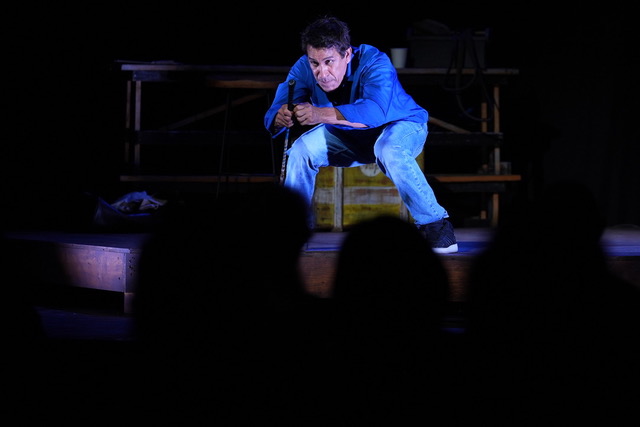
            The play “Small,” a one-man show, written and starring Robert Montano, is a 90-minute memoir about his attempt as a teenager to become a jockey. Why would anyone be interested in such a story? It is because Montano is a seasoned dancer and actor and knows how to enact a story with many characters with both passion and humor. It is a joy just to watch him move about the stage, a paddock inside a stable.

            He portrays his religious mother, his mentor, Robert Pineda, (a major rider of the day), and others so effectively that it is as if they are on the stage with him. But mostly, he portrays his younger self. He hangs around the stables. He gets a few rides. He sticks to his goal until the inevitable happens- he grows and gains weight.

            Montano struggles at first with his passion for ice cream, but all food is his nemesis. Jockeys are not supposed to weigh over 105 lbs. He is constantly working out to lose weight. He doesn’t eat properly and takes the drug Lasix to rid himself of the weight of his body water before they weigh him.

            The story is that of a struggle to realize a dream. He rides despite three broken ribs in one race. He prays for God’s help. There is so much that is packed into Montano’s story. But in the end, he comes to grips with his changing body and returns to his other passion, dance. He goes to college and continues to dance until he gets a small role in the Broadway show, “Cats.”

            Montano is so talented and versatile, I was shocked to learn that he is 63 years old. I would never have guessed he was over 40. He’s no small man! It’s a wonderful, powerful, one-of-a kind show that shouldn’t be missed.

“Small” by Robert Montano at People’s Light, 39 Conestoga Rd., Malvern, PA 19355, 610-644-3500, peopleslight.org   Thru February 4, 2024

Christmas in the Catskills at Act II Playhouse

`           In the 1950’s and ‘60’s, entertainment in the Catskill Mountains in Upstate New York, was dominated by many extraordinary entertainers. Tony Bennett, Harry Belafonte, and Sammy Davis, Jr. were among the scores of famous performers. Even more than the singers, the Catskills (also known as the Borscht Belt for decades) were the great comedians of the day- Jackie Mason, Buddy Hackett, George Burns, Henny Youngman, Joan Rivers, and Billy Crystal, to name a few. These are among the many portrayed by Tony Braithwaite in a 70-minute performance on the Act II Playhouse stage in Ambler. In the show, “Christmas in the Catskills.”  He is truly amazing!

            The Borscht Belt arose when Jews weren’t permitted entry into many of the hotels around the country. Places like Kutcshers, Grossingers, The Nevele, and Browns soon developed a reputation for having the finest food and the finest comedians. Tony Braithwaite, with the assistance of Assistant Director Nick Cordillo and pianist Dan Matarazzo, have collected routines and monologues and created a show for the ages. And only Braithwaite, amongst all the Philadelphia comedians, could portray these iconic comedians with both subtlety and panache. And while it is most appealing to an older crowd, I do think that younger folks who enjoy comedy will get a kick out of the wide assortment of jokes.

            I find lots of today’s comedy a bit over-the-top, but what I loved about this show is that Braithwaite lets the lines speak for themselves with just little nuances. As he imitates the styles of Jerry Lewis, Mort Sahl and others, he doesn’t try to overdo it- still, he nails each one.

            Early on, Braithwaite informs us that he grew up a practicing Catholic. What’s he doing, then, performing the likes of these great Jewish comedians? He’s doing what he does best- portraying them and portraying them probably better than anyone else. He had me, usually smiling at good comedy, laughing out loud.

            One sad note. At the end of the show, Braithwaite comes on to tell us that if we liked the show, not to tell our friends about it. It is sold out for the run. I am glad for them, and hope they bring it back next December. to make it available for the tons of others who would love this show as I did.

“Christmas in the Catskills” created by Tony Braithwaite, Nick Cardillo, and Dan Matarazzo at Act II Playhouse, 56 E. Butler Avenue., Ambler, PA 19002, 215-654-0200,  act2.org   Thru December 30, 2023